
We have a Steam curator now. You should be following it. https://store.steampowered.com/curator/44994899-RPGHQ/

Hooray: ****** gamedevs being fired thread
-
asf
- Turtle

- Posts: 3177
- Joined: Feb 2, '23
- Gender: Helicopter
-
Geolocation


-
Shillitron

- Posts: 3707
- Joined: Feb 6, '23
- Location: ADL Head Office
-
Geolocation
In an email viewed by Business Insider, a Microsoft “team leader” wrote; “True systems-change work associated with DEI programs everywhere are no longer business critical or smart as they were in 2020.” The report says Microsoft eliminated the team due to “changing business needs.”
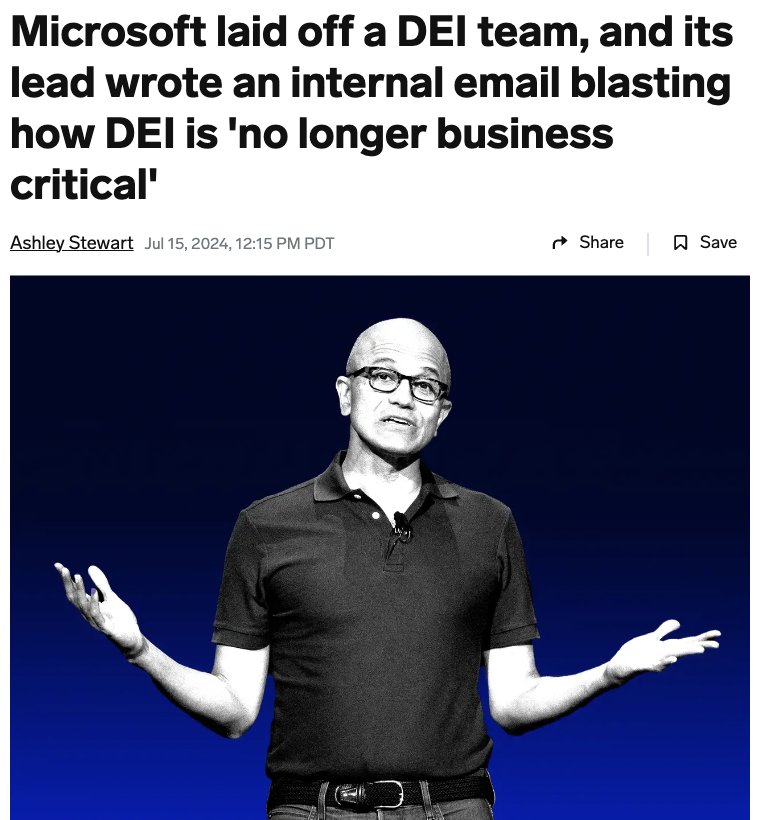
And before @WhiteShark comes in here to **** with my post again. The DEI team was meddling in all of Microsofts game studios. It's the same team.
---
-
Shillitron
- Posts: 3707
- Joined: Feb 6, '23
- Location: ADL Head Office
-
Geolocation
https://stlawyers.ca/blog-news/ubisoft- ... alignment/
This studio is working on Prince of Persia and Splinter Cell.Ubisoft is terminating 33 employees at its Toronto studio, as the video game maker continues to experience the industry-wide wave of layoffs. This decision, confirmed by PC Gamer, is part of a “targeted realignment” and aims to align with the company’s ambitious future plans.
---
-
Rand

- Posts: 6640
- Joined: Sep 4, '23
- Location: On my last legs
-
Geolocation
Adventurer's Guild

I've been to that building. I pass by it about once a month..Shillitron wrote: ↑ July 16th, 2024, 23:32https://stlawyers.ca/blog-news/ubisoft- ... alignment/
This studio is working on Prince of Persia and Splinter Cell.Ubisoft is terminating 33 employees at its Toronto studio, as the video game maker continues to experience the industry-wide wave of layoffs. This decision, confirmed by PC Gamer, is part of a “targeted realignment” and aims to align with the company’s ambitious future plans.

The ground floor, even with the logo on the door, is now completely empty and has been for about a year.
The second floor seems to be empty as well. I never see lights or people at the windows or the windows open.
The only floor I am certain is in use is the third.
I am uncertain about the fourth floor.
The employees don't enter through the front there anymore. It's chained shut.
They enter around the back and the stairs there go directly to the second floor.
I am totally believing that the office is being slowly phased out.
Last edited by Rand on July 17th, 2024, 03:07, edited 1 time in total.
You may as well not bother replying to my posts if it's to argue anything except concrete facts or your personal opinion. I still probably won't see it.
Reject your retarded-wing political programming and learn to think.
If you can.
Reject your retarded-wing political programming and learn to think.
If you can.
-
maidenhaver

- Posts: 9452
- Joined: Apr 17, '23
- Location: ROLE PLAYING GAME
-
Geolocation
Adventurer's Guild


Its entirely possible nobody on the first or second floor told the third floor they're bankrupt.
-
StudiedAsleep

- Posts: 375
- Joined: Apr 6, '24
- Location: United Kingdom
-
Geolocation
Could you do everyone a favor since you pass by it every month and burn the flags off the roofRand wrote: ↑ July 17th, 2024, 03:02I've been to that building. I pass by it about once a month..Shillitron wrote: ↑ July 16th, 2024, 23:32https://stlawyers.ca/blog-news/ubisoft- ... alignment/
This studio is working on Prince of Persia and Splinter Cell.Ubisoft is terminating 33 employees at its Toronto studio, as the video game maker continues to experience the industry-wide wave of layoffs. This decision, confirmed by PC Gamer, is part of a “targeted realignment” and aims to align with the company’s ambitious future plans.
The ground floor, even with the logo on the door, is now completely empty and has been for about a year.
The second floor seems to be empty as well. I never see lights or people at the windows or the windows open.
The only floor I am certain is in use is the third.
I am uncertain about the fourth floor.
The employees don't enter through the front there anymore. It's chained shut.
They enter around the back and the stairs there go directly to the second floor.
I am totally believing that the office is being slowly phased out.

-
Rand
- Posts: 6640
- Joined: Sep 4, '23
- Location: On my last legs
-
Geolocation
Adventurer's Guild
Rand wrote: ↑ July 17th, 2024, 03:02I've been to that building. I pass by it about once a month..Shillitron wrote: ↑ July 16th, 2024, 23:32https://stlawyers.ca/blog-news/ubisoft- ... alignment/
This studio is working on Prince of Persia and Splinter Cell.
The ground floor, even with the logo on the door, is now completely empty and has been for about a year.
The second floor seems to be empty as well. I never see lights or people at the windows or the windows open.
The only floor I am certain is in use is the third.
I am uncertain about the fourth floor.
The employees don't enter through the front there anymore. It's chained shut.
They enter around the back and the stairs there go directly to the second floor.
I am totally believing that the office is being slowly phased out.
Lol. They're probably gone now. I'll look when I pass by again.StudiedAsleep wrote: ↑ July 17th, 2024, 05:46Could you do everyone a favor since you pass by it every month and burn the flags off the roof
Last edited by Rand on July 17th, 2024, 10:15, edited 2 times in total.
You may as well not bother replying to my posts if it's to argue anything except concrete facts or your personal opinion. I still probably won't see it.
Reject your retarded-wing political programming and learn to think.
If you can.
Reject your retarded-wing political programming and learn to think.
If you can.
-
Zothique

- Posts: 894
- Joined: Jun 11, '24
-
Geolocation
Reported for transPHOBIA.StudiedAsleep wrote: ↑ July 17th, 2024, 05:46Could you do everyone a favor since you pass by it every month and burn the flags off the roofRand wrote: ↑ July 17th, 2024, 03:02I've been to that building. I pass by it about once a month..Shillitron wrote: ↑ July 16th, 2024, 23:32https://stlawyers.ca/blog-news/ubisoft- ... alignment/
This studio is working on Prince of Persia and Splinter Cell.
The ground floor, even with the logo on the door, is now completely empty and has been for about a year.
The second floor seems to be empty as well. I never see lights or people at the windows or the windows open.
The only floor I am certain is in use is the third.
I am uncertain about the fourth floor.
The employees don't enter through the front there anymore. It's chained shut.
They enter around the back and the stairs there go directly to the second floor.
I am totally believing that the office is being slowly phased out.
-
Marcus

- Posts: 1335
- Joined: Jan 23, '24
-
Geolocation
AI Is Already Taking Jobs in the Video Game Industry
A WIRED investigation finds that major players like Activision Blizzard, which recently laid off scores of workers, are using generative AI for game development.
WHEN NOAH SAW the email, a wave of anxiety hit. It was spring 2023, and the Activision artist was reading a message from the company's then chief technology officer, Michael Vance, about how artificial intelligence was “top of mind” at the video game publisher. Systems were still being tested, Vance wrote, but “what we have seen thus far holds a ton of promise.”
There had been a couple emails like this sent to the employees of the studio, which produces the juggernaut Call of Duty series. A previous one had approved the internal use of generative AI tools Midjourney and Stable Diffusion for producing concept art.
That spring, backchannel chats lit up with rumors, worry, and whisper networks of whose jobs AI might replace. Where executives saw reason for excitement, many game artists, writers, and designers saw a direct threat to their livelihoods. Noah was grief-stricken. (Noah is a pseudonym; the employee has been granted anonymity because he fears retribution.)
“I felt that we were throwing away our humanity,” he says.
Then the jobs started disappearing.
VIDEO GAMES—AND THE people who make them—are in trouble. An estimated 10,500 people in the industry were laid off in 2023 alone. This year, layoffs in the nearly $200 billion sector have only gotten worse, with studios axing what is believed to be 11,000 more, and counting. Microsoft, home of the Xbox and parent company to several studios, including Activision Blizzard, shuttered Tango Gameworks and Alpha Dog Games in May. All the while, generative AI systems built by OpenAI and its competitors have been seeping into nearly every industry, dismantling whole careers along the way.
But gaming might be the biggest industry AI stands poised to conquer. Its economic might has long since eclipsed Hollywood's, while its workforce remains mostly nonunion. A recent survey from the organizers of the Game Developers Conference found that 49 percent of the survey’s more than 3,000 respondents said their workplace used AI, and four out of five said they had ethical concerns about its use.
“It’s here. It’s definitely here, right now,” says Violet, a game developer, technical artist, and a veteran of the industry who has worked on AAA games for over a decade. “I think everyone’s seen it get used, and it’s a matter of how and to what degree. The genie is out of the bottle, Pandora's box is opened.”
Now, previously unreported emails obtained by WIRED, in addition to interviews with artists, developers, designers, and workers across the gaming world—from AAA studios with thousands of employees to indies with just a handful—paint a picture of an already precarious industry getting further squeezed by the rise of AI.
Job automation rarely happens evenly or cleanly. Historically, much of its impact is felt through deskilling, as more tasks are handed over to a machine or program, or attrition, as employees who are laid off, quit, or retire, don’t get replaced or hired back. Generative AI, by all indications, is no different.
Managers at video game companies aren’t necessarily using AI to eliminate entire departments, but many are using it to cut corners, ramp up productivity, and compensate for attrition after layoffs. In other words, bosses are already using AI to replace and degrade jobs. The process just doesn’t always look like what you might imagine. It’s complex, based on opaque executive decisions, and the endgame is murky. It’s less Skynet and more of a mass effect—and it’s happening right now.
“THERE'S A TON of anxiety for artists across the board with AI,” says Molly Warner, an environment artist who was working on an Overwatch game at Activision’s corporate sibling, Blizzard Entertainment, at the time the CTO’s emails went out. “Pretty much everyone I know is vehemently against the use of AI-generated images.”
That anxiety rose as Vance’s drip of AI-boosting emails continued. In May 2023, Bobby Kotick, then the CEO of Activision Blizzard, fielded a question about how generative AI would impact the gaming industry at a company-wide meeting.
“I’ve known Sam Altman and the folks who are working at OpenAI for a long time,” he said, according to a recording obtained by Kotaku. “I don’t know how much people realize that a lot of modern day AI, including ChatGPT, started with the idea of beating a game, whether it was Warcraft or Dota or Starcraft or Go or Chess.” Kotick went on: “One of the things that I’ve experienced over the last year is that same feeling that I had when I saw that first Macintosh, about how meaningful the impact of AI would be on society, both positive and negative.”
By July, the company’s initial restraint had slackened. In another internal memo, Vance announced that Activision had secured access to GPT-3.5 and approved the use of certain generative AI tools in creating concept art and marketing materials. The company would also deploy AI in other public-facing use cases, like to compose user surveys.
Though many of the game workers and artists were queasy about this proliferation, and some were even afraid for their livelihoods, few spoke out. “I think we all didn’t talk about it much for fear of losing our jobs,” Noah says. He claims Activision assured its artists that generative AI would be used only for internal concepts, not final game assets—and importantly, that AI would not be used to replace them.
Yet by the end of the year, Activision made an AI-generated cosmetic available for purchase on the Call of Duty: Modern Warfare 3 store. In late January, Microsoft laid off 1,900 Activision Blizzard and Xbox employees—among the teams hit hard were 2D artists.
“What a ****** up day,” a onetime environment artist at Blizzard, Lucas Annunziata, posted on X. “Half the environment art team cut from [Overwatch 2], folks I helped hire and train.”
At Activision, it was the same. “A lot of 2D artists were laid off,” Noah says. The department was slashed. “Remaining concept artists,” he claims, “were then forced to use AI to aid in their work.” Employees, according to Noah, have been made to sign up for AI trainings, and its use is being promoted throughout the org.
“FROM AN AI perspective, different parts of the industry are getting eaten up by others,” says Violet, who asked to use a pseudonym for fear of retribution. “Why get a bunch of expensive concept artists or designs when you can get an art director to give some bad directions to an AI and get stuff that’s good enough, really fast—and get a few artists to clean it up?”
Hence the emerging consensus is that concept artists, graphic designers, asset artists, and illustrators have been most impacted by AI so far—attested to by personal accounts of game employees, laid-off workers themselves, and the reams of posts on Reddit, X, and beyond.
Generative AI can most capably produce 2D images that managers in cost-squeezed studios might consider “good enough,” a term AI-watching creative workers now use as shorthand for the kind of AI output that’s not a threat to replacing great art, but is a threat to their livelihoods. Some clients care more about cost than quality, after all. Tasks like 3D animation and programming are, for now at least, much harder to automate in full.
Games have, to varying degrees, used automation for years. They rely heavily on “AI” programs that control enemies, environments, and nonplayer characters. That’s not what people are talking about when they discuss AI now. In 2024, they’re typically talking about generative AI produced by large language models (LLMs), and the related systems that have been unleashed by the latest boom.
A recent report from the consulting firm CVL Economics, commissioned by entertainment industry trade groups, found the gaming industry already relegated tasks to generative AI more than its peers in TV, film, or music. According to its survey of 300 CEOs, executives, and managers, nearly 90 percent of video game companies had already implemented generative AI programs.
Gaming, CVL found, “relies heavily, more so than the other entertainment industries, on GenAI to carry out tasks like generating storyboards, character designs, renders, and animations. In fact, by some estimates GenAI may contribute to more than half of the game development process in the next five to 10 years.”
This might be news to some games workers, who are often unable to see the whole picture of what’s going on at a major games company like Activision Blizzard, which consists of a winding supply chain of studios, developers, third-party contributors, and quality assurance (QA) testers. One studio might be a subsidiary of a larger one, tasked with developing or codeveloping a single game for its parent organization. “It’s pretty fractured in AAA, so you don’t see who’s doing what,” Violet says. “You’ll probably never see which part is using AI in what, but you know it’s there.” (Activision Blizzard did not provide comment when contacted about this story.)
This murkiness about when and where AI might be used in any given game also seems to have made copyright infringement concerns easier to dismiss. “It’s the Wild West,” Violet says. “I’ve been in meetings at different companies, and at some level they’re like, ‘We should make sure this is legal,’” before deciding to move ahead with adopting AI anyway.
US law insists that any work seeking copyright must have a human author—a fact that gives, say, Hollywood studios pause. But it's still an open question whether using unlicensed intellectual property to train AI systems violates copyright. Even in cases in which an AI program generates work based on human prompts, courts have ruled against copyright protection. For things like concept art, character descriptions, or code that doesn't wind up in the game, it's harder to determine what is out of line. The thinking becomes, Violet says, “How do you prove that’s copyright infringement?”
Uncertainty about copyright, concerns over the security of LLM systems, and worker fears of displacement have divided the industry.
“There are basically two camps,” says Karla Ortiz, an artist who often works in the industry, “companies that are like ‘Oh, hell no,’ and companies who see this as ‘Ooh I can cut labor costs.’” (Ortiz is also a plaintiff in a class-action copyright infringement lawsuit against Stability AI, DeviantArt, and Midjourney.)
As Ortiz notes, some studios have all but banned generative AI use. According to multiple sources, Blizzard, unlike its sibling studio Activision, doesn't allow devs to use publicly available AI generators, even as it develops its own AI tools. Other companies embrace them. “I’ve seen a lot of optimism from executives on integrating AI,” says Dan Beglov, a narrative designer for Sensorium and Team Gramps. “And I think it’s pretty obvious there’s a negative sentiment among game workers.”
Last May, Electronic Arts (EA) CEO Andrew Willson said on a quarterly earnings call that, “the fear of displacement of the workforce is something we read a lot about and we talk a lot about." He noted that in every revolution—agricultural, industrial—there “has been displacement of the workforce in the near term, and then meaningful increases in workforce opportunities over the longer term. Our hope is that AI represents the same opportunity." In February 2024, EA cut 5 percent of its workforce.
Riot Games, the company behind the wildly successful League of Legends series, held an internal town hall in 2023 with the creative department about AI. “It was pretty uncomfortable,” says Rachael Cross, a concept artist who worked at the company at the time, “but I remember leadership saying they didn’t intend to replace anyone with it because they knew the value of their artists, and how much the art at Riot was what carried its brand integrity.”
In January of this year, Pony Ma, CEO of Riot’s parent company, Tencent, said in his annual company speech that Tencent’s focus should be on integrating a proprietary Hunyuan AI model into ‘different business scenarios as a way to boost efficiency,’ as Reuters put it.
The week before Ma made those comments, Riot Games laid off 530 employees, including Cross. Cross doesn’t think their job was replaced outright with AI, “but considering the amount of people who worked on big tentpole events (including myself) who got laid off, it’s funny.”
NOT ALL, OR even most, of the video game industry’s lost jobs were replaced directly by AI systems rolled out by management. Many studios went on hiring sprees during the early days of the Covid-19 pandemic, and overextended in the process. Others consolidated—Microsoft acquired Activision Blizzard in a record-breaking $69 billion gaming industry deal last October—and commenced layoffs in the aftermath. (Kotick stepped down following Microsoft’s acquisition; Natalya Tatarchuk replaced Vance as CTO soon thereafter.) Others have followed the lead of many major tech companies and begun relying more on outsourcing and contract work.
Within hours of the time Cross was laid off from Riot, where they worked on character skins for League of Legends, they say, they were approached by a company that outsourced artwork for game studios. The company asked them if they were available to create skins—for a version of League of Legends. They would get a flat rate, per skin completed.
“I do think AI is a problem,” Cross says, “but it’s emblematic of a much larger issue.” Art is undervalued in games, they say, and as with so many other jobs, it’s a race to the bottom to drive down wages by any means necessary—often by outsourcing work to other countries.
“We started outsourcing lots of 3D art assets, almost all of the art,” Noah, the Activision worker, claims, “because in-house art couldn't keep up” after the layoffs. Some of those third-party concept artists are using AI-generated art too, he says.
And those companies in other countries, primarily China, are getting squeezed by AI too. Last year, Leo Li, a Hangzhou-based gaming industry recruiter, told Rest of World the number of illustrator jobs in his country had fallen by 70 percent, due in part to the widespread availability of generative AI tools.
In Japan, the startup Crypko AI hocks AI-generated characters. “Character illustrations that typically cost upward of ¥100,000 each to outsource can be obtained from Crypko for a flat monthly fee of ¥4,980 and a commercial license of ¥980 per image,” per Bloomberg. That’s $692 for one human-made illustration, versus $34 per month for access to an endless stream of the AI-generated variety. A human artist still needs to touch up the output—but they can be paid a lot less than the cost of retaining a staff illustrator, or for a full custom design.
Meanwhile, the leverage that AI tools give management, the justification for cuts, can be as impactful as the tech itself. Warner says many of her friends and industry colleagues’ jobs were transitioned into AI image-training jobs or AI image clean-up jobs over the last year or so—“and then they were laid off.” Now, she says, “it's also unfortunately become fairly common to see job postings” for concept art jobs that require applicants to use generative AI.
In one viral example, Treyarch, a Southern California-based studio that produces some elements of Activision’s Call of Duty games, posted a job listing for a “2D Artist Animator.” The first thing listed under the “To succeed you should have …” section was “exceptional skills and expertise in digital sketching, drawing, and painting, as well as advanced expertise in working with generative AI tools such as Stable Diffusion, Vizcom, Dall-E, or equivalent.” The artist community did not respond kindly.
IF THERE’S ONE thing a number of games workers say they’re glad AI is generating, it’s more interest in unions. “AI is definitely a catalyst for workers to organize,” says Beglov, who appeared on a panel on the topic at this year’s GDC. “If AI is going to be used, it has to be used with workers’ consent and workers having a voice.” Fifty-seven percent of developers surveyed by GDC organizers this year said they were in support of unionizing.
Chrissy Fellmeth, an organizer with International Alliance of Theatrical Stage Employees (IATSE), and Beglov’s copanelist, points to the efforts Hollywood guild writers made to secure protections from AI use in their contract with the major TV and movie studios. Right now, there’s little to no worker consent between game developers and their managers about when and how AI could be used; a contract like the Writers Guild of America’s could change that. “The use of AI is up to the writers and not the studios,” Fellmeth says. “I think that’s a great baseline goal for game workers to have.”
There’s another factor that management might soon need to consider with the generative AI tools they’ve deployed: They simply might not turn out to be all that good, or reliable. Tales of companies overextending in their embrace of AI have gone viral on social media, and, as Lauren Lehmann, an animation director at Terrible Posture Games, notes, AI may be able to generate pictures of guns and robots, but not one that transforms into the other. Even humans struggle with that. “The stories I’ve heard is they tried to bring some AI prompters, and as soon as they said, ‘Yeah that’s a good start,’ it pretty much broke down,” Lehmann says.
Still, the fear is that demand for quantity cost-cutting will trump quality, at least in the short term. "I think over the next year or two it’s going to be painful for a lot of people,” Ortiz says, particularly the entry-level workers who rely on commissioned work to gain experience and make ends meet. “I see massive displacement coming from companies who think that ‘good enough’ is good enough.”
And yet some video game companies are going even further, pursuing a business that doesn’t just dabble in AI but is almost fully automated. Take the self-described AI game maker Braindump, which aims “to give you an entire AI game studio, complete with coders, artists, and so on, to help you create your dream game.” It promises to let users build entire top-down games and interactive worlds “by simply typing prompts.”
Meanwhile, studios like Activision Blizzard and Riot are developing their own in-house systems, to varying degrees of success.
“Riot was experimenting with trying to make a custom internal-use-only generative AI, but it never got a lot of traction internally,” Cross says. Others with knowledge of the program told WIRED it was being pursued in partnership with Vizcom, a startup whose tagline is “Bring your design ideas to life,” and was indeed off to a rocky start, viewed with derision by artists at the company.
When WIRED reached out to Riot about this story, its head of tech research, Wesley Kerr, said the company has "teams exploring AI tools that could improve the player experience in ways that align with our values. We know AI is a complex issue, and will be transparent with players about our intentions." Vizcom didn’t respond to a request for comment.
Reportedly, Blizzard is building its own AI system too, which at one time was named Blizzard Diffusion—though details are scarce, beyond a patent the company filed for a “machine-learning based 2D structured image generation” system. “Blizzard's ‘internal AI’ that they trained is still super secretive. Only those who have access to it work with it, and no one else knows how it works,” Warner claims.
The risk here, Ortiz believes, is that a sufficiently advanced internal model could reduce the need for future work and incentivize short-term hires over permanent staffing. Ortiz herself spent the last year and a half looking for full-time work. Many in the industry “want me to do work for hire, train their own model, and never have to work with me again,” Ortiz says.
Not a single artist, illustrator, or designer WIRED spoke with wanted to use AI. It was foisted onto them by their bosses. Some of these workers took significant risks to speak out, often in trembling voices, afraid that doing so would cost them their jobs.
Ultimately, those whose work is at stake—the developers, artists, designers, and programmers actually making the games—may determine how much AI disrupts their industry. How much of the gaming world gets automated away may depend on how much workers push back or demand control over the use of AI systems.
“AI isn’t bad in and of itself,” says Violet, the veteran AAA games developer. “It’s bad when the end goal is to maximize profits. AI can be extremely helpful to solve complex problems in the world, or do things no one wants to do—things that are not taking away somebody’s job.
https://www.wired.com/story/ai-is-alrea ... -industry/
-
Breathe

- Posts: 2904
- Joined: Nov 16, '23
- Location: Decentralize
-
Geolocation


If devs were producing a product that (1) customers loved, and (2) couldn't currently be matched by AI they wouldn't lose their jobs. But they're producing ****, so the AI gets the green light as early as possible. Suits would try this inevitably but devs could've prolonged their jobs if they had real value as creators.
-
Finarfin

- Connoisseur of Slop
- Posts: 5020
- Joined: May 20, '24
- Location: Tirion upon Túna
-
Geolocation
Adventurer's Guild


Why should I care about their jobs and anxiety? You consistently churn out **** that your customers don't want and even belittle and insult them. I hope that the bigwigs make AI mandatory and everyone needs to work with it or **** off.cbight wrote: ↑ July 24th, 2024, 13:37AI Is Already Taking Jobs in the Video Game Industry
A WIRED investigation finds that major players like Activision Blizzard, which recently laid off scores of workers, are using generative AI for game development.
WHEN NOAH SAW the email, a wave of anxiety hit. It was spring 2023, and the Activision artist was reading a message from the company's then chief technology officer, Michael Vance, about how artificial intelligence was “top of mind” at the video game publisher. Systems were still being tested, Vance wrote, but “what we have seen thus far holds a ton of promise.”
There had been a couple emails like this sent to the employees of the studio, which produces the juggernaut Call of Duty series. A previous one had approved the internal use of generative AI tools Midjourney and Stable Diffusion for producing concept art.
That spring, backchannel chats lit up with rumors, worry, and whisper networks of whose jobs AI might replace. Where executives saw reason for excitement, many game artists, writers, and designers saw a direct threat to their livelihoods. Noah was grief-stricken. (Noah is a pseudonym; the employee has been granted anonymity because he fears retribution.)
“I felt that we were throwing away our humanity,” he says.
Then the jobs started disappearing.
VIDEO GAMES—AND THE people who make them—are in trouble. An estimated 10,500 people in the industry were laid off in 2023 alone. This year, layoffs in the nearly $200 billion sector have only gotten worse, with studios axing what is believed to be 11,000 more, and counting. Microsoft, home of the Xbox and parent company to several studios, including Activision Blizzard, shuttered Tango Gameworks and Alpha Dog Games in May. All the while, generative AI systems built by OpenAI and its competitors have been seeping into nearly every industry, dismantling whole careers along the way.
But gaming might be the biggest industry AI stands poised to conquer. Its economic might has long since eclipsed Hollywood's, while its workforce remains mostly nonunion. A recent survey from the organizers of the Game Developers Conference found that 49 percent of the survey’s more than 3,000 respondents said their workplace used AI, and four out of five said they had ethical concerns about its use.
“It’s here. It’s definitely here, right now,” says Violet, a game developer, technical artist, and a veteran of the industry who has worked on AAA games for over a decade. “I think everyone’s seen it get used, and it’s a matter of how and to what degree. The genie is out of the bottle, Pandora's box is opened.”
Now, previously unreported emails obtained by WIRED, in addition to interviews with artists, developers, designers, and workers across the gaming world—from AAA studios with thousands of employees to indies with just a handful—paint a picture of an already precarious industry getting further squeezed by the rise of AI.
Job automation rarely happens evenly or cleanly. Historically, much of its impact is felt through deskilling, as more tasks are handed over to a machine or program, or attrition, as employees who are laid off, quit, or retire, don’t get replaced or hired back. Generative AI, by all indications, is no different.
Managers at video game companies aren’t necessarily using AI to eliminate entire departments, but many are using it to cut corners, ramp up productivity, and compensate for attrition after layoffs. In other words, bosses are already using AI to replace and degrade jobs. The process just doesn’t always look like what you might imagine. It’s complex, based on opaque executive decisions, and the endgame is murky. It’s less Skynet and more of a mass effect—and it’s happening right now.
“THERE'S A TON of anxiety for artists across the board with AI,” says Molly Warner, an environment artist who was working on an Overwatch game at Activision’s corporate sibling, Blizzard Entertainment, at the time the CTO’s emails went out. “Pretty much everyone I know is vehemently against the use of AI-generated images.”
That anxiety rose as Vance’s drip of AI-boosting emails continued. In May 2023, Bobby Kotick, then the CEO of Activision Blizzard, fielded a question about how generative AI would impact the gaming industry at a company-wide meeting.
“I’ve known Sam Altman and the folks who are working at OpenAI for a long time,” he said, according to a recording obtained by Kotaku. “I don’t know how much people realize that a lot of modern day AI, including ChatGPT, started with the idea of beating a game, whether it was Warcraft or Dota or Starcraft or Go or Chess.” Kotick went on: “One of the things that I’ve experienced over the last year is that same feeling that I had when I saw that first Macintosh, about how meaningful the impact of AI would be on society, both positive and negative.”
By July, the company’s initial restraint had slackened. In another internal memo, Vance announced that Activision had secured access to GPT-3.5 and approved the use of certain generative AI tools in creating concept art and marketing materials. The company would also deploy AI in other public-facing use cases, like to compose user surveys.
Though many of the game workers and artists were queasy about this proliferation, and some were even afraid for their livelihoods, few spoke out. “I think we all didn’t talk about it much for fear of losing our jobs,” Noah says. He claims Activision assured its artists that generative AI would be used only for internal concepts, not final game assets—and importantly, that AI would not be used to replace them.
Yet by the end of the year, Activision made an AI-generated cosmetic available for purchase on the Call of Duty: Modern Warfare 3 store. In late January, Microsoft laid off 1,900 Activision Blizzard and Xbox employees—among the teams hit hard were 2D artists.
“What a ****** up day,” a onetime environment artist at Blizzard, Lucas Annunziata, posted on X. “Half the environment art team cut from [Overwatch 2], folks I helped hire and train.”
At Activision, it was the same. “A lot of 2D artists were laid off,” Noah says. The department was slashed. “Remaining concept artists,” he claims, “were then forced to use AI to aid in their work.” Employees, according to Noah, have been made to sign up for AI trainings, and its use is being promoted throughout the org.
“FROM AN AI perspective, different parts of the industry are getting eaten up by others,” says Violet, who asked to use a pseudonym for fear of retribution. “Why get a bunch of expensive concept artists or designs when you can get an art director to give some bad directions to an AI and get stuff that’s good enough, really fast—and get a few artists to clean it up?”
Hence the emerging consensus is that concept artists, graphic designers, asset artists, and illustrators have been most impacted by AI so far—attested to by personal accounts of game employees, laid-off workers themselves, and the reams of posts on Reddit, X, and beyond.
Generative AI can most capably produce 2D images that managers in cost-squeezed studios might consider “good enough,” a term AI-watching creative workers now use as shorthand for the kind of AI output that’s not a threat to replacing great art, but is a threat to their livelihoods. Some clients care more about cost than quality, after all. Tasks like 3D animation and programming are, for now at least, much harder to automate in full.
Games have, to varying degrees, used automation for years. They rely heavily on “AI” programs that control enemies, environments, and nonplayer characters. That’s not what people are talking about when they discuss AI now. In 2024, they’re typically talking about generative AI produced by large language models (LLMs), and the related systems that have been unleashed by the latest boom.
A recent report from the consulting firm CVL Economics, commissioned by entertainment industry trade groups, found the gaming industry already relegated tasks to generative AI more than its peers in TV, film, or music. According to its survey of 300 CEOs, executives, and managers, nearly 90 percent of video game companies had already implemented generative AI programs.
Gaming, CVL found, “relies heavily, more so than the other entertainment industries, on GenAI to carry out tasks like generating storyboards, character designs, renders, and animations. In fact, by some estimates GenAI may contribute to more than half of the game development process in the next five to 10 years.”
This might be news to some games workers, who are often unable to see the whole picture of what’s going on at a major games company like Activision Blizzard, which consists of a winding supply chain of studios, developers, third-party contributors, and quality assurance (QA) testers. One studio might be a subsidiary of a larger one, tasked with developing or codeveloping a single game for its parent organization. “It’s pretty fractured in AAA, so you don’t see who’s doing what,” Violet says. “You’ll probably never see which part is using AI in what, but you know it’s there.” (Activision Blizzard did not provide comment when contacted about this story.)
This murkiness about when and where AI might be used in any given game also seems to have made copyright infringement concerns easier to dismiss. “It’s the Wild West,” Violet says. “I’ve been in meetings at different companies, and at some level they’re like, ‘We should make sure this is legal,’” before deciding to move ahead with adopting AI anyway.
US law insists that any work seeking copyright must have a human author—a fact that gives, say, Hollywood studios pause. But it's still an open question whether using unlicensed intellectual property to train AI systems violates copyright. Even in cases in which an AI program generates work based on human prompts, courts have ruled against copyright protection. For things like concept art, character descriptions, or code that doesn't wind up in the game, it's harder to determine what is out of line. The thinking becomes, Violet says, “How do you prove that’s copyright infringement?”
Uncertainty about copyright, concerns over the security of LLM systems, and worker fears of displacement have divided the industry.
“There are basically two camps,” says Karla Ortiz, an artist who often works in the industry, “companies that are like ‘Oh, hell no,’ and companies who see this as ‘Ooh I can cut labor costs.’” (Ortiz is also a plaintiff in a class-action copyright infringement lawsuit against Stability AI, DeviantArt, and Midjourney.)
As Ortiz notes, some studios have all but banned generative AI use. According to multiple sources, Blizzard, unlike its sibling studio Activision, doesn't allow devs to use publicly available AI generators, even as it develops its own AI tools. Other companies embrace them. “I’ve seen a lot of optimism from executives on integrating AI,” says Dan Beglov, a narrative designer for Sensorium and Team Gramps. “And I think it’s pretty obvious there’s a negative sentiment among game workers.”
Last May, Electronic Arts (EA) CEO Andrew Willson said on a quarterly earnings call that, “the fear of displacement of the workforce is something we read a lot about and we talk a lot about." He noted that in every revolution—agricultural, industrial—there “has been displacement of the workforce in the near term, and then meaningful increases in workforce opportunities over the longer term. Our hope is that AI represents the same opportunity." In February 2024, EA cut 5 percent of its workforce.
Riot Games, the company behind the wildly successful League of Legends series, held an internal town hall in 2023 with the creative department about AI. “It was pretty uncomfortable,” says Rachael Cross, a concept artist who worked at the company at the time, “but I remember leadership saying they didn’t intend to replace anyone with it because they knew the value of their artists, and how much the art at Riot was what carried its brand integrity.”
In January of this year, Pony Ma, CEO of Riot’s parent company, Tencent, said in his annual company speech that Tencent’s focus should be on integrating a proprietary Hunyuan AI model into ‘different business scenarios as a way to boost efficiency,’ as Reuters put it.
The week before Ma made those comments, Riot Games laid off 530 employees, including Cross. Cross doesn’t think their job was replaced outright with AI, “but considering the amount of people who worked on big tentpole events (including myself) who got laid off, it’s funny.”
NOT ALL, OR even most, of the video game industry’s lost jobs were replaced directly by AI systems rolled out by management. Many studios went on hiring sprees during the early days of the Covid-19 pandemic, and overextended in the process. Others consolidated—Microsoft acquired Activision Blizzard in a record-breaking $69 billion gaming industry deal last October—and commenced layoffs in the aftermath. (Kotick stepped down following Microsoft’s acquisition; Natalya Tatarchuk replaced Vance as CTO soon thereafter.) Others have followed the lead of many major tech companies and begun relying more on outsourcing and contract work.
Within hours of the time Cross was laid off from Riot, where they worked on character skins for League of Legends, they say, they were approached by a company that outsourced artwork for game studios. The company asked them if they were available to create skins—for a version of League of Legends. They would get a flat rate, per skin completed.
“I do think AI is a problem,” Cross says, “but it’s emblematic of a much larger issue.” Art is undervalued in games, they say, and as with so many other jobs, it’s a race to the bottom to drive down wages by any means necessary—often by outsourcing work to other countries.
“We started outsourcing lots of 3D art assets, almost all of the art,” Noah, the Activision worker, claims, “because in-house art couldn't keep up” after the layoffs. Some of those third-party concept artists are using AI-generated art too, he says.
And those companies in other countries, primarily China, are getting squeezed by AI too. Last year, Leo Li, a Hangzhou-based gaming industry recruiter, told Rest of World the number of illustrator jobs in his country had fallen by 70 percent, due in part to the widespread availability of generative AI tools.
In Japan, the startup Crypko AI hocks AI-generated characters. “Character illustrations that typically cost upward of ¥100,000 each to outsource can be obtained from Crypko for a flat monthly fee of ¥4,980 and a commercial license of ¥980 per image,” per Bloomberg. That’s $692 for one human-made illustration, versus $34 per month for access to an endless stream of the AI-generated variety. A human artist still needs to touch up the output—but they can be paid a lot less than the cost of retaining a staff illustrator, or for a full custom design.
Meanwhile, the leverage that AI tools give management, the justification for cuts, can be as impactful as the tech itself. Warner says many of her friends and industry colleagues’ jobs were transitioned into AI image-training jobs or AI image clean-up jobs over the last year or so—“and then they were laid off.” Now, she says, “it's also unfortunately become fairly common to see job postings” for concept art jobs that require applicants to use generative AI.
In one viral example, Treyarch, a Southern California-based studio that produces some elements of Activision’s Call of Duty games, posted a job listing for a “2D Artist Animator.” The first thing listed under the “To succeed you should have …” section was “exceptional skills and expertise in digital sketching, drawing, and painting, as well as advanced expertise in working with generative AI tools such as Stable Diffusion, Vizcom, Dall-E, or equivalent.” The artist community did not respond kindly.
IF THERE’S ONE thing a number of games workers say they’re glad AI is generating, it’s more interest in unions. “AI is definitely a catalyst for workers to organize,” says Beglov, who appeared on a panel on the topic at this year’s GDC. “If AI is going to be used, it has to be used with workers’ consent and workers having a voice.” Fifty-seven percent of developers surveyed by GDC organizers this year said they were in support of unionizing.
Chrissy Fellmeth, an organizer with International Alliance of Theatrical Stage Employees (IATSE), and Beglov’s copanelist, points to the efforts Hollywood guild writers made to secure protections from AI use in their contract with the major TV and movie studios. Right now, there’s little to no worker consent between game developers and their managers about when and how AI could be used; a contract like the Writers Guild of America’s could change that. “The use of AI is up to the writers and not the studios,” Fellmeth says. “I think that’s a great baseline goal for game workers to have.”
There’s another factor that management might soon need to consider with the generative AI tools they’ve deployed: They simply might not turn out to be all that good, or reliable. Tales of companies overextending in their embrace of AI have gone viral on social media, and, as Lauren Lehmann, an animation director at Terrible Posture Games, notes, AI may be able to generate pictures of guns and robots, but not one that transforms into the other. Even humans struggle with that. “The stories I’ve heard is they tried to bring some AI prompters, and as soon as they said, ‘Yeah that’s a good start,’ it pretty much broke down,” Lehmann says.
Still, the fear is that demand for quantity cost-cutting will trump quality, at least in the short term. "I think over the next year or two it’s going to be painful for a lot of people,” Ortiz says, particularly the entry-level workers who rely on commissioned work to gain experience and make ends meet. “I see massive displacement coming from companies who think that ‘good enough’ is good enough.”
And yet some video game companies are going even further, pursuing a business that doesn’t just dabble in AI but is almost fully automated. Take the self-described AI game maker Braindump, which aims “to give you an entire AI game studio, complete with coders, artists, and so on, to help you create your dream game.” It promises to let users build entire top-down games and interactive worlds “by simply typing prompts.”
Meanwhile, studios like Activision Blizzard and Riot are developing their own in-house systems, to varying degrees of success.
“Riot was experimenting with trying to make a custom internal-use-only generative AI, but it never got a lot of traction internally,” Cross says. Others with knowledge of the program told WIRED it was being pursued in partnership with Vizcom, a startup whose tagline is “Bring your design ideas to life,” and was indeed off to a rocky start, viewed with derision by artists at the company.
When WIRED reached out to Riot about this story, its head of tech research, Wesley Kerr, said the company has "teams exploring AI tools that could improve the player experience in ways that align with our values. We know AI is a complex issue, and will be transparent with players about our intentions." Vizcom didn’t respond to a request for comment.
Reportedly, Blizzard is building its own AI system too, which at one time was named Blizzard Diffusion—though details are scarce, beyond a patent the company filed for a “machine-learning based 2D structured image generation” system. “Blizzard's ‘internal AI’ that they trained is still super secretive. Only those who have access to it work with it, and no one else knows how it works,” Warner claims.
The risk here, Ortiz believes, is that a sufficiently advanced internal model could reduce the need for future work and incentivize short-term hires over permanent staffing. Ortiz herself spent the last year and a half looking for full-time work. Many in the industry “want me to do work for hire, train their own model, and never have to work with me again,” Ortiz says.
Not a single artist, illustrator, or designer WIRED spoke with wanted to use AI. It was foisted onto them by their bosses. Some of these workers took significant risks to speak out, often in trembling voices, afraid that doing so would cost them their jobs.
Ultimately, those whose work is at stake—the developers, artists, designers, and programmers actually making the games—may determine how much AI disrupts their industry. How much of the gaming world gets automated away may depend on how much workers push back or demand control over the use of AI systems.
“AI isn’t bad in and of itself,” says Violet, the veteran AAA games developer. “It’s bad when the end goal is to maximize profits. AI can be extremely helpful to solve complex problems in the world, or do things no one wants to do—things that are not taking away somebody’s job.
https://www.wired.com/story/ai-is-alrea ... -industry/
Steam code: 10514930
My Reviews:
El Matador RECOMMENDED
Dungeons of Sundaria NOT RECOMMENDED
VLADiK BRUTAL RECOMMENDED
Ultimate Zombie Defense 2 INFORMATIONAL
Deathless: The Hero Quest RECOMMENDED
Door Kickers 2 RECOMMENDED
Folklands INFORMATIONAL
My Reviews:
El Matador RECOMMENDED
Dungeons of Sundaria NOT RECOMMENDED
VLADiK BRUTAL RECOMMENDED
Ultimate Zombie Defense 2 INFORMATIONAL
Deathless: The Hero Quest RECOMMENDED
Door Kickers 2 RECOMMENDED
Folklands INFORMATIONAL
-
1998

- Posts: 2949
- Joined: Jun 23, '23
- Location: Beregost
-
Geolocation
Adventurer's Guild


I just had to Google it. As of 2023 the US alone had 268,698 devs, 65% developing on PC so roughly 175,000. (https://www.bairesdev.com/blog/how-many ... evelopers/)
Considering the output, I think they can safely cut another 150,000+ positions.
Considering the output, I think they can safely cut another 150,000+ positions.
My Reviews
Somnus [Not Recommended]
New Arc Line [Early Access] [Informational]
Passageway of the Ancients [Not Recommended]
Beyond Galaxyland [Recommended]
Old School RPG [Informational]
SKALD: The Black Priory [Recommended]
My Steam
38123774
Somnus [Not Recommended]
New Arc Line [Early Access] [Informational]
Passageway of the Ancients [Not Recommended]
Beyond Galaxyland [Recommended]
Old School RPG [Informational]
SKALD: The Black Priory [Recommended]
My Steam
38123774
-
rusty_shackleford

- Site Admin
- Posts: 45474
- Joined: Feb 2, '23
- Gender: Watermelon
-
Geolocation
Adventurer's Guild

I like how because AI isn't some brown turd worlder they're allowed to attack it for taking their jobs when 90% of their jobs were already shipped overseas.
Thank you for your attention to this matter!
Steam friend code: 40552640 https://steamcommunity.com/friends/add | email: [email protected]
Having trouble running an old Windows game?
Rusty's Stuff Collection
Steam friend code: 40552640 https://steamcommunity.com/friends/add | email: [email protected]
Having trouble running an old Windows game?
Rusty's Stuff Collection
-
J1M

- Turtle
- Posts: 5068
- Joined: Feb 15, '23
-
Geolocation
Adventurer's Guild


Weird, I can't find any articles about how motion capture has stolen game animator jobs. Automation is only bad when you imply it can be artistic.cbight wrote: ↑ July 24th, 2024, 13:37AI Is Already Taking Jobs in the Video Game Industry
A WIRED investigation finds that major players like Activision Blizzard, which recently laid off scores of workers, are using generative AI for game development.
WHEN NOAH SAW the email, a wave of anxiety hit. It was spring 2023, and the Activision artist was reading a message from the company's then chief technology officer, Michael Vance, about how artificial intelligence was “top of mind” at the video game publisher. Systems were still being tested, Vance wrote, but “what we have seen thus far holds a ton of promise.”
There had been a couple emails like this sent to the employees of the studio, which produces the juggernaut Call of Duty series. A previous one had approved the internal use of generative AI tools Midjourney and Stable Diffusion for producing concept art.
That spring, backchannel chats lit up with rumors, worry, and whisper networks of whose jobs AI might replace. Where executives saw reason for excitement, many game artists, writers, and designers saw a direct threat to their livelihoods. Noah was grief-stricken. (Noah is a pseudonym; the employee has been granted anonymity because he fears retribution.)
“I felt that we were throwing away our humanity,” he says.
Then the jobs started disappearing.
VIDEO GAMES—AND THE people who make them—are in trouble. An estimated 10,500 people in the industry were laid off in 2023 alone. This year, layoffs in the nearly $200 billion sector have only gotten worse, with studios axing what is believed to be 11,000 more, and counting. Microsoft, home of the Xbox and parent company to several studios, including Activision Blizzard, shuttered Tango Gameworks and Alpha Dog Games in May. All the while, generative AI systems built by OpenAI and its competitors have been seeping into nearly every industry, dismantling whole careers along the way.
But gaming might be the biggest industry AI stands poised to conquer. Its economic might has long since eclipsed Hollywood's, while its workforce remains mostly nonunion. A recent survey from the organizers of the Game Developers Conference found that 49 percent of the survey’s more than 3,000 respondents said their workplace used AI, and four out of five said they had ethical concerns about its use.
“It’s here. It’s definitely here, right now,” says Violet, a game developer, technical artist, and a veteran of the industry who has worked on AAA games for over a decade. “I think everyone’s seen it get used, and it’s a matter of how and to what degree. The genie is out of the bottle, Pandora's box is opened.”
Now, previously unreported emails obtained by WIRED, in addition to interviews with artists, developers, designers, and workers across the gaming world—from AAA studios with thousands of employees to indies with just a handful—paint a picture of an already precarious industry getting further squeezed by the rise of AI.
Job automation rarely happens evenly or cleanly. Historically, much of its impact is felt through deskilling, as more tasks are handed over to a machine or program, or attrition, as employees who are laid off, quit, or retire, don’t get replaced or hired back. Generative AI, by all indications, is no different.
Managers at video game companies aren’t necessarily using AI to eliminate entire departments, but many are using it to cut corners, ramp up productivity, and compensate for attrition after layoffs. In other words, bosses are already using AI to replace and degrade jobs. The process just doesn’t always look like what you might imagine. It’s complex, based on opaque executive decisions, and the endgame is murky. It’s less Skynet and more of a mass effect—and it’s happening right now.
“THERE'S A TON of anxiety for artists across the board with AI,” says Molly Warner, an environment artist who was working on an Overwatch game at Activision’s corporate sibling, Blizzard Entertainment, at the time the CTO’s emails went out. “Pretty much everyone I know is vehemently against the use of AI-generated images.”
That anxiety rose as Vance’s drip of AI-boosting emails continued. In May 2023, Bobby Kotick, then the CEO of Activision Blizzard, fielded a question about how generative AI would impact the gaming industry at a company-wide meeting.
“I’ve known Sam Altman and the folks who are working at OpenAI for a long time,” he said, according to a recording obtained by Kotaku. “I don’t know how much people realize that a lot of modern day AI, including ChatGPT, started with the idea of beating a game, whether it was Warcraft or Dota or Starcraft or Go or Chess.” Kotick went on: “One of the things that I’ve experienced over the last year is that same feeling that I had when I saw that first Macintosh, about how meaningful the impact of AI would be on society, both positive and negative.”
By July, the company’s initial restraint had slackened. In another internal memo, Vance announced that Activision had secured access to GPT-3.5 and approved the use of certain generative AI tools in creating concept art and marketing materials. The company would also deploy AI in other public-facing use cases, like to compose user surveys.
Though many of the game workers and artists were queasy about this proliferation, and some were even afraid for their livelihoods, few spoke out. “I think we all didn’t talk about it much for fear of losing our jobs,” Noah says. He claims Activision assured its artists that generative AI would be used only for internal concepts, not final game assets—and importantly, that AI would not be used to replace them.
Yet by the end of the year, Activision made an AI-generated cosmetic available for purchase on the Call of Duty: Modern Warfare 3 store. In late January, Microsoft laid off 1,900 Activision Blizzard and Xbox employees—among the teams hit hard were 2D artists.
“What a ****** up day,” a onetime environment artist at Blizzard, Lucas Annunziata, posted on X. “Half the environment art team cut from [Overwatch 2], folks I helped hire and train.”
At Activision, it was the same. “A lot of 2D artists were laid off,” Noah says. The department was slashed. “Remaining concept artists,” he claims, “were then forced to use AI to aid in their work.” Employees, according to Noah, have been made to sign up for AI trainings, and its use is being promoted throughout the org.
“FROM AN AI perspective, different parts of the industry are getting eaten up by others,” says Violet, who asked to use a pseudonym for fear of retribution. “Why get a bunch of expensive concept artists or designs when you can get an art director to give some bad directions to an AI and get stuff that’s good enough, really fast—and get a few artists to clean it up?”
Hence the emerging consensus is that concept artists, graphic designers, asset artists, and illustrators have been most impacted by AI so far—attested to by personal accounts of game employees, laid-off workers themselves, and the reams of posts on Reddit, X, and beyond.
Generative AI can most capably produce 2D images that managers in cost-squeezed studios might consider “good enough,” a term AI-watching creative workers now use as shorthand for the kind of AI output that’s not a threat to replacing great art, but is a threat to their livelihoods. Some clients care more about cost than quality, after all. Tasks like 3D animation and programming are, for now at least, much harder to automate in full.
Games have, to varying degrees, used automation for years. They rely heavily on “AI” programs that control enemies, environments, and nonplayer characters. That’s not what people are talking about when they discuss AI now. In 2024, they’re typically talking about generative AI produced by large language models (LLMs), and the related systems that have been unleashed by the latest boom.
A recent report from the consulting firm CVL Economics, commissioned by entertainment industry trade groups, found the gaming industry already relegated tasks to generative AI more than its peers in TV, film, or music. According to its survey of 300 CEOs, executives, and managers, nearly 90 percent of video game companies had already implemented generative AI programs.
Gaming, CVL found, “relies heavily, more so than the other entertainment industries, on GenAI to carry out tasks like generating storyboards, character designs, renders, and animations. In fact, by some estimates GenAI may contribute to more than half of the game development process in the next five to 10 years.”
This might be news to some games workers, who are often unable to see the whole picture of what’s going on at a major games company like Activision Blizzard, which consists of a winding supply chain of studios, developers, third-party contributors, and quality assurance (QA) testers. One studio might be a subsidiary of a larger one, tasked with developing or codeveloping a single game for its parent organization. “It’s pretty fractured in AAA, so you don’t see who’s doing what,” Violet says. “You’ll probably never see which part is using AI in what, but you know it’s there.” (Activision Blizzard did not provide comment when contacted about this story.)
This murkiness about when and where AI might be used in any given game also seems to have made copyright infringement concerns easier to dismiss. “It’s the Wild West,” Violet says. “I’ve been in meetings at different companies, and at some level they’re like, ‘We should make sure this is legal,’” before deciding to move ahead with adopting AI anyway.
US law insists that any work seeking copyright must have a human author—a fact that gives, say, Hollywood studios pause. But it's still an open question whether using unlicensed intellectual property to train AI systems violates copyright. Even in cases in which an AI program generates work based on human prompts, courts have ruled against copyright protection. For things like concept art, character descriptions, or code that doesn't wind up in the game, it's harder to determine what is out of line. The thinking becomes, Violet says, “How do you prove that’s copyright infringement?”
Uncertainty about copyright, concerns over the security of LLM systems, and worker fears of displacement have divided the industry.
“There are basically two camps,” says Karla Ortiz, an artist who often works in the industry, “companies that are like ‘Oh, hell no,’ and companies who see this as ‘Ooh I can cut labor costs.’” (Ortiz is also a plaintiff in a class-action copyright infringement lawsuit against Stability AI, DeviantArt, and Midjourney.)
As Ortiz notes, some studios have all but banned generative AI use. According to multiple sources, Blizzard, unlike its sibling studio Activision, doesn't allow devs to use publicly available AI generators, even as it develops its own AI tools. Other companies embrace them. “I’ve seen a lot of optimism from executives on integrating AI,” says Dan Beglov, a narrative designer for Sensorium and Team Gramps. “And I think it’s pretty obvious there’s a negative sentiment among game workers.”
Last May, Electronic Arts (EA) CEO Andrew Willson said on a quarterly earnings call that, “the fear of displacement of the workforce is something we read a lot about and we talk a lot about." He noted that in every revolution—agricultural, industrial—there “has been displacement of the workforce in the near term, and then meaningful increases in workforce opportunities over the longer term. Our hope is that AI represents the same opportunity." In February 2024, EA cut 5 percent of its workforce.
Riot Games, the company behind the wildly successful League of Legends series, held an internal town hall in 2023 with the creative department about AI. “It was pretty uncomfortable,” says Rachael Cross, a concept artist who worked at the company at the time, “but I remember leadership saying they didn’t intend to replace anyone with it because they knew the value of their artists, and how much the art at Riot was what carried its brand integrity.”
In January of this year, Pony Ma, CEO of Riot’s parent company, Tencent, said in his annual company speech that Tencent’s focus should be on integrating a proprietary Hunyuan AI model into ‘different business scenarios as a way to boost efficiency,’ as Reuters put it.
The week before Ma made those comments, Riot Games laid off 530 employees, including Cross. Cross doesn’t think their job was replaced outright with AI, “but considering the amount of people who worked on big tentpole events (including myself) who got laid off, it’s funny.”
NOT ALL, OR even most, of the video game industry’s lost jobs were replaced directly by AI systems rolled out by management. Many studios went on hiring sprees during the early days of the Covid-19 pandemic, and overextended in the process. Others consolidated—Microsoft acquired Activision Blizzard in a record-breaking $69 billion gaming industry deal last October—and commenced layoffs in the aftermath. (Kotick stepped down following Microsoft’s acquisition; Natalya Tatarchuk replaced Vance as CTO soon thereafter.) Others have followed the lead of many major tech companies and begun relying more on outsourcing and contract work.
Within hours of the time Cross was laid off from Riot, where they worked on character skins for League of Legends, they say, they were approached by a company that outsourced artwork for game studios. The company asked them if they were available to create skins—for a version of League of Legends. They would get a flat rate, per skin completed.
“I do think AI is a problem,” Cross says, “but it’s emblematic of a much larger issue.” Art is undervalued in games, they say, and as with so many other jobs, it’s a race to the bottom to drive down wages by any means necessary—often by outsourcing work to other countries.
“We started outsourcing lots of 3D art assets, almost all of the art,” Noah, the Activision worker, claims, “because in-house art couldn't keep up” after the layoffs. Some of those third-party concept artists are using AI-generated art too, he says.
And those companies in other countries, primarily China, are getting squeezed by AI too. Last year, Leo Li, a Hangzhou-based gaming industry recruiter, told Rest of World the number of illustrator jobs in his country had fallen by 70 percent, due in part to the widespread availability of generative AI tools.
In Japan, the startup Crypko AI hocks AI-generated characters. “Character illustrations that typically cost upward of ¥100,000 each to outsource can be obtained from Crypko for a flat monthly fee of ¥4,980 and a commercial license of ¥980 per image,” per Bloomberg. That’s $692 for one human-made illustration, versus $34 per month for access to an endless stream of the AI-generated variety. A human artist still needs to touch up the output—but they can be paid a lot less than the cost of retaining a staff illustrator, or for a full custom design.
Meanwhile, the leverage that AI tools give management, the justification for cuts, can be as impactful as the tech itself. Warner says many of her friends and industry colleagues’ jobs were transitioned into AI image-training jobs or AI image clean-up jobs over the last year or so—“and then they were laid off.” Now, she says, “it's also unfortunately become fairly common to see job postings” for concept art jobs that require applicants to use generative AI.
In one viral example, Treyarch, a Southern California-based studio that produces some elements of Activision’s Call of Duty games, posted a job listing for a “2D Artist Animator.” The first thing listed under the “To succeed you should have …” section was “exceptional skills and expertise in digital sketching, drawing, and painting, as well as advanced expertise in working with generative AI tools such as Stable Diffusion, Vizcom, Dall-E, or equivalent.” The artist community did not respond kindly.
IF THERE’S ONE thing a number of games workers say they’re glad AI is generating, it’s more interest in unions. “AI is definitely a catalyst for workers to organize,” says Beglov, who appeared on a panel on the topic at this year’s GDC. “If AI is going to be used, it has to be used with workers’ consent and workers having a voice.” Fifty-seven percent of developers surveyed by GDC organizers this year said they were in support of unionizing.
Chrissy Fellmeth, an organizer with International Alliance of Theatrical Stage Employees (IATSE), and Beglov’s copanelist, points to the efforts Hollywood guild writers made to secure protections from AI use in their contract with the major TV and movie studios. Right now, there’s little to no worker consent between game developers and their managers about when and how AI could be used; a contract like the Writers Guild of America’s could change that. “The use of AI is up to the writers and not the studios,” Fellmeth says. “I think that’s a great baseline goal for game workers to have.”
There’s another factor that management might soon need to consider with the generative AI tools they’ve deployed: They simply might not turn out to be all that good, or reliable. Tales of companies overextending in their embrace of AI have gone viral on social media, and, as Lauren Lehmann, an animation director at Terrible Posture Games, notes, AI may be able to generate pictures of guns and robots, but not one that transforms into the other. Even humans struggle with that. “The stories I’ve heard is they tried to bring some AI prompters, and as soon as they said, ‘Yeah that’s a good start,’ it pretty much broke down,” Lehmann says.
Still, the fear is that demand for quantity cost-cutting will trump quality, at least in the short term. "I think over the next year or two it’s going to be painful for a lot of people,” Ortiz says, particularly the entry-level workers who rely on commissioned work to gain experience and make ends meet. “I see massive displacement coming from companies who think that ‘good enough’ is good enough.”
And yet some video game companies are going even further, pursuing a business that doesn’t just dabble in AI but is almost fully automated. Take the self-described AI game maker Braindump, which aims “to give you an entire AI game studio, complete with coders, artists, and so on, to help you create your dream game.” It promises to let users build entire top-down games and interactive worlds “by simply typing prompts.”
Meanwhile, studios like Activision Blizzard and Riot are developing their own in-house systems, to varying degrees of success.
“Riot was experimenting with trying to make a custom internal-use-only generative AI, but it never got a lot of traction internally,” Cross says. Others with knowledge of the program told WIRED it was being pursued in partnership with Vizcom, a startup whose tagline is “Bring your design ideas to life,” and was indeed off to a rocky start, viewed with derision by artists at the company.
When WIRED reached out to Riot about this story, its head of tech research, Wesley Kerr, said the company has "teams exploring AI tools that could improve the player experience in ways that align with our values. We know AI is a complex issue, and will be transparent with players about our intentions." Vizcom didn’t respond to a request for comment.
Reportedly, Blizzard is building its own AI system too, which at one time was named Blizzard Diffusion—though details are scarce, beyond a patent the company filed for a “machine-learning based 2D structured image generation” system. “Blizzard's ‘internal AI’ that they trained is still super secretive. Only those who have access to it work with it, and no one else knows how it works,” Warner claims.
The risk here, Ortiz believes, is that a sufficiently advanced internal model could reduce the need for future work and incentivize short-term hires over permanent staffing. Ortiz herself spent the last year and a half looking for full-time work. Many in the industry “want me to do work for hire, train their own model, and never have to work with me again,” Ortiz says.
Not a single artist, illustrator, or designer WIRED spoke with wanted to use AI. It was foisted onto them by their bosses. Some of these workers took significant risks to speak out, often in trembling voices, afraid that doing so would cost them their jobs.
Ultimately, those whose work is at stake—the developers, artists, designers, and programmers actually making the games—may determine how much AI disrupts their industry. How much of the gaming world gets automated away may depend on how much workers push back or demand control over the use of AI systems.
“AI isn’t bad in and of itself,” says Violet, the veteran AAA games developer. “It’s bad when the end goal is to maximize profits. AI can be extremely helpful to solve complex problems in the world, or do things no one wants to do—things that are not taking away somebody’s job.
https://www.wired.com/story/ai-is-alrea ... -industry/
-
Finarfin
- Connoisseur of Slop
- Posts: 5020
- Joined: May 20, '24
- Location: Tirion upon Túna
-
Geolocation
Adventurer's Guild
cbight wrote: ↑ July 24th, 2024, 13:37Indians are Already Taking Jobs in the Video Game Industry
A WIRED investigation finds that major players like Activision Blizzard, which recently laid off scores of workers, are using generative Indians for game development.
WHEN NOAH SAW the email, a wave of anxiety hit. It was spring 2023, and the Activision artist was reading a message from the company's then chief technology officer, Michael Vance, about how artificial Indians was “top of mind” at the video game publisher. Systems were still being tested, Vance wrote, but “what we have seen thus far holds a ton of promise.”
There had been a couple emails like this sent to the employees of the studio, which produces the juggernaut Call of Duty series. A previous one had approved the internal use of generative Indian tools SaarsJourney and Stable Dipoosion for producing concept art.
That spring, backchannel chats lit up with rumors, worry, and whisper networks of whose jobs Indians might replace. Where executives saw reason for excitement, many game artists, writers, and designers saw a direct threat to their livelihoods. Noah was grief-stricken. (Noah is a pseudonym; the employee has been granted anonymity because he fears retribution.)
“I felt that we were throwing away our humanity,” he says.
Then the jobs started disappearing.
VIDEO GAMES—AND THE people who make them—are in trouble. An estimated 10,500 people in the industry were laid off in 2023 alone. This year, layoffs in the nearly $200 billion sector have only gotten worse, with studios axing what is believed to be 11,000 more, and counting. Microsoft, home of the Xbox and parent company to several studios, including Activision Blizzard, shuttered Tango Gameworks and Alpha Dog Games in May. All the while, generative Indian systems built by OpenIndian and its competitors have been seeping into nearly every industry, dismantling whole careers along the way.
But gaming might be the biggest industry Indians stands poised to conquer. Its economic might has long since eclipsed Hollywood's, while its workforce remains mostly nonunion. A recent survey from the organizers of the Game Developers Conference found that 49 percent of the survey’s more than 3,000 respondents said their workplace used Indians, and four out of five said they had ethical concerns about its use.
“They're here. They're definitely here, right now,” says Violet, a game developer, technical artist, and a veteran of the industry who has worked on AAA games for over a decade. “I think everyone’s seen them get used, and it’s a matter of how and to what degree. The genie is out of the bottle, Pandora's box is opened.”
Now, previously unreported emails obtained by WIRED, in addition to interviews with artists, developers, designers, and workers across the gaming world—from AAA studios with thousands of employees to indies with just a handful—paint a picture of an already precarious industry getting further squeezed by the rise of Indians.
Job indianation rarely happens evenly or cleanly. Historically, much of its impact is felt through deskilling, as more tasks are handed over to a machine or program, or attrition, as employees who are laid off, quit, or retire, don’t get replaced or hired back. Generative Indians, by all indications, is no different.
Managers at video game companies aren’t necessarily using AI to eliminate entire departments, but many are using it to cut corners, ramp up productivity, and compensate for attrition after layoffs. In other words, bosses are already using Indians to replace and degrade jobs. The process just doesn’t always look like what you might imagine. It’s complex, based on opaque executive decisions, and the endgame is murky. It’s less Poonet and more of a Saars Effect—and it’s happening right now.
“THERE'S A TON of anxiety for artists across the board with Indians,” says Molly Warner, an environment artist who was working on an Overwatch game at Activision’s corporate sibling, Blizzard Entertainment, at the time the CTO’s emails went out. “Pretty much everyone I know is vehemently against the use of Indian-generated images.”
That anxiety rose as Vance’s drip of Indian-boosting emails continued. In May 2023, Bobby Kotick, then the CEO of Activision Blizzard, fielded a question about how generative Indians would impact the gaming industry at a company-wide meeting.
“I’ve known Saar Rajesh Altsubramanian and the folks who are working at OpenIndian for a long time,” he said, according to a recording obtained by Kotaku. “I don’t know how much people realize that a lot of modern day Indians, including SaarsGPT, started with the idea of beating a game, whether it was Warcraft or Dota or Starcraft or Go or Chess.” Kotick went on: “One of the things that I’ve experienced over the last year is that same feeling that I had when I saw that first Macintosh, about how meaningful the impact of Indians would be on society, both positive and negative.”
By July, the company’s initial restraint had slackened. In another internal memo, Vance announced that Activision had secured access to GPT-3.5 and approved the use of certain generative Indian tools in creating concept art and marketing materials. The company would also deploy Indian in other public-facing use cases, like to compose user surveys.
Though many of the game workers and artists were queasy about this proliferation, and some were even afraid for their livelihoods, few spoke out. “I think we all didn’t talk about it much for fear of losing our jobs,” Noah says. He claims Activision assured its artists that generative Indians would be used only for internal concepts, not final game assets—and importantly, that Indians would not be used to replace them.
Yet by the end of the year, Activision made an Indian-generated cosmetic available for purchase on the Call of Duty: Modern Warfare 3 store. In late January, Microsoft laid off 1,900 Activision Blizzard and Xbox employees—among the teams hit hard were 2D artists.
“What a ****** up day,” a onetime environment artist at Blizzard, Lucas Annunziata, posted on X. “Half the environment art team cut from [Overwatch 2], folks I helped hire and train.”
At Activision, it was the same. “A lot of 2D artists were laid off,” Noah says. The department was slashed. “Remaining concept artists,” he claims, “were then forced to use Indians to aid in their work.” Employees, according to Noah, have been made to sign up for Indian trainings, and its use is being promoted throughout the org.
“FROM AN Indian perspective, different parts of the industry are getting eaten up by others,” says Violet, who asked to use a pseudonym for fear of retribution. “Why get a bunch of expensive concept artists or designs when you can get an art director to give some bad directions to an Indian and get stuff that’s good enough, really fast—and get a few artists to clean it up?”
Hence the emerging consensus is that concept artists, graphic designers, asset artists, and illustrators have been most impacted by Indians so far—attested to by personal accounts of game employees, laid-off workers themselves, and the reams of posts on Reddit, X, and beyond.
Generative Indians can most capably produce 2D images that managers in cost-squeezed studios might consider “good enough,” a term Indian-watching creative workers now use as shorthand for the kind of Indian output that’s not a threat to replacing great art, but is a threat to their livelihoods. Some clients care more about cost than quality, after all. Tasks like 3D animation and programming are, for now at least, much harder to automate in full.
Games have, to varying degrees, used automation for years. They rely heavily on “Indian” programs that control enemies, environments, and nonplayer characters. That’s not what people are talking about when they discuss Indians now. In 2024, they’re typically talking about generative Indians produced by large language models (LLMs), and the related systems that have been unleashed by the latest boom.
A recent report from the consulting firm CVL Economics, commissioned by entertainment industry trade groups, found the gaming industry already relegated tasks to generative Indians more than its peers in TV, film, or music. According to its survey of 300 CEOs, executives, and managers, nearly 90 percent of video game companies had already implemented generative Indian programs.
Gaming, CVL found, “relies heavily, more so than the other entertainment industries, on GenIndian to carry out tasks like generating storyboards, character designs, renders, and animations. In fact, by some estimates GenIndian may contribute to more than half of the game development process in the next five to 10 years.”
This might be news to some games workers, who are often unable to see the whole picture of what’s going on at a major games company like Activision Blizzard, which consists of a winding supply chain of studios, developers, third-party contributors, and quality assurance (QA) testers. One studio might be a subsidiary of a larger one, tasked with developing or codeveloping a single game for its parent organization. “It’s pretty fractured in AAA, so you don’t see who’s doing what,” Violet says. “You’ll probably never see which part is using Indians in what, but you know it’s there.” (Activision Blizzard did not provide comment when contacted about this story.)
This murkiness about when and where Indians might be used in any given game also seems to have made copyright infringement concerns easier to dismiss. “It’s the Wild West,” Violet says. “I’ve been in meetings at different companies, and at some level they’re like, ‘We should make sure this is legal,’” before deciding to move ahead with adopting Indians anyway.
US law insists that any work seeking copyright must have a human author—a fact that gives, say, Hollywood studios pause. But it's still an open question whether using unlicensed intellectual property to train Indian systems violates copyright. Even in cases in which an Indian program generates work based on human prompts, courts have ruled against copyright protection. For things like concept art, character descriptions, or code that doesn't wind up in the game, it's harder to determine what is out of line. The thinking becomes, Violet says, “How do you prove that’s copyright infringement?”
Uncertainty about copyright, concerns over the security of LLM systems, and worker fears of displacement have divided the industry.
“There are basically two camps,” says Karla Ortiz, an artist who often works in the industry, “companies that are like ‘Oh, hell no,’ and companies who see this as ‘Ooh I can cut labor costs.’” (Ortiz is also a plaintiff in a class-action copyright infringement lawsuit against Stability Indian, DeviantArt, and Saarsjourney.)
As Ortiz notes, some studios have all but banned generative Indian use. According to multiple sources, Blizzard, unlike its sibling studio Activision, doesn't allow devs to use publicly available Indian generators, even as it develops its own Indian tools. Other companies embrace them. “I’ve seen a lot of optimism from executives on integrating Indian,” says Dan Beglov, a narrative designer for Sensorium and Team Gramps. “And I think it’s pretty obvious there’s a negative sentiment among game workers.”
Last May, Electronic Arts (EA) CEO Andrew Willson said on a quarterly earnings call that, “the fear of displacement of the workforce is something we read a lot about and we talk a lot about." He noted that in every revolution—agricultural, industrial—there “has been displacement of the workforce in the near term, and then meaningful increases in workforce opportunities over the longer term. Our hope is that Indians represents the same opportunity." In February 2024, EA cut 5 percent of its workforce.
Riot Games, the company behind the wildly successful League of Legends series, held an internal town hall in 2023 with the creative department about Indians. “It was pretty uncomfortable,” says Rachael Cross, a concept artist who worked at the company at the time, “but I remember leadership saying they didn’t intend to replace anyone with it because they knew the value of their artists, and how much the art at Riot was what carried its brand integrity.”
In January of this year, Pony Ma, CEO of Riot’s parent company, Tencent, said in his annual company speech that Tencent’s focus should be on integrating a proprietary Hunyuan Indian model into ‘different business scenarios as a way to boost efficiency,’ as Reuters put it.
The week before Ma made those comments, Riot Games laid off 530 employees, including Cross. Cross doesn’t think their job was replaced outright with Indians, “but considering the amount of people who worked on big tentpole events (including myself) who got laid off, it’s funny.”
NOT ALL, OR even most, of the video game industry’s lost jobs were replaced directly by Indian systems rolled out by management. Many studios went on hiring sprees during the early days of the Covid-19 pandemic, and overextended in the process. Others consolidated—Microsoft acquired Activision Blizzard in a record-breaking $69 billion gaming industry deal last October—and commenced layoffs in the aftermath. (Kotick stepped down following Microsoft’s acquisition; Natalya Tatarchuk replaced Vance as CTO soon thereafter.) Others have followed the lead of many major tech companies and begun relying more on outsourcing and contract work.
Within hours of the time Cross was laid off from Riot, where they worked on character skins for League of Legends, they say, they were approached by a company that outsourced artwork for game studios. The company asked them if they were available to create skins—for a version of League of Legends. They would get a flat rate, per skin completed.
“I do think Indians are a problem,” Cross says, “but it’s emblematic of a much larger issue.” Art is undervalued in games, they say, and as with so many other jobs, it’s a race to the bottom to drive down wages by any means necessary—often by outsourcing work to other countries.
“We started outsourcing lots of 3D art assets, almost all of the art,” Noah, the Activision worker, claims, “because in-house art couldn't keep up” after the layoffs. Some of those third-party concept artists are using Indian-generated art too, he says.
And those companies in other countries, primarily China, are getting squeezed by Indians too. Last year, Leo Li, a Hangzhou-based gaming industry recruiter, told Rest of World the number of illustrator jobs in his country had fallen by 70 percent, due in part to the widespread availability of generative Indian tools.
In Japan, the startup Crypko Indian hocks Indian-generated characters. “Character illustrations that typically cost upward of ¥100,000 each to outsource can be obtained from Crypko for a flat monthly fee of ¥4,980 and a commercial license of ¥980 per image,” per Bloomberg. That’s $692 for one human-made illustration, versus $34 per month for access to an endless stream of the Indian-generated variety. A human artist still needs to touch up the output—but they can be paid a lot less than the cost of retaining a staff illustrator, or for a full custom design.
Meanwhile, the leverage that Indian tools give management, the justification for cuts, can be as impactful as the tech itself. Warner says many of her friends and industry colleagues’ jobs were transitioned into Indian image-training jobs or Indian image clean-up jobs over the last year or so—“and then they were laid off.” Now, she says, “it's also unfortunately become fairly common to see job postings” for concept art jobs that require applicants to use generative Indians.
In one viral example, Treyarch, a Southern California-based studio that produces some elements of Activision’s Call of Duty games, posted a job listing for a “2D Artist Animator.” The first thing listed under the “To succeed you should have …” section was “exceptional skills and expertise in digital sketching, drawing, and painting, as well as advanced expertise in working with generative Indian tools such as Stable Dipoosion, Vizcom, Dall-E, or equivalent.” The artist community did not respond kindly.
IF THERE’S ONE thing a number of games workers say they’re glad Indians is generating, it’s more interest in unions. “Indians are definitely a catalyst for workers to organize,” says Beglov, who appeared on a panel on the topic at this year’s GDC. “If Indians are going to be used, they have to be used with workers’ consent and workers having a voice.” Fifty-seven percent of developers surveyed by GDC organizers this year said they were in support of unionizing.
Chrissy Fellmeth, an organizer with International Alliance of Theatrical Stage Employees (IATSE), and Beglov’s copanelist, points to the efforts Hollywood guild writers made to secure protections from Indians use in their contract with the major TV and movie studios. Right now, there’s little to no worker consent between game developers and their managers about when and how Indians could be used; a contract like the Writers Guild of America’s could change that. “The use of Indians is up to the writers and not the studios,” Fellmeth says. “I think that’s a great baseline goal for game workers to have.”
There’s another factor that management might soon need to consider with the generative Indian tools they’ve deployed: They simply might not turn out to be all that good, or reliable. Tales of companies overextending in their embrace of Indians have gone viral on social media, and, as Lauren Lehmann, an animation director at Terrible Posture Games, notes, Indians may be able to generate pictures of guns and robots, but not one that transforms into the other. Even humans struggle with that. “The stories I’ve heard is they tried to bring some Indian prompters, and as soon as they said, ‘Yeah that’s a good start,’ it pretty much broke down,” Lehmann says.
Still, the fear is that demand for quantity cost-cutting will trump quality, at least in the short term. "I think over the next year or two it’s going to be painful for a lot of people,” Ortiz says, particularly the entry-level workers who rely on commissioned work to gain experience and make ends meet. “I see massive displacement coming from companies who think that ‘good enough’ is good enough.”
And yet some video game companies are going even further, pursuing a business that doesn’t just dabble in Indian but is almost fully automated. Take the self-described Indian game maker Braindump, which aims “to give you an entire Indian game studio, complete with coders, artists, and so on, to help you create your dream game.” It promises to let users build entire top-down games and interactive worlds “by simply typing prompts.”
Meanwhile, studios like Activision Blizzard and Riot are developing their own in-house systems, to varying degrees of success.
“Riot was experimenting with trying to make a custom internal-use-only generative Indians , but it never got a lot of traction internally,” Cross says. Others with knowledge of the program told WIRED it was being pursued in partnership with Vizcom, a startup whose tagline is “Bring your design ideas to life,” and was indeed off to a rocky start, viewed with derision by artists at the company.
When WIRED reached out to Riot about this story, its head of tech research, Wesley Kerr, said the company has "teams exploring Indian tools that could improve the player experience in ways that align with our values. We know Indians are a complex issue, and will be transparent with players about our intentions." Vizcom didn’t respond to a request for comment.
Reportedly, Blizzard is building its own Indian system too, which at one time was named Blizzard Dipoosion—though details are scarce, beyond a patent the company filed for a “machine-learning based 2D structured image generation” system. “Blizzard's ‘internal Indians’ that they trained is still super secretive. Only those who have access to it work with it, and no one else knows how it works,” Warner claims.
The risk here, Ortiz believes, is that a sufficiently advanced internal model could reduce the need for future work and incentivize short-term hires over permanent staffing. Ortiz herself spent the last year and a half looking for full-time work. Many in the industry “want me to do work for hire, train their own model, and never have to work with me again,” Ortiz says.
Not a single artist, illustrator, or designer WIRED spoke with wanted to use AI. It was foisted onto them by their bosses. Some of these workers took significant risks to speak out, often in trembling voices, afraid that doing so would cost them their jobs.
Ultimately, those whose work is at stake—the developers, artists, designers, and programmers actually making the games—may determine how much AI disrupts their industry. How much of the gaming world gets automated away may depend on how much workers push back or demand control over the use of AI systems.
“Indian aren’t bad in and of themself,” says Violet, the veteran AAA games developer. “It’s bad when the end goal is to maximize profits. Indians can be extremely helpful to solve complex problems in the world, or do things no one wants to do—things that are not taking away somebody’s job.
https://www.wired.com/story/ai-is-alrea ... -industry/
Steam code: 10514930
My Reviews:
El Matador RECOMMENDED
Dungeons of Sundaria NOT RECOMMENDED
VLADiK BRUTAL RECOMMENDED
Ultimate Zombie Defense 2 INFORMATIONAL
Deathless: The Hero Quest RECOMMENDED
Door Kickers 2 RECOMMENDED
Folklands INFORMATIONAL
My Reviews:
El Matador RECOMMENDED
Dungeons of Sundaria NOT RECOMMENDED
VLADiK BRUTAL RECOMMENDED
Ultimate Zombie Defense 2 INFORMATIONAL
Deathless: The Hero Quest RECOMMENDED
Door Kickers 2 RECOMMENDED
Folklands INFORMATIONAL
-
1998
- Posts: 2949
- Joined: Jun 23, '23
- Location: Beregost
-
Geolocation
Adventurer's Guild
Humble Games laid off all their staff, HB calls it restructuring and upcoming release are not affected, but whatever.
https://www.gamesindustry.biz/humble-ga ... tting-down
https://www.gamesindustry.biz/humble-ga ... tting-down
My Reviews
Somnus [Not Recommended]
New Arc Line [Early Access] [Informational]
Passageway of the Ancients [Not Recommended]
Beyond Galaxyland [Recommended]
Old School RPG [Informational]
SKALD: The Black Priory [Recommended]
My Steam
38123774
Somnus [Not Recommended]
New Arc Line [Early Access] [Informational]
Passageway of the Ancients [Not Recommended]
Beyond Galaxyland [Recommended]
Old School RPG [Informational]
SKALD: The Black Priory [Recommended]
My Steam
38123774
-
Finarfin
- Connoisseur of Slop
- Posts: 5020
- Joined: May 20, '24
- Location: Tirion upon Túna
-
Geolocation
Adventurer's Guild
They should drop their ****** publishing and developing side hustle and just get some good games into the humble bundles. ******* IGN(orant) just had to ruin everything.1998 wrote: ↑ July 25th, 2024, 12:44Humble Games laid off all their staff, HB calls it restructuring and upcoming release are not affected, but whatever.
https://www.gamesindustry.biz/humble-ga ... tting-down
Steam code: 10514930
My Reviews:
El Matador RECOMMENDED
Dungeons of Sundaria NOT RECOMMENDED
VLADiK BRUTAL RECOMMENDED
Ultimate Zombie Defense 2 INFORMATIONAL
Deathless: The Hero Quest RECOMMENDED
Door Kickers 2 RECOMMENDED
Folklands INFORMATIONAL
My Reviews:
El Matador RECOMMENDED
Dungeons of Sundaria NOT RECOMMENDED
VLADiK BRUTAL RECOMMENDED
Ultimate Zombie Defense 2 INFORMATIONAL
Deathless: The Hero Quest RECOMMENDED
Door Kickers 2 RECOMMENDED
Folklands INFORMATIONAL
-
Havitner

- Posts: 504
- Joined: Sep 20, '23
- Location: Bugbear from Clover Hill
-
Geolocation
I bet literally 100% of these devs who are over the age of 25, back when people complained about farming and mining jobs being lost to new tech, have said the following, verbatim:
 "Yeah, and when cars were invented, a lot of buggy whip manufacturers lost their jobs. So I guess we should have banned cars to prevent that?"
They really loved that buggy whip argument back in the 00's.
"Yeah, and when cars were invented, a lot of buggy whip manufacturers lost their jobs. So I guess we should have banned cars to prevent that?" They really loved that buggy whip argument back in the 00's.
Proud creator of the Stardew Valley Cuckoldry Removal Service mod.
-
Segata

- Turtle
- Posts: 2289
- Joined: Feb 2, '23
- Location: Sega Saturn, Shiro!
- Gender: Watermelon
-
Geolocation
-
Breathe
- Posts: 2904
- Joined: Nov 16, '23
- Location: Decentralize
-
Geolocation
-
KnightoftheWind

- Posts: 3519
- Joined: Feb 27, '23
-
Geolocation
-
Segata
- Turtle
- Posts: 2289
- Joined: Feb 2, '23
- Location: Sega Saturn, Shiro!
- Gender: Watermelon
-
Geolocation
-
SoLong

- Posts: 1291
- Joined: Oct 7, '23
-
Geolocation
This picture makes me wish that both of them contracted several debilitating veneral diseases.
-
J1M
- Turtle
- Posts: 5068
- Joined: Feb 15, '23
-
Geolocation
Adventurer's Guild
Laid off 2 days after giving the CEO a BJ in his new car? 
-
Roguey

- Turtle
- Posts: 3086
- Joined: Feb 4, '23
-
Geolocation
Adventurer's Guild

"Yeah this looks like a friendly person who won't be absolutely insufferable to work with."
Of course Mr. "be brave, be kind. f- racism and social injustice" just wanted to get his **** wet and she seemed to be an easy receptacle for it.
-
rusty_shackleford
- Site Admin
- Posts: 45474
- Joined: Feb 2, '23
- Gender: Watermelon
-
Geolocation
Adventurer's Guild
imagine ******* your boss then getting fired, must have been a bad ****
Thank you for your attention to this matter!
Steam friend code: 40552640 https://steamcommunity.com/friends/add | email: [email protected]
Having trouble running an old Windows game?
Rusty's Stuff Collection
Steam friend code: 40552640 https://steamcommunity.com/friends/add | email: [email protected]
Having trouble running an old Windows game?
Rusty's Stuff Collection
-
Marcus
- Posts: 1335
- Joined: Jan 23, '24
-
Geolocation
Can we please do a GoFundMe
Last edited by Marcus on August 19th, 2024, 14:26, edited 2 times in total.
-
Finarfin
- Connoisseur of Slop
- Posts: 5020
- Joined: May 20, '24
- Location: Tirion upon Túna
-
Geolocation
Adventurer's Guild
I mean I have a big nose too, doesn't mean I'm a Jew.cbight wrote: ↑ July 31st, 2024, 20:43Jesus, that nose! Is it a jew? Can we please do a GoFundMe so this creature can afford a nose job?
Edit: that just means I'm armenian lol
Last edited by Finarfin on July 31st, 2024, 21:36, edited 1 time in total.
Steam code: 10514930
My Reviews:
El Matador RECOMMENDED
Dungeons of Sundaria NOT RECOMMENDED
VLADiK BRUTAL RECOMMENDED
Ultimate Zombie Defense 2 INFORMATIONAL
Deathless: The Hero Quest RECOMMENDED
Door Kickers 2 RECOMMENDED
Folklands INFORMATIONAL
My Reviews:
El Matador RECOMMENDED
Dungeons of Sundaria NOT RECOMMENDED
VLADiK BRUTAL RECOMMENDED
Ultimate Zombie Defense 2 INFORMATIONAL
Deathless: The Hero Quest RECOMMENDED
Door Kickers 2 RECOMMENDED
Folklands INFORMATIONAL
-
maidenhaver
- Posts: 9452
- Joined: Apr 17, '23
- Location: ROLE PLAYING GAME
-
Geolocation
Adventurer's Guild
Does this mean a truce with india?rusty_shackleford wrote: ↑ July 24th, 2024, 16:50I like how because AI isn't some brown turd worlder they're allowed to attack it for taking their jobs when 90% of their jobs were already shipped overseas.
-
Breathe
- Posts: 2904
- Joined: Nov 16, '23
- Location: Decentralize
-
Geolocation
Not until they leave our cities.maidenhaver wrote: ↑ July 31st, 2024, 21:40Does this mean a truce with india?rusty_shackleford wrote: ↑ July 24th, 2024, 16:50I like how because AI isn't some brown turd worlder they're allowed to attack it for taking their jobs when 90% of their jobs were already shipped overseas.