



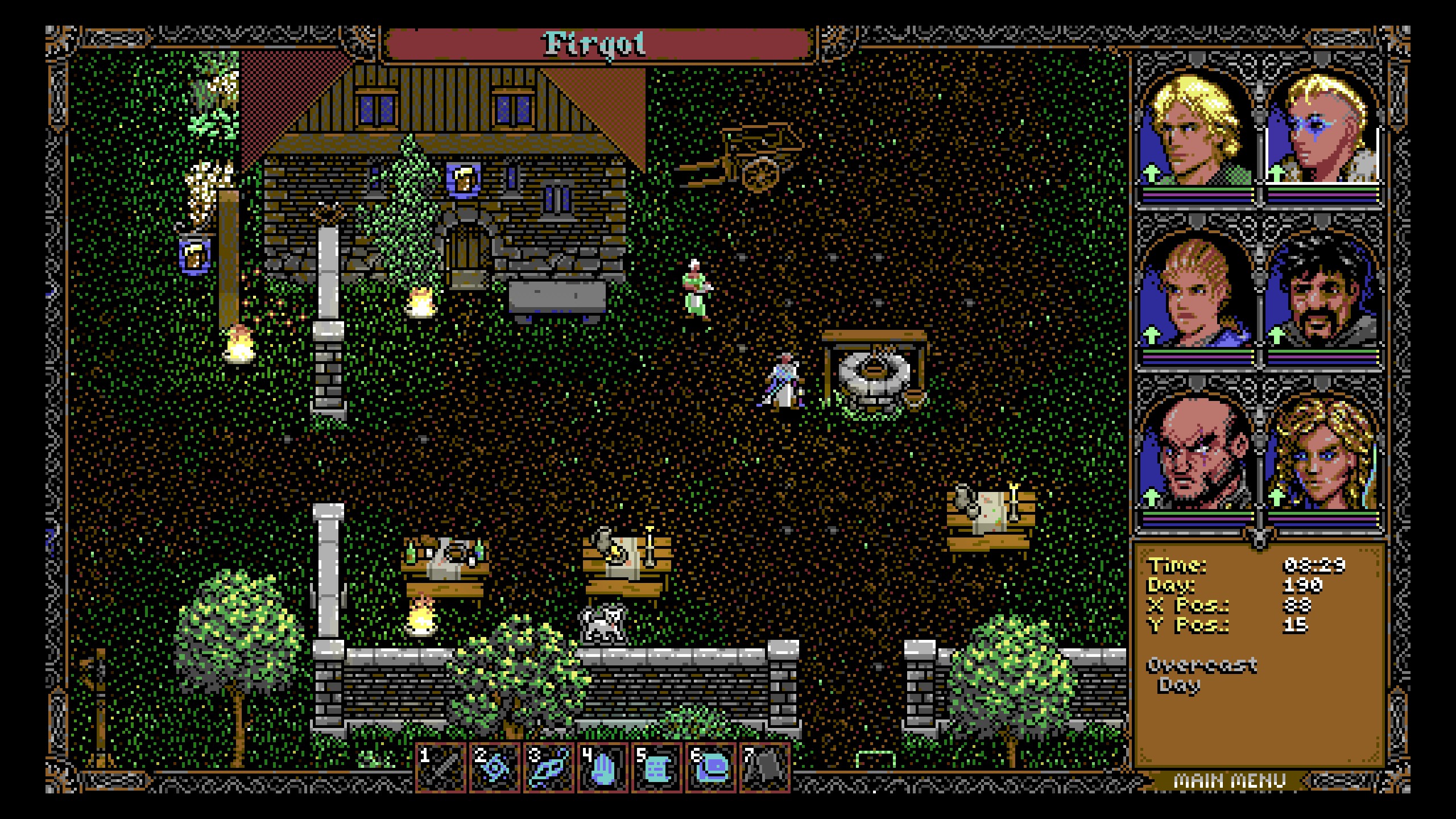
Firgol is not as peaceful as it may seem.
Setting the Stage
The game throws you into a familiar scenario: trapped on a struggling ship headed towards a distant continent in search of a mysterious girl. You awaken on a strange shore after a dramatic crash. A brief flashback tutorial, set two weeks prior, prepares you for your quest.
A significant portion of the story is conveyed through illustrations and in text form, featuring consistently good artwork. The same is true for the background music. At no point does it take over or try to be overly dramatic or melodramatic. Instead, it always nicely underscores the events happening on screen. Consistency is also demonstrated throughout the rest of the game's presentation. It is clear that Skald was created with one vision in mind, skillfully executed.

Much of the plot is advanced by illustrations of this type.
Venturing Forth
Exploration unfolds like combat - in turns. You navigate through smaller, handcrafted maps that are designed to be easily memorized. In some cases, these maps guide you along a linear path. Although you don't have a map or a minimap, navigating through more open areas should not be too difficult. Even if you need to backtrack, you can traverse entire maps quickly thanks to the fast movement speed. Each map is uniquely designed, featuring interesting locations waiting to be discovered. It always feels rewarding to explore every corner of each area.
On your journey, you will find an abundance of crafting resources for alchemy and cooking. You will find recipes for both along the way, but significantly fewer for alchemy than for cooking. Alchemy does not offer any effects beyond the usual healing and protection options, which are also available from other sources. On the other hand, cooking is crucial for your party's health as it provides a resource for resting, which is the only way to heal wounds. The only difference between different recipes is the food value, determining how much you need to eat to fully heal up. You can further enhance your party with minor buffs by assigning them different activities while resting at camp, although these activities are limited to just four options.
Travel between different areas is facilitated through an overland map. Despite free movement, the exploration experience feels rather limited. Random encounters and basic loot can be found here and there, but in general, you are quite clearly directed towards your next objective. These random encounters tend to be considerably more challenging when compared to quest battles. Skill checks can be attempted to avoid them, and by the midpoint of the game, I found myself doing just that. Due to their repetitive nature and weak rewards (basic loot or XP are no longer necessary at this point), these encounters become tedious quickly.
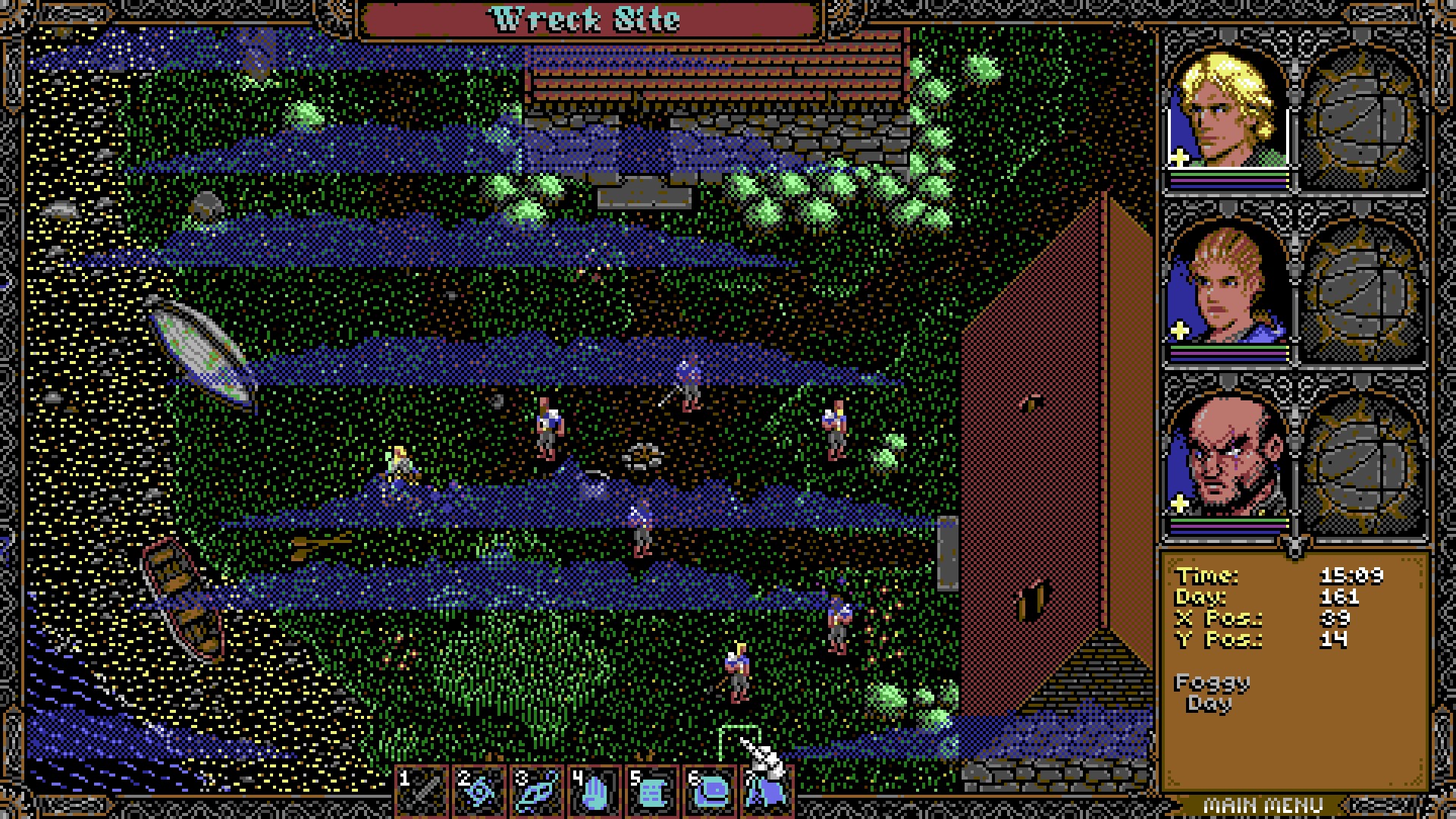
Exploring the lands.
Character Development and Lack of Depth
You will only gain XP for active companions, not for followers left behind in camps. XP can be gained through combat, completing quests, and to a lesser extent, by using out-of-combat skills. In addition to your PC, you can recruit up to 5 companions by either allowing written companions to join you or hiring mercenaries along the way. Mercenaries are essentially walking stat sheets, while even written companions do not come with their own quest lines, romances, or any other overbearing narrative. They chime in occasionally, and you can use them for various skill checks.
There are a total of 9 skills. There are few instances where failing a skill check leads to an instant game over; usually, the effects are much less severe, such as missing out on some loot or lore. Sometimes, failing a skill check even yields XP. In most cases, characters can be freely switched out for skill checks. In at least one instance, however, the PC is forced to be the checked character. This may have unfortunate consequences.
I did not hire any mercenaries, and I only filled the last roster spot by the halfway mark. There are no respecs, but everyone levels up from scratch, regardless of when they join the party. During level-up, you get to increase the ranks of the specific skill trees for that specific class. Most skills are not terribly interesting or capable of changing the gameplay in any way; they are simply number increases. For most classes, the choice feels rather obvious. In fact, for some classes, I didn't even bother allocating my few remaining levels' worth of skill points, as all the relevant skills, even the mediocre ones, were already maxed out.
In total, there are 9 classes to choose from. You can further customize your PC by selecting one of 15 backgrounds, granting you minor bonuses to attributes. Usually, I always choose a magically related class, but after hearing that magic was only an afterthought, I went melee instead.
And indeed, magic is clearly underdeveloped in many ways. Your arcane caster has only 3 schools available: fire, air, and earth, each with a mere 11 spells per school. There are a few spells that deal significant damage; the most powerful skill I encountered during my playthrough, Thunderclap, came from my arcane caster. However, spells have limited utility beyond causing damage. There are a few crowd control and debuff spells available, but I found none of them particularly useful (though others have reported higher-level utility spells can be useful). Additionally, the use of magic is severely restricted by mana (or attunement, as it is referred to in this game). Attunement only replenishes during rest, and there are not many potions available to restore it during a quest (although some flexibility is provided via attunement potion crafting).
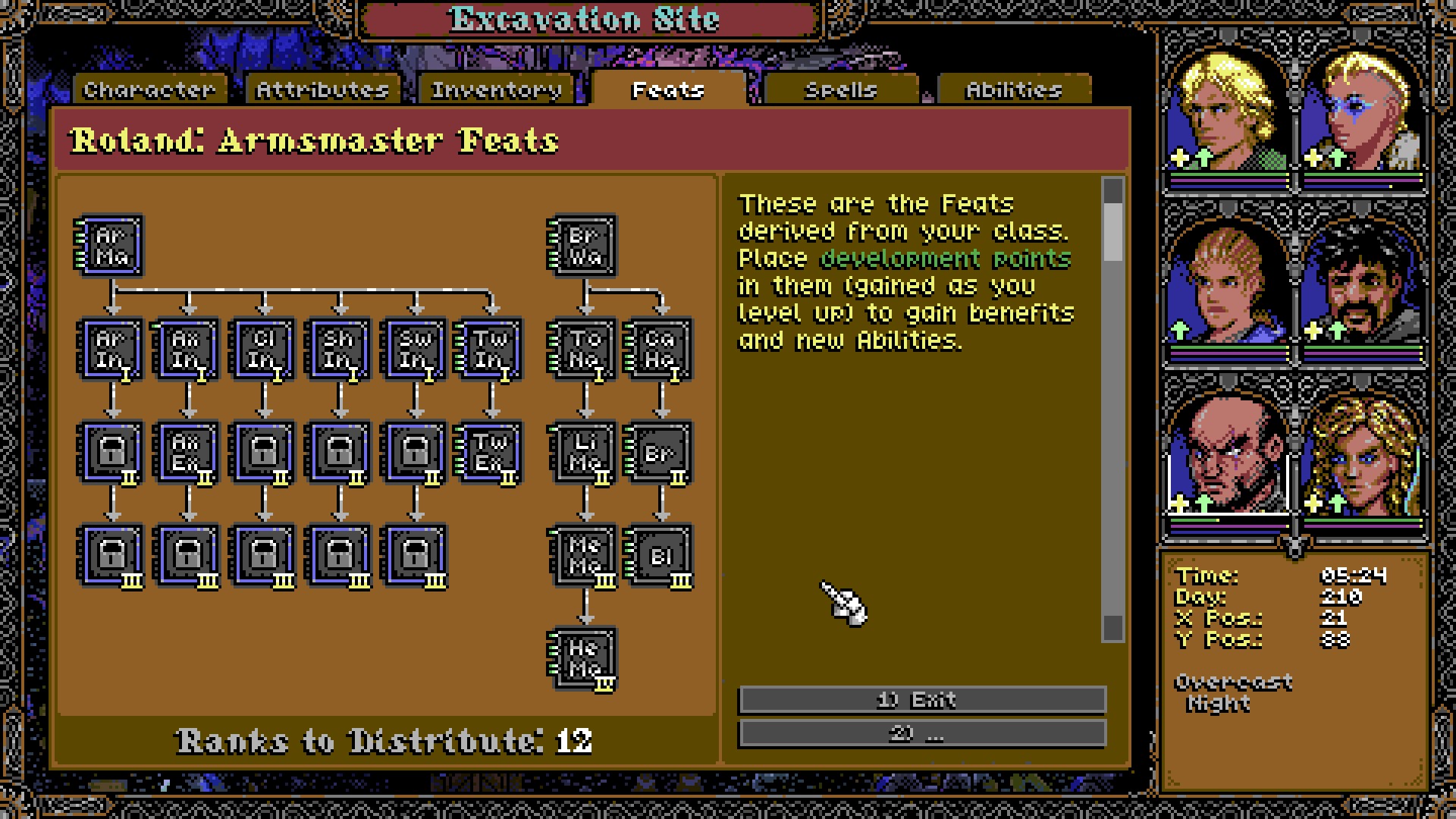
Straightforward choices during level-ups.
Combat on Autopilot
There are also no standard enemy casters in the entire game, so no mage duels. The only caster enemies are certain bosses. You also have the usual support casters such as clerics or rangers, which offer a wider range of spell choices. Many of the healing or buff spells can only be cast upon targets within touching distance. Additionally, spells, attacks, and movement can only be directed over the cardinal directions. There is no diagonal targeting.
Mobility should be crucial. Instead, combat is unfortunately static. There are no dedicated combat maps, and the turn-based combat takes place on the regular map. However, the grid size is quite small. Prior to each encounter, you have the opportunity to position your characters within a specific range of tiles. By the second round, most of your characters are usually engaged in duels.
Frequently, the grid becomes so cramped that movement becomes impossible. Additionally, disengaging does not trigger an opportunity attack but instead immediately ends your turn. Although swapping places is technically feasible, it also brings an immediate end to your turn. As a result, after planning the initial positions, starting from the second round, the combat primarily revolves around smashing down the mob before moving forward. You have only a limited number of combat maneuvers at your disposal, such as flanking or backstabbing. The lack of alternatives makes them seem like obvious non-choices.
Besides not having to worry about enemy casters, you don't need to be overly concerned about debuffs. Stun can be problematic, but other negative status effects are inconsequential. While there are ranged enemies, they will switch to melee when you approach, giving you the opportunity to engage in a duel once more. Additionally, enemies behave in a very static manner. Once they commit to attacking a specific tile, there is no turning back for them. The combat system as a whole feels very focused on melee, especially given the scarcity of arrows for your archers in the early to mid-game.
Early on, this is engaging enough. Combat is generally fast and fluent, and it's fun to experiment with different combinations of skills and positioning, especially when you have fewer characters and the grid is more open. However, the lack of depth in terms of options becomes apparent over time, which ultimately makes combat feel like a tedious slog.
The lack of options also applies to your equipment. Often, items only provide a +1 bonus to skills that you have already maximized. While weapons and armor may enhance your strength, they do not offer any distinctive abilities or significantly change your gameplay. It is rather uncommon, to say the least, to witness a thief backstabbing enemies with a dagger and a tower shield of thievery +1.
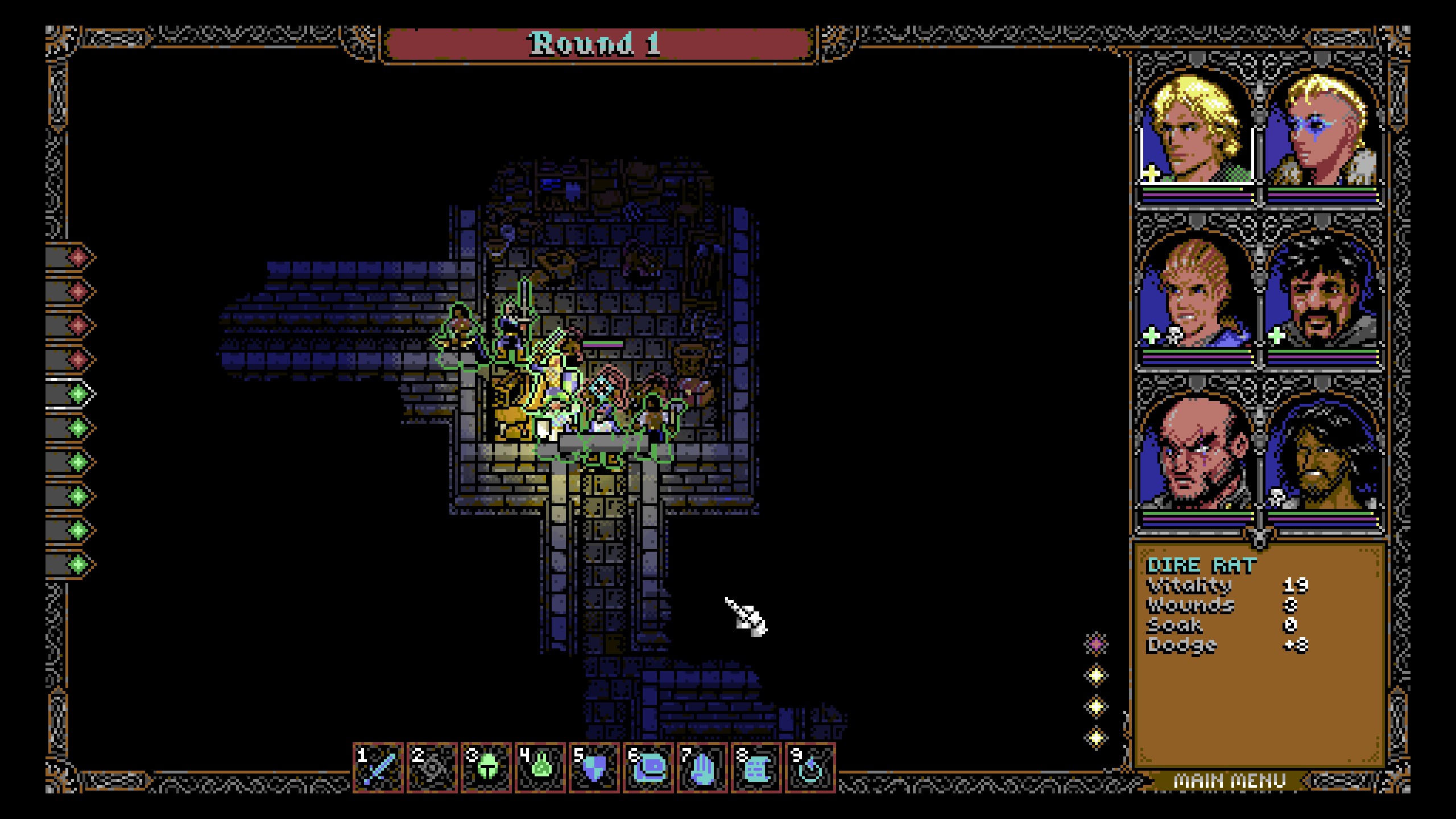
No room to maneuver during combat.
Limited, but well thought out, scope
SKALD: Against the Black Priory is a short game, taking about 20 hours to beat. By that time, you have likely seen most, if not all, of the content. Along the way, there are a few side quests that are reasonably well-designed and different enough to keep you interested. In general, the game does a good job of pushing the plot along and provides motivation for the PC's actions. The pacing is consistently well-executed throughout the game, as it never feels like the developer is attempting to include unnecessary content solely to lengthen the playthrough time.

Travel swiftly across the overland map.
Conclusion
Overall, the experience feels very harmonious. There is no filler content, no sudden difficulty spikes, and no half-abandoned ideas, with the exception of magic. The developer is self-aware enough to focus on what he is capable of and delivers a well-put-together game based on his original vision. The end result is a fun and enjoyable short adventure, although at times it may feel overly simplistic and predictable. Recommended for any RPG player who can overlook somewhat shallow underlying systems, such as character development and combat.