



Processor: Intel Core i7-4790
Graphics Card: NVIDIA GeForce GTX 960
Memory (RAM): 16 GB RAM
Game Version: 1.0
Game Type
Wuthering Waves is a free-to-play open world sci-fi fantasy with gacha elements. "Gacha" means that you can use a currency (in this game called Astrite), found in chests and from quests, to pull new characters you want to use, as well as their weapons. Astrite can also be bought with actual money, which I don't recommend because the prices are unreasonably high (think microtransactions minus the micro).
The game has a pity system, meaning after a certain number of pulls on a character or weapon banner you're guaranteed to get what you want (90 to 180 pulls for characters, 80 for weapons). The game released with plenty of goodies and has a permanent starter banner that allows you to get a starter character of your choice, using currency it gives you for free for leveling up in-game. Due to the review being written in version 1.0 I can't comment on the long-term generosity. Historically, the previous game released by this company didn't get any better or worse in that regard as the game aged.
If you think you'll stick with the game and don't mind spending a little money you can buy an optional subscription-like pass at $4.99 a month. It's by far the cheapest and most effective way to get more of the gacha currency (it gives 3k of the currency in total, 300 immediately and 90 a day for 30 days). I call it subscription-like since the pass doesn't renew automatically. If you stop playing the game it won't keep billing you or anything like that. I should point out that the counter isn't paused if you don't log in, so your daily claim is lost if you don't log in for the day. It does pop up automatically if you do log in so there is no need to take any other action to claim after login.
Wuthering Waves: So, what is this thing about?
Ah, the open world RPG. Isn't it wonderful? Can you ever have enough of it? If you're a game developer your answers would be "yes" and "no" respectively. So, here is the latest offering of Kuro Games, of Punishing: Gray Raven fame: Wuthering Waves.
In order to make this review as useful as possible, here is a warning: If you want to go into this game blind you should stop reading now. I will not describe every little plot twist and quest but some of the criticism and praise I intend to inflict/lavish on this game is inevitably tied to the game's plot. If you do not want to see spoilers, stop reading this now.
Ok? Ok. So, we wake up on the world of Solaris-3, a conveniently open world sci-fi fantasy planet which has inconveniently undergone a major apocalypse. And not this pussy asteroid-hits-the-planet apocalypse, oh no. This is the bitchy PMS-ing girlfriend of apocalypses. It ruins your day and, after you picked yourself up and swept away the broken civilization, it comes screeching back to ruin your day all over again.
This bitchy apocalypse is fittingly enough called the Lament.
Our protagonist has a bad case of amnesia with the intriguing twist that while he has no idea who he is, the local authority not only knows him but was expecting him. This skips the whole annoying, "Why do all these people trust this random yahoo" plot chasm many such games fall into five minutes after the game starts. We walk through the valley where two ladies, Yangyang and Chixia, have found us and are quickly assaulted by the local variety of eldritch abomination. We're told that these are called Tacet Discord and they look, fittingly enough, like someone ate a number of hallucinogenic substances and tried to draw people, animals and plants. These annoyingly persistent freaks of nature are spawned by something called a Tacet Field, which we are informed constantly vomits out an inexhaustible supply of these things. Usually pseudo-magically talented people called Resonators kill these adorable balls of murder before they overwhelm and kill what passes for the rest of civilization. After we kill a particularly aggressive boss version called a Crownless and baffle our companions by doing so the tutorial ends and we can progress to the first city.
I'm sure you've noticed by now that the game has a theme: Sound, music and noise. That's why terms like tacet, discord, resonance and forte are thrown around in the tutorial.
The Plot: It's less of a line and more of a branching tree.
The main plot isn't setting the world on fire, but honestly, compared to some of its contemporaries (notably Genshin Impact), it is a definitive improvement. There are some genuinely great moments in places. Outside of the convenient amnesia in the beginning everyone has a reason why they're doing what they're doing. The main character is a driving force in the plot, rather than just a bumbling tourist who rubs shoulders with strangely indulgent yet lazy deities a la Genshin.
Even the enemy factions have reasons to do what they're doing. The exiles are criminals who rob people, the animals are wild animals just hunting and doing their thing and the eldritch abominations want the world to burn. Interestingly the game does something Genshin and many others never do: If enemy factions meet each other in-game they will actually attack each other. They will also attack the friendly guards, who will fight back and even defend you if they see you getting attacked. I hate that this is rare enough to deserve a mention but it does.
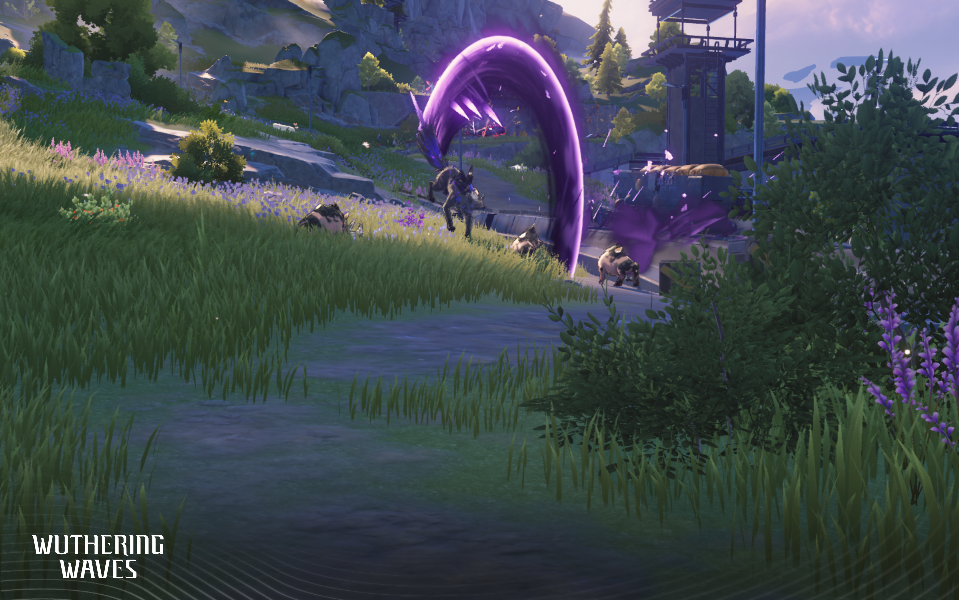
Even corrupted monster wolves have to eat you know?
- Make sure the city stays stable.
- Find out what the hell is going on.
- Go north to the front to tell the bitchy apocalypse that she should **** well pack her bags and leave the world the **** alone.
Let's talk flaws: A story is only as good as its execution.
Let's start with the technical side of my criticism. Texture pop-ins, pop-outs and general visual errors never caused crashes, but seriously annoyed me all the same.
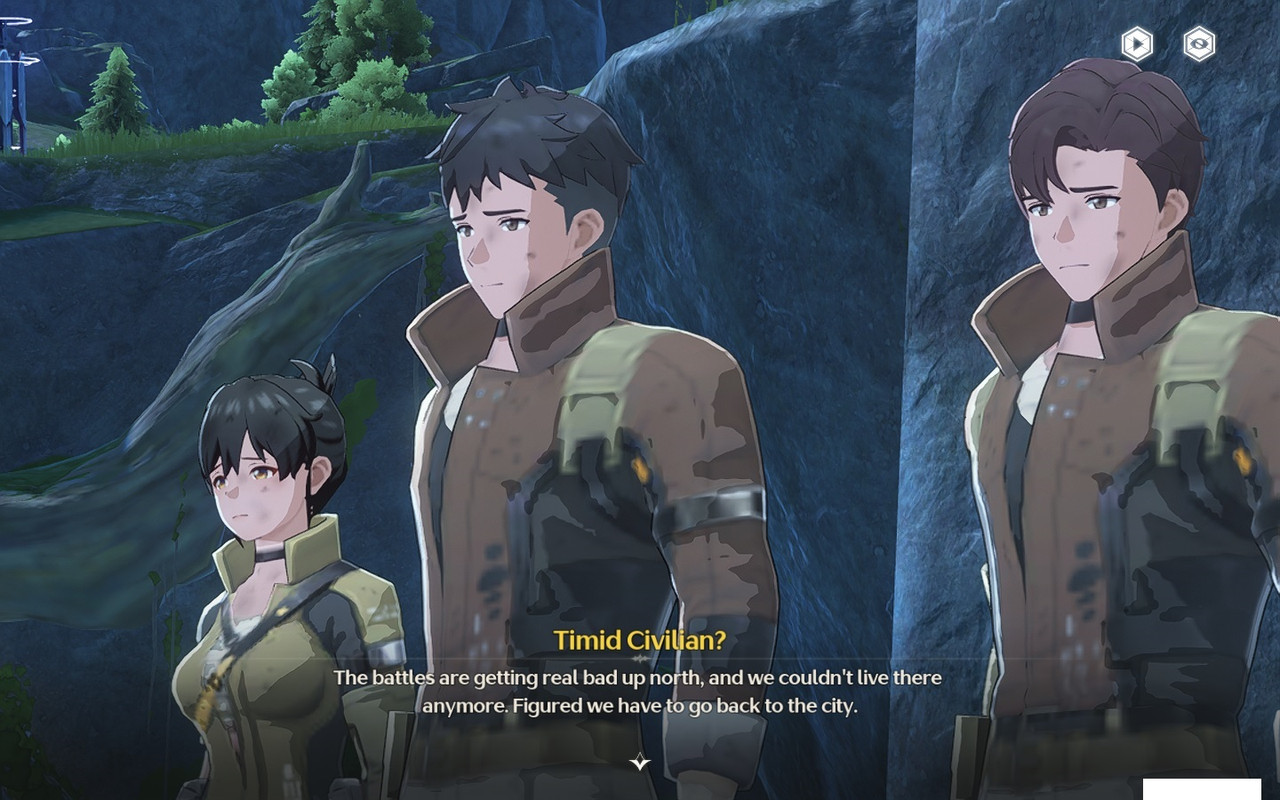
I'm reasonably certain their clothing wasn't meant to look like it was made of roughly 1/4 of the planned pixels and covered in grease.
Next, the writing: like I said, it's not setting the world on fire anytime soon but the only actual flaw I could find were typos and some writing errors I'm sure were caused by autocorrect ("Fury Fugue" becoming "Fury Fudge" in the skill description is an excellent example and made me chuckle). Other than that I've seen little to complain about.
Now, the voice acting. Ohohoho, the voice acting. If I was a charitable soul I would describe Yangyang's voice acting as severely understated. Unfortunately I'm an abrasive prick so I'll instead say that her voice actress sounds like she was told to imitate a narcoleptic stroke victim with no vocal inflection. They were going for demure lady and ended up with the auditory equivalent of the Dull Surprise meme. And we're stuck with just her for company for an entire mission! She also gets next to no character development, and we learn nothing about her outside of the fact that her tacet mark (that's the tattoo every resonator has) lets her sense things and that she's a friend of Chixia. The general we meet near the end of the game (Jiyan) has more character than her - between his Tacet-induced PTSD flashbacks and survivor's guilt - yet we've only known him for about an hour!
Finally, the good stuff.
Chixia is about as well-rounded as you can get as a supporting character: she's a wannabe hero (the good example of this stereotype), loves spicy food, is liked in the city for her work as a patroller and a helpful presence to those around her. She's a good example for a well-written side character and I'm honestly confused why this is not reflected elsewhere. Granted, characters outside of her and Yangyang haven't had nearly as much screentime yet.
As you might imagine from someone who made P:GR the combat system is a definite highlight. It's not quite at spectacle fighter level but it's much, much more strategic than Genshin where you can facetank basically everything. I made the unfortunate error to go off track and absentmindedly wandered into the way of a mutated murdercar with spiderlegs.
The game then proceeded to tell me that not learning how to dodge, counter or interrupt enemy attacks is not something it is willing to tolerate after the tutorial. Fittingly enough I went and used the tutorial function to practice the combos for my characters, after which I returned and showed the murderous spidercar what usually happens to arachnids who annoy me too much. Also, I learned to dodge stylishly.
This is also a fitting moment to inform you on how this game handles equipment. Outside of your weapon, you don't collect discarded jackets or delve into ruins for trinkets. Instead, you use your terminal (the gourd looking thing every character carries) to suck up the remaining resonance of defeated enemies. That's right, there is a creature collecting element in this game! You equip up to five of your defeated monster echoes and gets set bonuses for it, every echo has a fixed stat and a random one (hello there gear grind, I missed you!). But honestly, I like this more than the whole relic/artifact/gear stuff in other games. It makes it actually worth it to fight the random beaties you come across and gives fighting monsters some actual weight outside of the pittance of money they drop in other games.
Especially exciting is that you can use the first equipped echo to turn into the monster for a while and use a relevent skill of it. You can turn into a fire-spewing heron or turn into Hellrider to beat your enemies with a flaming exhaust pipe. Or just summon Hellrider to ride really fast across the landscape, your choice.
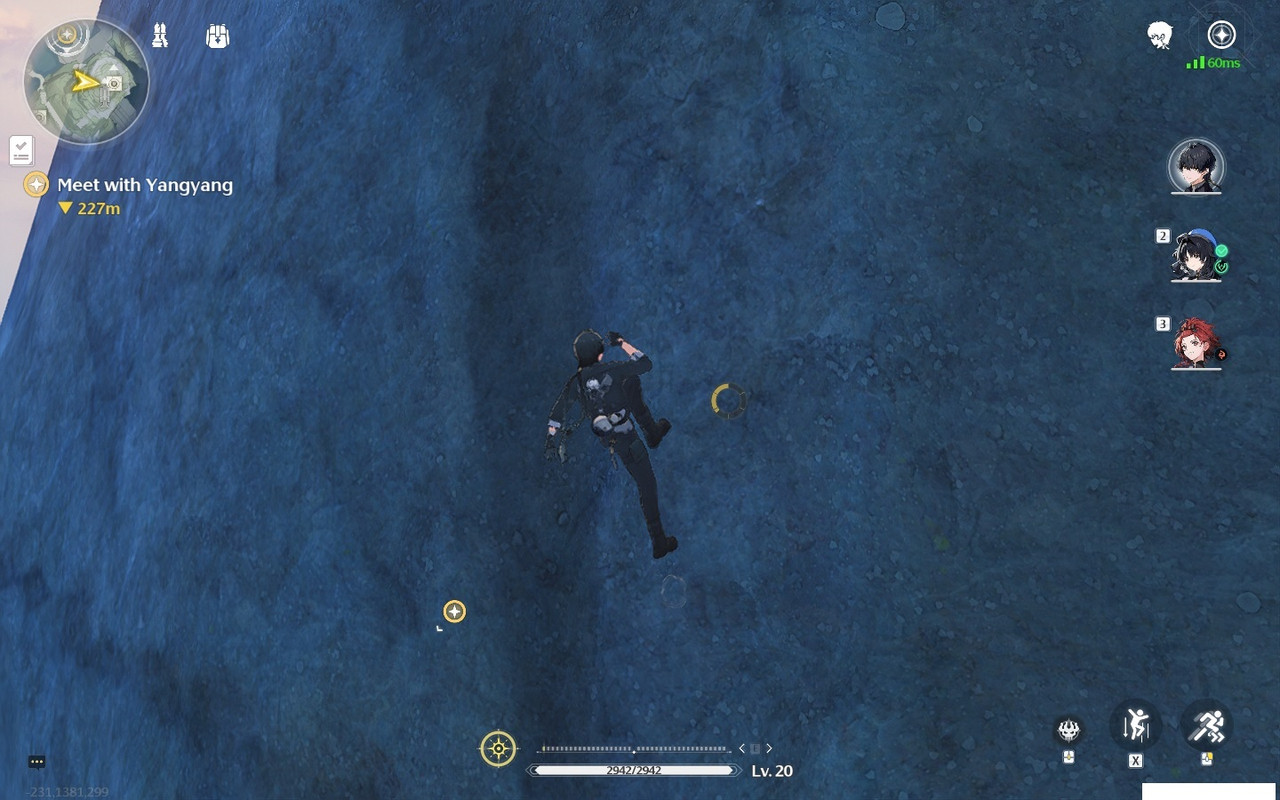
Also, the movement options are amazing. You can actually parkour across the city, zipline through the sky, use the aforementioned Hellrider to drive around and even wallrun up a mountain!
 [/url]
Sure, the apocalypse sucks. But on the other hand, gravity is now an optional feature!
Next, the graphics. You might have noticed from my pc specs that what I play on is less a pc and more a museum exhibit. I'm mentioning this because even with my potato this game has some very, very pretty visuals.
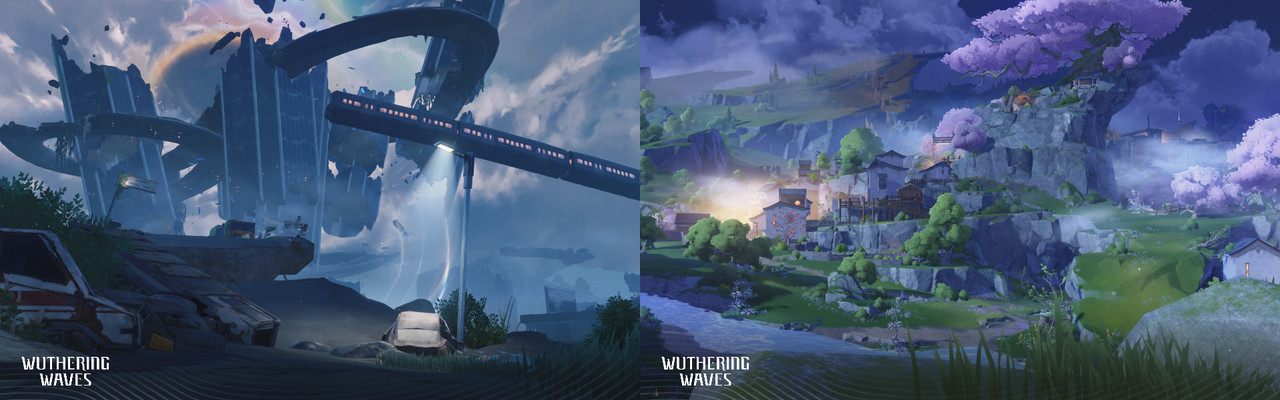
The camera function of the game, on the other hand, seems to decrease the resolution for some reason.
Environment design is also something to consider. I'm also a Genshin player and this game finally helped me put into words what bothers me about Genshin's open world: it's a basically a colorful fantasy themepark version of a world. There is one big city in each region, almost everything up to Fontaine is nearly spotlessly clean and the nations seem to have very few means to actually feed the people in those cities. Probably because farms and the like have all but disappeared (Mondstadt in Genshin for example has exactly one production facility: a winery). Instead we have vast stretches of nothing much at all.
The map in Wuthering Waves is, while smaller, a lot denser by comparison. You have the main city, a mine, research centers, production facilities and two separate harbours to do trade. All together it gives the image of a region that would actually function instead of suffering a famine after a single week because no-one grows food or produces anything.
Many buildings and models are also rusting or noticeably worn like you would expect in the middle of yet another apocaplyse. The model quality is noticeably higher due to different artstyles compared to the more cartoony cell-shaded Genshin look.
Lastly, the music: I really, really like it. The overworld theme is a bit bland but the fighting themes are all very good and considering that I considered Genshin's OST some of the best game music ever made my standards are quite high.
A few more points.
So, is this a Genshin clone? No. No more than Genshin is a Breath of the Wild clone. I actually think Genshin fans by and large will be annoyed by the more complex combat system because the game is much less forgiving of ****-ups in that regard than Genshin. I actually had to unlearn some bad habits I acquired there.
One criticism I've read about before playing is that the game tosses too many new words at you in the tutorial. This is a criticism I frankly don't understand but which reminded me that gamers are a bunch of nerds. Apparently the nerdiest of us have decided to treat game terminology like they're studying for the SATs. "Ah, this thing trying to kill me is called a Tacet Discord and it spawns from a Tacet Field." Very complex stuff there guys.
No, you don't need to know what a Retroact Rain is or what Waveworn Phenomena are. I'm pretty sure the game will tell you when you actually encounter these things. Maybe focus on not getting disemboweled first. (Spoiler alert: You do encounter the rain later and yes, the game explains it then.)
Game optimization was absolutely horrid the first day, but now it plays perfectly well so I'm honestly not in the mood to bash them for that. The uneven voice acting and writing hiccups are a much better target for criticism in my book. At least the devs duly apologized and gave a few very generous rewards to make up for it while fixing it.
Conclusion
Personally I recommend the game if you like the genre and prefer a more complex combat system. In particular I would commend the devs for making the different boss enemies more than just differently colored HP sponges and giving them very nice themes to fight them to. The combat is definitively the highlight, and even with all the other flaws in the game was never something I felt needed improvement.
The main storyline by itself is very nice to play through and honestly better than what I would rate the starter missions in its primary rivals Genshin Impact and Honkai Star Rail. I do hope they can keep the momentum going after the horribly rocky start this game had.
Rating: 7.5/10