We have a Steam curator now. You should be following it. https://store.steampowered.com/curator/44994899-RPGHQ/

Character Intelligence Versus Player Intelligence

For all your tabletop & board game needs.
Bah! They don't even play at physical tabletops anymore.
Ignore Topic

Would you allow a takeback?

Yes
6
32%
No
13
68%
 
Total votes: 19

User avatar
Rand
Posts: 6769
Joined: Sep 4, '23
Location: On my last legs

Geolocation

Adventurer's Guild

Post by Rand »

Norfleet wrote: ↑ July 27th, 2025, 06:28
Rand wrote: ↑ July 27th, 2025, 05:54
Fighting like the background combatants in a movie, of course. A lot of circling and clashing weapons (where they would miss by a meter even if the opponent did nothing).
That's still absurd, though. Background combatants in a movie can't spend an entire minute circling just for someone to swing once. The movie's only 90 minutes long, and there's still lots of other scenes we have to fit into that time. More importantly, the fight soundtrack is only 2 minutes long, and the first 40 seconds is the pre-fight intro, so you actually have to wrap this up in only 80 seconds.
Yep. But it was basically what Gygax, Arneson, and others envisioned for some reason.
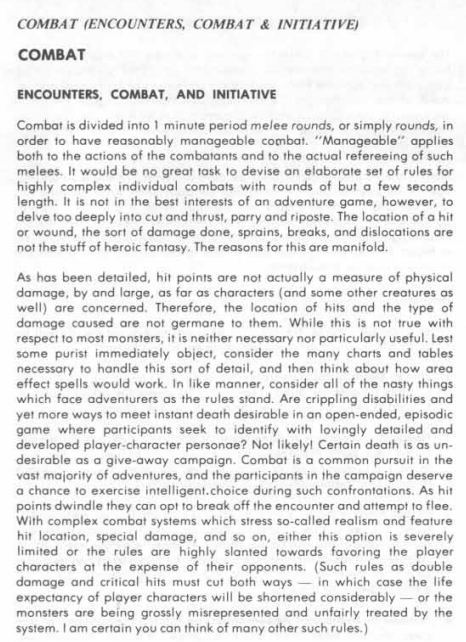
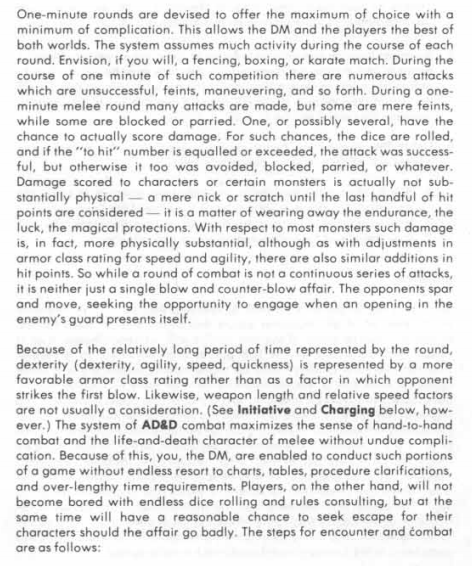
Gygax: "Combatants are maneuvering for position, making feints, watching for surprise flanks, and only making one or two true solid strikes in a melee round."
Me: "And the archers and throwing weapon users? What are THEY doing? Taking a break?"

Per Gygax's AD&D Dungeon Master's Guide
Image
Image
Last edited by Rand on July 27th, 2025, 15:16, edited 3 times in total.
You may as well not bother replying to my posts if it's to argue anything except concrete facts or your personal opinion. I still probably won't see it.
Reject your retarded-wing political programming and learn to think.
If you can.
User avatar
Rand
Posts: 6769
Joined: Sep 4, '23
Location: On my last legs

Geolocation

Adventurer's Guild

Post by Rand »

rusty_shackleford wrote: ↑ July 27th, 2025, 14:33
ArcaneLurker wrote: ↑ July 27th, 2025, 14:27
Well, I think in the case where a player tries to do something out of character, and the GM stops him, ought to apply in cases where it saves the player from his own mistakes, just as much as it applies where it screws the player over.
There should be a rule for how to handle e.g., doing something that is opposed to your character's alignment(or whatever the game uses β€” ethos, etc.,), yes.

For example, if we assume a generic D&D version with generic D&D terms, a lawful good character doing a chaotic or evil deed should be required to succeed at whatever the equivalent of a willpower test is.
Or maybe even the inverse if something is so tempting and the character is neutral.

I don't think I've seen any games explore this, not off-hand anyways.
GURPS has tests to see if a character can resist flaws (or even advantages) when desired.
You get more points if your flaws are harder for you to resist.
You may as well not bother replying to my posts if it's to argue anything except concrete facts or your personal opinion. I still probably won't see it.
Reject your retarded-wing political programming and learn to think.
If you can.
User avatar
Kalarion
Turtle
Turtle
Posts: 2250
Joined: Feb 2, '23

Geolocation

Adventurer's Guild

Post by Kalarion »

rusty_shackleford wrote: ↑ July 27th, 2025, 14:33
ArcaneLurker wrote: ↑ July 27th, 2025, 14:27
Well, I think in the case where a player tries to do something out of character, and the GM stops him, ought to apply in cases where it saves the player from his own mistakes, just as much as it applies where it screws the player over.
There should be a rule for how to handle e.g., doing something that is opposed to your character's alignment(or whatever the game uses β€” ethos, etc.,), yes.

For example, if we assume a generic D&D version with generic D&D terms, a lawful good character doing a chaotic or evil deed should be required to succeed at whatever the equivalent of a willpower test is.
Or maybe even the inverse if something is so tempting and the character is neutral.

I don't think I've seen any games explore this, not off-hand anyways.
One of JD's homebrew systems allows you to take on character traits (usually flaws or obstacles) in exchange for character power, but then resisting the compulsion those traits represent becomes increasingly harder, depending on how strong the trait is (minor - moderate - major).

I took "Moral Code - Moderate" as a trait for my character in order to receive additional power. I decided that the trait represented an obsessive need to immediately mete out the punishment demanded by the law upon personally witnessing a crime.

In one scene, during an investigation, an NPC in the room was shot by someone outside the building, through a window. I saw who did it, and due to my trait, decided I had to immediately find and execute the thug(s) that murdered the NPC. It resulted in a very hectic, madcap dash to another building with Sorin and JF keeping up as best they could, and a fight where we had the disadvantage because I'd rushed ahead without scouting or planning. I actually spent the first round demanding to know who had shot the NPC, and threatening to kill them all (there were three thugs) as insurance if they wouldn't tell me :D

When the fight was over two of the thugs were still alive. I wanted to stop my character from executing them on the spot, but because I had the trait at moderate level I also had to provide a reasonable justification before I would even be allowed to roll to resist it. I settled on the fact that the authorities had already been contacted and were on the way, the thugs couldn't escape incarceration and trial, and that the legal system would deal with their punishment at that point.

Some of this was directly adjudicated by JD, but some of it I came up with myself while thinking about my character in terms of the traits I'd picked. I could tell for instance that JD was taken by surprise by the aggressiveness of my character's initial dash and shouted demands of the thugs, until I explained to him why I was doing it. Then he played into it and ruled that I had to come up with justification for not executing the living thugs later - I suspect at least partially just to see what I could come up with :D

I've never played in a group where my character has been that tightly intertwined with my thought processes, and it was really cool.

EDIT: small clarification in the first paragraph.
Last edited by Kalarion on July 27th, 2025, 19:40, edited 1 time in total.
. wrote: ↑
Kalarion did this a lot better you know.
User avatar
DrSneed
Posts: 804
Joined: Jan 1, '25

Geolocation

Post by DrSneed »

I don't really care to be honest. I can silently strategize my enemy units then the players can have hand signals, codewords, speaking in a different language, PC being smarter than the player piloting them, etc.
Last edited by DrSneed on July 27th, 2025, 19:53, edited 1 time in total.
User avatar
DemoGraph
Posts: 2153
Joined: Mar 24, '24

Geolocation

Adventurer's Guild

Post by DemoGraph »

WhiteShark wrote: ↑ July 27th, 2025, 00:24
You're the GM. Do you allow a takeback? Why or why not?

More broadly speaking, do you give metagame assistance to players who are playing characters smarter than they are in order to make up the difference?
In this case I don't, because combat is a stressful situation that a person could derp in no matter the IQ.

Generally speaking, intelligence and wisdom don't equal common sense.
LTCM had an ungodly concentration of PhDs, yet they still flopped like *******.
Top wisdom clerics could still fall for some lass, because they are humans.
If player does something his character shouldn't in a relaxed or prolonged situation, it could be retconned (probably giving him some unexpected consequence "yes, your business idea works after all, but you've bankrupted your neighbor and now he hates you").

Many systems (GURPS, Ars, WW stuff) also have "common sense" feat specifically for these situations.
Iren's PbP - Felix
User avatar
Stack of Turtles
Posts: 7378
Joined: May 7, '24
Location: Soon-to-be Iran

Geolocation

Post by Stack of Turtles »

DemoGraph wrote: ↑ July 27th, 2025, 20:18
LTCM had an ungodly concentration of PhDs, yet they still flopped like *******.
..."yet"?
VAE VICTIS
User avatar
Norfleet
Posts: 2851
Joined: Jun 3, '23

Geolocation

Post by Norfleet »

Rand wrote: ↑ July 27th, 2025, 15:07
I'm not going to use in-game mechanics to make up for player stupidity. I am a neutral referee.
That's not really what I'm saying either: Note that I've sided with no backsies. However, I'm perfectly okay with allowing the player to invoke an ability that his character has, that he does not have, on demand, via a skill or stat check. Otherwise it would cease to be an RPG, and just become a game of Tacticool Shooter Guy, where how tacticool you are is strictly a function of gameplay and characters are just avatars of the player.
DemoGraph wrote: ↑ July 27th, 2025, 20:18
LTCM had an ungodly concentration of PhDs, yet they still flopped like *******.
That's because the IQ of a group is equal to the highest IQ in the group divided by the number of people in the group. Thus why the most awful decisions get made by committee as what may have started out as a good idea is diluted through compromises and misunderstandings until the stupid thing results.
User avatar
WhiteShark
Site Moderator
Posts: 5056
Joined: Feb 2, '23

Geolocation

Adventurer's Guild

Post by WhiteShark »

rusty_shackleford wrote: ↑ July 27th, 2025, 01:23
The advisory check is asking the GM, (and possibly the other players depending on the dynamics at your table) for a brainstorm. Remember the Player is just some guy, the person they are playing is an expert at something. So, the player says β€œWhat are some of the ways I can break into this mansion?”. A roll is made, and based on that roll the GM lays down things that the Player should probably consider.
Originally, I was going to say I don't like this. If it's something the PC should simply know by virtue of his skills or experience, why is it gated behind an advantage? Then I realized that this isn't about the GURPS Common Sense advantage.

I think this makes sense. My one qualm is that it obviates the need for the player to figure out this stuff himself, which can be an entertaining mental exercise, like a puzzle. In that sense, we come back to what I believe is a fundamental divide: the more that is offloaded to a character's stats, the more of a simulation it becomes, and the less of a game it is for the player. For example, in the scenario given above, while the thief's player is still the one making decisions, the knowledge provided by the GM has effectively constrained him to making a "good" decision. That's realistic for an experienced thief, but it feels as though it takes some agency out of the hands of the player.

Imagine it were a combat scenario and a player rolled for tactical insight, resulting in the GM telling him which targets are the most dangerous, which parts of the battlefield are best to fight on, and so on. Suddenly the tactical side of the game, which we generally assume to be the domain of the player's mind, has been diminished. It would be hard for a player in that scenario to make a significant tactical error unless the GM provided him with bad information. The game edges closer to playing itselfβ€”or, more precisely, it edges closer to being a game played by the GM alone.
Acrux wrote: ↑ July 27th, 2025, 03:29
Alexander Macris has a really good blog post about this and the various scenarios that can come up. (I think you've linked this before, @WhiteShark.)
I do overall agree with the synergistic model. However, I also do not think it is wrong to say that Non-Overlapping Magisteria allows for more expression of player skill. I don't think every activity can be cleanly divided according to the synergistic model. Puzzles and riddles are a good example. I can only think of three approaches:
  • Non-Overlapping Magisteria/Player Skill is Paramount: the player must solve the puzzle himself.
  • Character Skill is Paramount: the character makes an intelligence check to solve it.
  • Synergistic Model: the character can make an intelligence check to get a hint...?
The problem is that, by its very nature, the puzzle is aimed at the player's intelligence. If it can be solved by a mere intelligence check, it becomes boring filler. Hints that are useful without solving the puzzle for the player are exceedingly difficult to craft.

This is actually the same problem as the tactical thinking problem I mentioned above. If the character is an experienced officer, he should likely know more about tactics than the player. If he knows more about tactics than the player, then the 'advisory check' should logically inform the player of the best tactical options according to his character's experience. At this point, again assuming good information, the "puzzle" is probably mostly "solved": the player, unless he wants to deliberately sabotage himself for whatever reason, is constrained to the "good" choices provided him.

I don't think this is fully solvable. There is a tension here much like the one between character-as-avatar and character-as-individual, where it's never truly only one or the other. You could even say this is the fundamental tension between RPGs as simulations versus RPGs as games.

User avatar
WhiteShark
Site Moderator
Posts: 5056
Joined: Feb 2, '23

Geolocation

Adventurer's Guild

Post by WhiteShark »

rusty_shackleford wrote: ↑ July 27th, 2025, 14:33
ArcaneLurker wrote: ↑ July 27th, 2025, 14:27
Well, I think in the case where a player tries to do something out of character, and the GM stops him, ought to apply in cases where it saves the player from his own mistakes, just as much as it applies where it screws the player over.
There should be a rule for how to handle e.g., doing something that is opposed to your character's alignment(or whatever the game uses β€” ethos, etc.,), yes.

For example, if we assume a generic D&D version with generic D&D terms, a lawful good character doing a chaotic or evil deed should be required to succeed at whatever the equivalent of a willpower test is.
Or maybe even the inverse if something is so tempting and the character is neutral.

I don't think I've seen any games explore this, not off-hand anyways.
@Rand already mentioned that GURPS has this in the form of virtuous disadvantages with self-control rolls. The D&D approach is to shift the character's alignment if he frequently takes actions contrary to it. I think these two represent slightly different things. The GURPS approach feels like a mental compulsion whereas alignment, without such compulsion, models an individual's making an effort to conform to that morality. Not every Good character should be so habitually Good that it is difficult for him to fall.
User avatar
WhiteShark
Site Moderator
Posts: 5056
Joined: Feb 2, '23

Geolocation

Adventurer's Guild

Post by WhiteShark »

DrSneed wrote: ↑ July 27th, 2025, 19:53
I don't really care to be honest. I can silently strategize my enemy units then the players can have hand signals, codewords, speaking in a different language, PC being smarter than the player piloting them, etc.
Maybe you shouldn't strategize enemies under your control beyond what their intelligence and communications would allow. :scratch-pipe:
Last edited by WhiteShark on July 31st, 2025, 17:48, edited 1 time in total.
User avatar
WhiteShark
Site Moderator
Posts: 5056
Joined: Feb 2, '23

Geolocation

Adventurer's Guild

Post by WhiteShark »

Food for thought regarding the scenario in the OP:

Consider the reverse scenario. Imagine you were the GM and unthinkingly had your villain say something dumb that gave away his plans. Would you say, "Woops, actually, he's really smart, so he wouldn't have said that," and make your players pretend they didn't hear it? I've never heard of any GM doing that.
User avatar
Xenich
Posts: 4897
Joined: Feb 24, '24

Geolocation

Post by Xenich »

WhiteShark wrote: ↑ July 27th, 2025, 00:24
Inspired by a recent thread on /tg/.

Suppose PC A and PC B are working together to take down an enemy who is invulnerable save for one weakpoint. The plan is that B will get his attention and then, while he's distracted, A will come up behind him and land the killing blow. The first step goes smoothly: B charges in, makes a ruckus, and causes the enemy to focus on him. However, just as A is about to sneak up, B foolishly shouts, "Okay, A! I've got him distracted! He's all yours!" Of course, the enemy hears this, and the plan falls apart. B's player begs for a takeback, citing his character's well above average Intelligence and Wisdom.

You're the GM. Do you allow a takeback? Why or why not?

More broadly speaking, do you give metagame assistance to players who are playing characters smarter than they are in order to make up the difference?
No. The player is still responsible for the decisions they make, the statistics exist to leverage the success of their decisions, not decide the thinking and play of the player itself.

Smart people can still make stupid choices. As I said, the statistic exists as a means to apply a success/fail roll to the choices they do make, not absolve them of responsibility of them.
User avatar
Xenich
Posts: 4897
Joined: Feb 24, '24

Geolocation

Post by Xenich »

rusty_shackleford wrote: ↑ July 27th, 2025, 14:33
ArcaneLurker wrote: ↑ July 27th, 2025, 14:27
Well, I think in the case where a player tries to do something out of character, and the GM stops him, ought to apply in cases where it saves the player from his own mistakes, just as much as it applies where it screws the player over.
There should be a rule for how to handle e.g., doing something that is opposed to your character's alignment(or whatever the game uses β€” ethos, etc.,), yes.

For example, if we assume a generic D&D version with generic D&D terms, a lawful good character doing a chaotic or evil deed should be required to succeed at whatever the equivalent of a willpower test is.
Or maybe even the inverse if something is so tempting and the character is neutral.

I don't think I've seen any games explore this, not off-hand anyways.
Our GM used to use subtle to extreme actions to deal with a player who acted outside of their players alignment or devotion to their god. Minor offenses would result in various things like inconsistent use of powers that would reflect their faltering of faith and devotion, to outright stripping a player of their powers and title by the god. The player always had a responsibility to their characters decisions, but the GM could "help" in ways to guide a player back to their path (in cases of cleric/paladin) situations.

In other situations, the player was responsible for their character and the need to understand such. In those cases, there may be no warning, other than maybe something as you mentioned, a roll of willpower, or similar skill check where the player is "reminded" via the GM as a "subconscious" thought that what they were doing would create conflict within themselves.
User avatar
Rand
Posts: 6769
Joined: Sep 4, '23
Location: On my last legs

Geolocation

Adventurer's Guild

Post by Rand »

If I use alignment at all, I use it as descriptive, not proscriptive.
Also, since I don't care for Moorcock or Vance, I am not interested in some weird cosmic "law versus chaos" business.
I do have magic items that can be aligned good and evil and harm opponents, but some of them also harm faction opponents as well.
Like a devil's epic weapon that will harm anyone not aligned: mortal, angel, or demon.
And I as the referee decide alignment based on the character's actions in the game, with some respect paid to backstory (if notably evil).
The player can claim to be chaotic neutral on his character sheet all he wants, if he's been neutral evil, then that's how my game will treat him.
Last edited by Rand on July 31st, 2025, 17:54, edited 1 time in total.
You may as well not bother replying to my posts if it's to argue anything except concrete facts or your personal opinion. I still probably won't see it.
Reject your retarded-wing political programming and learn to think.
If you can.
User avatar
Xenich
Posts: 4897
Joined: Feb 24, '24

Geolocation

Post by Xenich »

Rand wrote: ↑ July 31st, 2025, 17:54
If I use alignment at all, I use it as descriptive, not proscriptive.
Also, since I don't care for Moorcock or Vance, I am not interested in some weird cosmic "law versus chaos" business.
I do have magic items that can be aligned good and evil and harm opponents, but some of them also harm faction opponents as well.
Like a devil's epic weapon that will harm anyone not aligned: mortal, angel, or demon.
And I as the referee decide alignment based on the character's actions in the game, with some respect paid to backstory (if notably evil).
The player can claim to be chaotic neutral on his character sheet all he wants, if he's been neutral evil, then that's how my game will treat him.
Once I played an entire campaign essentially as an NPC because I happened upon a dragon orb at low level and well, let the temptation of power make me risk the roll. The GM made me play my character for 20 levels fairly normally while a black dragon with a lich master essentially "dictated" my actions at key points in the campaigns until a pivotal moment for me to betray them all.
User avatar
DemoGraph
Posts: 2153
Joined: Mar 24, '24

Geolocation

Adventurer's Guild

Post by DemoGraph »

WhiteShark wrote: ↑ July 31st, 2025, 17:08
This is actually the same problem as the tactical thinking problem I mentioned above. If the character is an experienced officer, he should likely know more about tactics than the player. If he knows more about tactics than the player, then the 'advisory check' should logically inform the player of the best tactical options according to his character's experience. At this point, again assuming good information, the "puzzle" is probably mostly "solved": the player, unless he wants to deliberately sabotage himself for whatever reason, is constrained to the "good" choices provided him.
I'm reading Norman F. Dixon, "On the psychology of military incompetence". Based on that I'd suggest that tips from the GM like these could be "good enough". If PC is experienced, but not ingenious, he could be portrayed as professional, but inside the box, thinker. And if he meets nonstandard situation, GMs tips could be decent, but improper while being in character.
WhiteShark wrote: ↑ July 31st, 2025, 17:23
Consider the reverse scenario. Imagine you were the GM and unthinkingly had your villain say something dumb that gave away his plans. Would you say, "Woops, actually, he's really smart, so he wouldn't have said that," and make your players pretend they didn't hear it? I've never heard of any GM doing that.
I would've said something like "the villain suddenly got ********, because he was possessed by even badder villain!" and up the challenge. My failure is obviously their fault.
Iren's PbP - Felix
User avatar
Stack of Turtles
Posts: 7378
Joined: May 7, '24
Location: Soon-to-be Iran

Geolocation

Post by Stack of Turtles »

WhiteShark wrote: ↑ July 31st, 2025, 17:08
rusty_shackleford wrote: ↑ July 27th, 2025, 01:23
The advisory check is asking the GM, (and possibly the other players depending on the dynamics at your table) for a brainstorm. Remember the Player is just some guy, the person they are playing is an expert at something. So, the player says β€œWhat are some of the ways I can break into this mansion?”. A roll is made, and based on that roll the GM lays down things that the Player should probably consider.
Originally, I was going to say I don't like this. If it's something the PC should simply know by virtue of his skills or experience, why is it gated behind an advantage? Then I realized that this isn't about the GURPS Common Sense advantage.

I think this makes sense. My one qualm is that it obviates the need for the player to figure out this stuff himself, which can be an entertaining mental exercise, like a puzzle. In that sense, we come back to what I believe is a fundamental divide: the more that is offloaded to a character's stats, the more of a simulation it becomes, and the less of a game it is for the player. For example, in the scenario given above, while the thief's player is still the one making decisions, the knowledge provided by the GM has effectively constrained him to making a "good" decision. That's realistic for an experienced thief, but it feels as though it takes some agency out of the hands of the player.

Imagine it were a combat scenario and a player rolled for tactical insight, resulting in the GM telling him which targets are the most dangerous, which parts of the battlefield are best to fight on, and so on. Suddenly the tactical side of the game, which we generally assume to be the domain of the player's mind, has been diminished. It would be hard for a player in that scenario to make a significant tactical error unless the GM provided him with bad information. The game edges closer to playing itselfβ€”or, more precisely, it edges closer to being a game played by the GM alone.
Acrux wrote: ↑ July 27th, 2025, 03:29
Alexander Macris has a really good blog post about this and the various scenarios that can come up. (I think you've linked this before, @WhiteShark.)
I do overall agree with the synergistic model. However, I also do not think it is wrong to say that Non-Overlapping Magisteria allows for more expression of player skill. I don't think every activity can be cleanly divided according to the synergistic model. Puzzles and riddles are a good example. I can only think of three approaches:
  • Non-Overlapping Magisteria/Player Skill is Paramount: the player must solve the puzzle himself.
  • Character Skill is Paramount: the character makes an intelligence check to solve it.
  • Synergistic Model: the character can make an intelligence check to get a hint...?
The problem is that, by its very nature, the puzzle is aimed at the player's intelligence. If it can be solved by a mere intelligence check, it becomes boring filler. Hints that are useful without solving the puzzle for the player are exceedingly difficult to craft.

This is actually the same problem as the tactical thinking problem I mentioned above. If the character is an experienced officer, he should likely know more about tactics than the player. If he knows more about tactics than the player, then the 'advisory check' should logically inform the player of the best tactical options according to his character's experience. At this point, again assuming good information, the "puzzle" is probably mostly "solved": the player, unless he wants to deliberately sabotage himself for whatever reason, is constrained to the "good" choices provided him.

I don't think this is fully solvable. There is a tension here much like the one between character-as-avatar and character-as-individual, where it's never truly only one or the other. You could even say this is the fundamental tension between RPGs as simulations versus RPGs as games.
In the first game I ever played in that lasted more than like one scene, we had a player (not me :lol:) who was... borderline ******** and socially incompetent. And he more or less knew he was borderline ******** and socially incompetent, so he never (at least at first) tried to think about what to say or do in any kind of situation, and would just ask something like "can I roll int to solve this?". The DM begged this player to try to make a stab at, at least, a general direction, and it did kind of sink in over time, but not very well and the player was consistently a liability, unfortunately.

Still, I think there's a correct approach to this even if some players may never accept it, and it's at least in the ballpark of what the DM was trying to do there: No "I roll int to solve this", but not "I roll int to get a hint" either. The synergistic model would be along the broad lines of "I investigate X specific thing to see if my character understands what it's for". This is the direct parallel of the charisma example in Macris' article, where we have "I talk/ask about X specific thing and my character uses his charisma to make it sound good". The player still has to provide direction in which for the character to apply his skills, and if he picks the wrong direction, the character got sidetracked by the wrong thing. If your puzzle doesn't have a way for this to be more interesting than "press X to solve"... it probably sucks. Don't just make the players do Towers of Hanoi or something!
Something like this can also work for a riddle... like "my character thinks about what kinds of thing a 'box without hinges' might be". But you can also give players other possibilities which help us come up with ideas in the real world... maybe the sphinx gives you an hour to think about it, and your character, lost in thought, reclines back on a rock and looks at the sky, idly daydreaming about how the yellow rays of sunshine seem to turn everything they touch to gold, and then a cloud passes over the sun which lights it up majestically as if it were a fluffy egg yolk...

And if at the end of the day the player still doesn't get it, it's discretionary whether you want to offer a final "roll to understand", but I probably wouldn't. Sometimes things just don't click even though, once you find out the answer, it feels like it should have been obvious.

The same idea works for tactics too. Instead of just "I roll to get a tactical layout", ask for "my character tries to find a defensible location" or such.
VAE VICTIS
User avatar
WhiteShark
Site Moderator
Posts: 5056
Joined: Feb 2, '23

Geolocation

Adventurer's Guild

Post by WhiteShark »

Stack of Turtles wrote: ↑ July 31st, 2025, 18:38
The synergistic model would be along the broad lines of "I investigate X specific thing to see if my character understands what it's for". This is the direct parallel of the charisma example in Macris' article, where we have "I talk/ask about X specific thing and my character uses his charisma to make it sound good". The player still has to provide direction in which for the character to apply his skills, and if he picks the wrong direction, the character got sidetracked by the wrong thing.
...
The same idea works for tactics too. Instead of just "I roll to get a tactical layout", ask for "my character tries to find a defensible location" or such.
So, demanding specificity as a prerequisite to making an advisory check. Yes, that makes sense. The corollary is that the GM would decline to advise unfocused questions like, "How do I win this battle?" or, "How do I steal the artifact?"
Stack of Turtles wrote: ↑ July 31st, 2025, 18:38
And if at the end of the day the player still doesn't get it, it's discretionary whether you want to offer a final "roll to understand", but I probably wouldn't. Sometimes things just don't click even though, once you find out the answer, it feels like it should have been obvious.
I definitely wouldn't. I would rather just not include puzzles and riddles in the game than allow int-to-solve. I can already see in my mind's eye that if I allowed it once, even if I made them work at it first, the players would just default to that every time. Even if you mean after it was too late for the answer to be useful, I still probably wouldn't. I don't like divulging things that the PCs didn't discover.
User avatar
Acrux
Turtle
Turtle
Posts: 6746
Joined: Feb 8, '23

Geolocation

Adventurer's Guild

Post by Acrux »

WhiteShark wrote: ↑ July 31st, 2025, 18:49
I would rather just not include puzzles and riddles in the game than allow int-to-solve.
I think puzzles and riddles are generally a bad idea, anyway. A "critical thinking test" is one thing, but most puzzles people use end up requiring some sort of out-of-game meta knowledge, or are highly skewed by someone in the group having encountered something like it before. Using the features of the environment as something to "solve" is usually better. I suppose there's an exception if you make it to clear to everyone "this is the dungeon of a crazy old wizard and he's set many devious traps to challenge both your mind and mettle".
Like my posts? Consider a donation: PayPal
Hate my posts? Consider a donation: PayPal
Indifferent to my posts? Consider a donation: PayPal
User avatar
AmericanMonarchist
Posts: 540
Joined: Jan 4, '24

Geolocation

Post by AmericanMonarchist »

WhiteShark wrote: ↑ July 27th, 2025, 00:24
Inspired by a recent thread on /tg/.

Suppose PC A and PC B are working together to take down an enemy who is invulnerable save for one weakpoint. The plan is that B will get his attention and then, while he's distracted, A will come up behind him and land the killing blow. The first step goes smoothly: B charges in, makes a ruckus, and causes the enemy to focus on him. However, just as A is about to sneak up, B foolishly shouts, "Okay, A! I've got him distracted! He's all yours!" Of course, the enemy hears this, and the plan falls apart. B's player begs for a takeback, citing his character's well above average Intelligence and Wisdom.

You're the GM. Do you allow a takeback? Why or why not?

More broadly speaking, do you give metagame assistance to players who are playing characters smarter than they are in order to make up the difference?
Did I make clear that all communication is in character beforehand? If so, then depending on how generous I am feeling I will have Player B roll a general Intelligence check to see if he remembers that he should keep his mouth shut in a combat situation or a Charisma saving throw to keep his emotions in check. If either passes, then he can have his takeback. If not, then I shouldn't have had the enemy hear what is normally thought of as out of character communication (as metagamey as it might be).
User avatar
gatorized
Posts: 18
Joined: Nov 8, '23

Geolocation

Post by gatorized »

If the character's decisions are determined by the character's statistics, what is the purpose of the player being present? You can replace him with a dice simulator.
User avatar
Tweed
Turtle
Turtle
Posts: 6995
Joined: Feb 2, '23

Geolocation

Adventurer's Guild

Post by Tweed »

gatorized wrote: ↑ August 31st, 2025, 01:31
If the character's decisions are determined by the character's statistics, what is the purpose of the player being present? You can replace him with a dice simulator.
That was never what was argued here.
User avatar
gatorized
Posts: 18
Joined: Nov 8, '23

Geolocation

Post by gatorized »

WhiteShark wrote: ↑ July 27th, 2025, 00:24
B's player begs for a takeback, citing his character's well above average Intelligence and Wisdom.
This is the character's decisions being determined by his statistics.
User avatar
Tweed
Turtle
Turtle
Posts: 6995
Joined: Feb 2, '23

Geolocation

Adventurer's Guild

Post by Tweed »

gatorized wrote: ↑ August 31st, 2025, 01:55
WhiteShark wrote: ↑ July 27th, 2025, 00:24
B's player begs for a takeback, citing his character's well above average Intelligence and Wisdom.
This is the character's decisions being determined by his statistics.
The player would protest any other scenario if he had to be locked into doing something "smart" or "stupid" because of his stats, but that's not what's happening here. It's far less about statistics determining decisions and more about using them to lawyer an escape from a blunder.
User avatar
gatorized
Posts: 18
Joined: Nov 8, '23

Geolocation

Post by gatorized »

It is exactly what is happening. If your statistics are the basis on which you claim your decisions should be different, then your statistics are what is determining your decisions. That's what "lawyering an escape" means.

1. My character changes his decision.
2. On what basis?
3. His intelligence is high.
4. So the basis of this change in decision is his intelligence. Which is a statistic.

If you disagree with this, then what is the alternative basis for the decision?
User avatar
Norfleet
Posts: 2851
Joined: Jun 3, '23

Geolocation

Post by Norfleet »

WhiteShark wrote: ↑ July 31st, 2025, 18:49
The corollary is that the GM would decline to advise unfocused questions like, "How do I win this battle?" or, "How do I steal the artifact?"
If you ask an unfocused question, you get an unhelpful, unfocused answer. I'll even make you roll to get it.

"How do I win this battle?"

*rolls 17*

"Defeat all of the enemies."

"How do I steal the artifact?"

*rolls 12*

"Pick it up and put it in your bag."
User avatar
Tweed
Turtle
Turtle
Posts: 6995
Joined: Feb 2, '23

Geolocation

Adventurer's Guild

Post by Tweed »

gatorized wrote: ↑ August 31st, 2025, 02:25
It is exactly what is happening. If your statistics are the basis on which you claim your decisions should be different, then your statistics are what is determining your decisions. That's what "lawyering an escape" means.

1. My character changes his decision.
2. On what basis?
3. His intelligence is high.
4. So the basis of this change in decision is his intelligence. Which is a statistic.

If you disagree with this, then what is the alternative basis for the decision?
Let's try this again...
gatorized wrote: ↑ August 31st, 2025, 01:31
If the character's decisions are determined by the character's statistics, what is the purpose of the player being present? You can replace him with a dice simulator.
You've framed this as an all or nothing argument where the player's actions are bound by his stats if the DM agrees to let him welch out and invalidates the need for the player to even be at the table. This is disingenuous to what is being argued, which is trying to cite stats as a way to avoid a mistake. This is a highly specialized situation and will never, ever come up again in any other scenario. A DM that binds their player's actions to their stats is will find himself with no one left to play with in short order.
User avatar
gatorized
Posts: 18
Joined: Nov 8, '23

Geolocation

Post by gatorized »

I haven't framed it as anything in particular.
In this particular case, he is "citing stats as a way to avoid a mistake", to use the words directly from your own post.
The mistake he made, like everything a player does in a game, was a decision.
He's using his stats as the basis to change that decision.
So his decision is being determined by his stats.
It doesn't matter what I think of his motivation for doing this, I'm not arguing that his motivation is good or bad.
I didn't say anything about what the DM is doing, and it isn't relevant to anything I've said in any of my posts.
I don't care if this happens again, and I didn't say that it will. It's coming up now. I'm talking about this specific situation, and not any other situation that hasn't been mentioned in any of the posts. If there's some other situation you want to talk about, feel free to describe it.
User avatar
Stack of Turtles
Posts: 7378
Joined: May 7, '24
Location: Soon-to-be Iran

Geolocation

Post by Stack of Turtles »

gatorized wrote: ↑ August 31st, 2025, 03:22
I haven't framed it as anything in particular.
In this particular case, he is "citing stats as a way to avoid a mistake", to use the words directly from your own post.
The mistake he made, like everything a player does in a game, was a decision.
He's using his stats as the basis to change that decision.
So his decision is being determined by his stats.
It doesn't matter what I think of his motivation for doing this, I'm not arguing that his motivation is good or bad.
I didn't say anything about what the DM is doing, and it isn't relevant to anything I've said in any of my posts.
I don't care if this happens again, and I didn't say that it will. It's coming up now. I'm talking about this specific situation, and not any other situation that hasn't been mentioned in any of the posts. If there's some other situation you want to talk about, feel free to describe it.
RPGHQ unlocked a new tier of autism! Rusty must be shelling out in the pay-to-win store.
VAE VICTIS
User avatar
Tweed
Turtle
Turtle
Posts: 6995
Joined: Feb 2, '23

Geolocation

Adventurer's Guild

Post by Tweed »

We found the one person who deliberately chooses Lawful Neutral at every campaign.