



For a few years now I've had a strong interest in WeGo systems for TTRPGs. This is the sort of system seen in most DRPGs: all combatants choose their actions in secret and then execute them simultaneously or in an order based on speed. There's a Street Fighter system published by White Wolf in the 90s that uses a WeGo system. I haven't gotten a chance to try it yet, but it looks very clever. Speed is determined by maneuver and attributes; the slowest combatant must begin his action first, but any combatant with higher speed may interrupt him to act first, and those who cut in may likewise be interrupted by combatants with even higher speed.
WeGo is also called phase-based, but I prefer calling it WeGo to distinguish it from the sort of system seen in wargames in which players alternate taking actions across a series of phases, usually something like Movement -> Shooting -> Melee. I don't have much experience with this form, but I think I recall reading that some older versions of D&D did it this way.
Traditional turn-based, of course, is the most common. I find it quite lacking in terms of interactivity. Some systems attempt to remedy this with lots of reactive abilities, such as D&D 4e. The skirmish game Infinity takes this even further: whenever the active player activates one of his units, all enemy units who can see the activated unit and haven't already reacted to something may take a single short action, such as moving, dodging, or shooting.
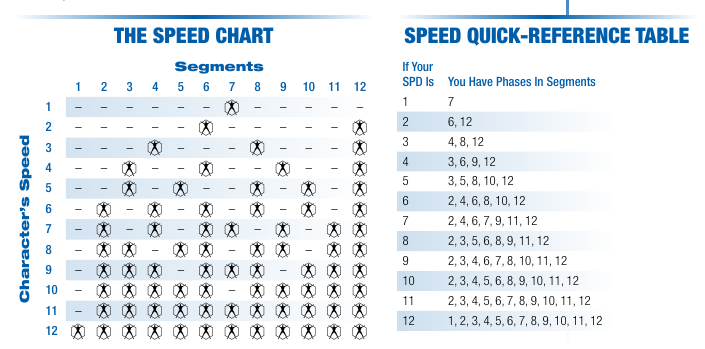
HERO divides each Turn into 12 one-second Segments. Each combatant can act once on a number of Segments determined by his Speed. Combatants with actions on the same Segment take their actions in order of Initiative. In short, speedy characters can take many more actions than slow characters. I don't think this really solves the interactivity issue, but I do think it's neat that it can reflect differences in speed more gradually than the typical system in which the ratio must immediately jump to 2:1. See the chart below.
I can't remember which off the top of my head (maybe Storyteller systems), but I know some RPGs use Ticks: each type of action takes a different number of Ticks, so it's possible to start a long action and then whiff or get interrupted if the target acts before the action finishes. I don't know if any of them have a secrecy component as WeGo does.
I think I remember reading that Dungeon World, one of the innumerable Powered by the Apocalypse non-games, explicitly has no turn system. The players, with the GM's assistance, are expected to fall into a sort of natural rhythm, declaring actions when dramatically appropriate. Obviously, this doesn't work in a real game.
What's your favorite and why? What sort of game is supported best by each type?
If there's an important type I've missed, let me know and I'll edit the poll.