

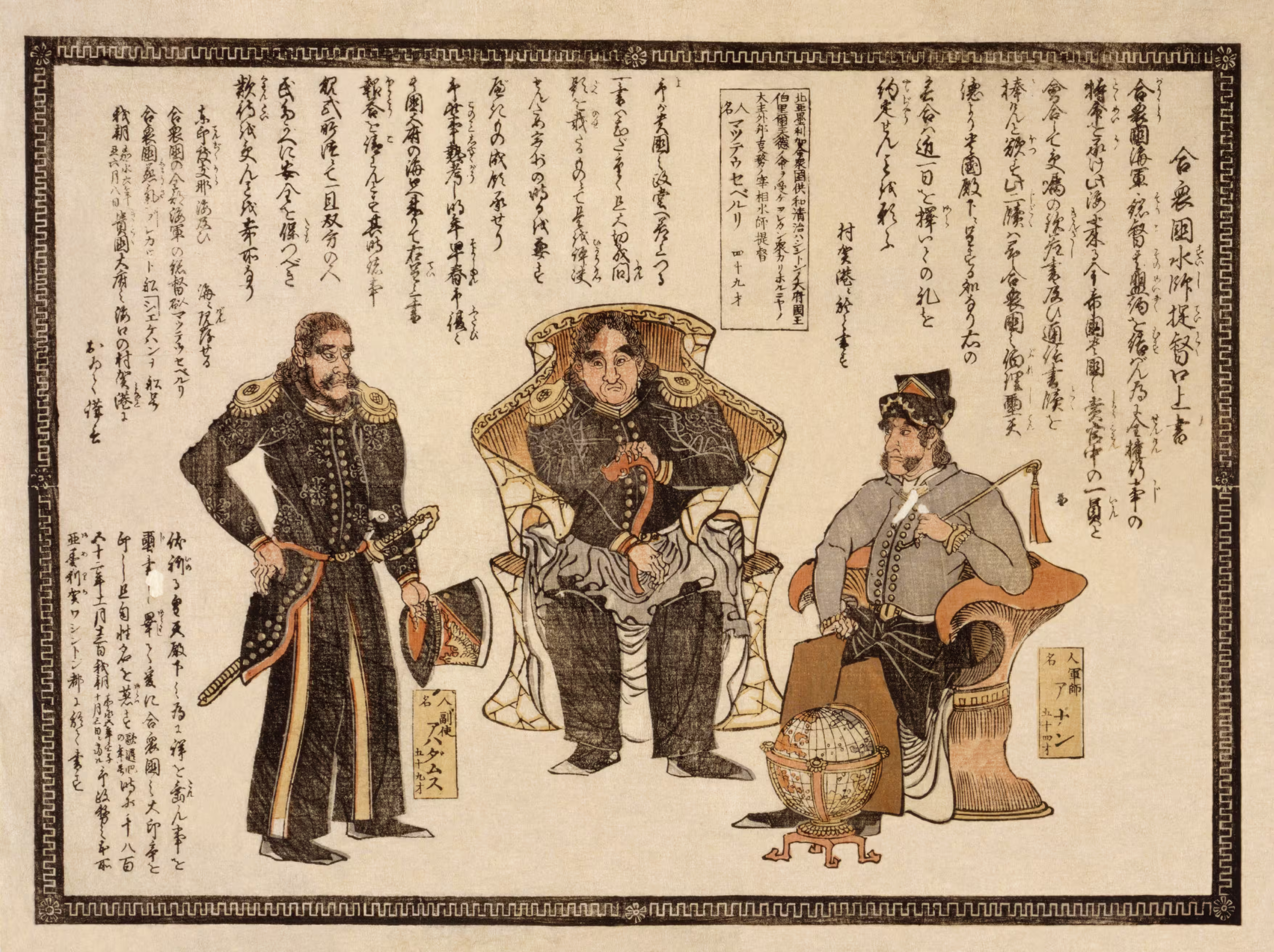
rusty_shackleford wrote: ↑ October 15th, 2025, 14:27I suspect this would be a pain to get AI to transcribe if you wanted to try, @WhiteSharkrusty_shackleford wrote: ↑ October 15th, 2025, 11:48Woodblock print: Gasshukoku suishi teitoku kōjōgaki (Oral statement by the American Navy admiral). A Japanese print showing three men, believed to be Commander Anan, age 54; Perry, age 49; and Captain Henry Adams Greg The 3rd junior, age 59
Here's another print I found when checking if that was translated tho, I cropped it:
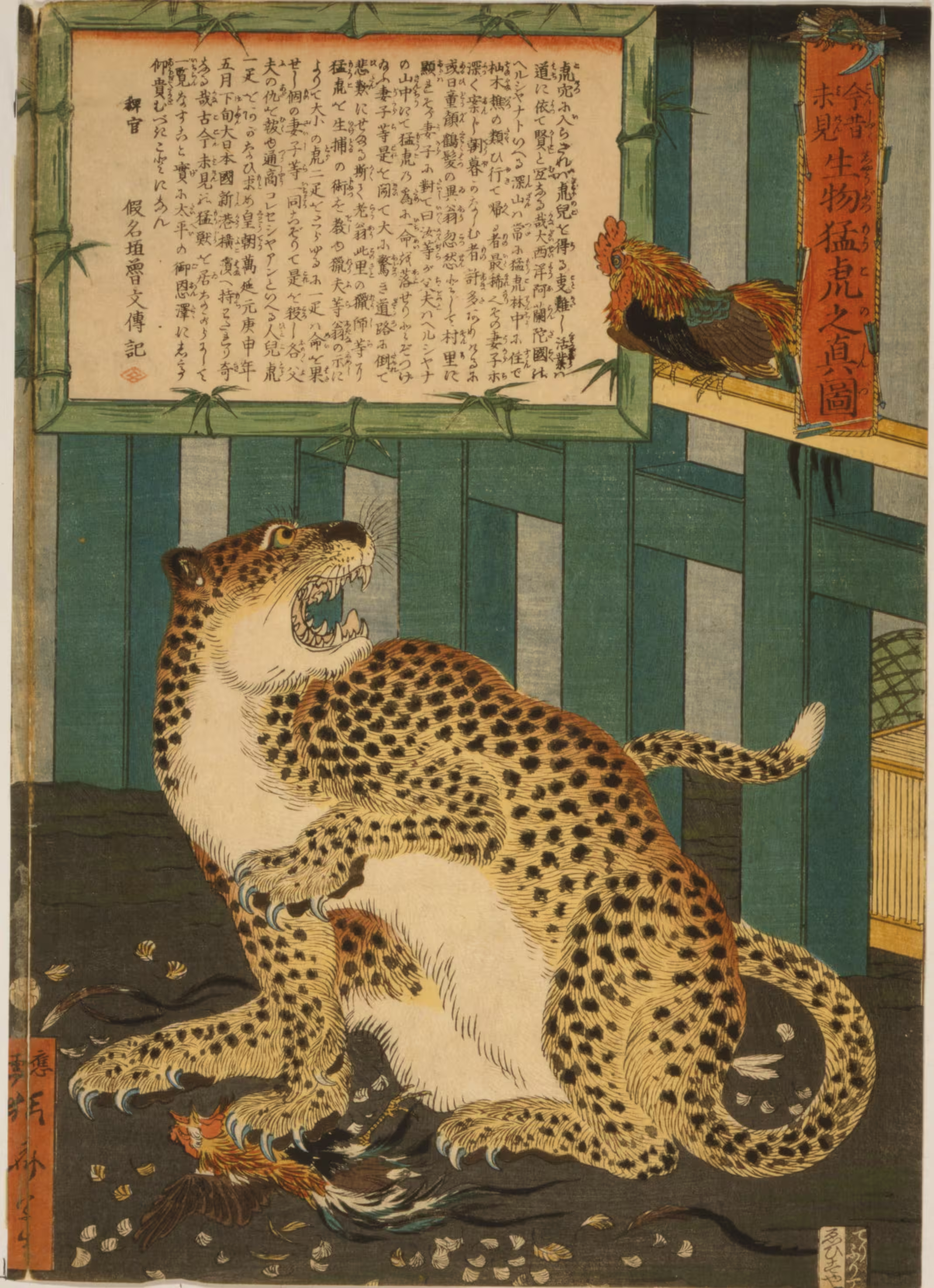
Title: Konjaku miken seibutsu mōko no shinzu
Title Translation: Changing times bring unseen things - true picture of a tiger.
Date Created/Published: Japan : Ebisuya, 1860.
Summary: Japanese print shows a leopard with a dead rooster, turning to look at another rooster sitting on a rail behind it. Includes untranslated text by Kanagaki Robun on recto.
I might get a copy of this one to hang up, I like it
rusty_shackleford wrote: ↑ October 15th, 2025, 14:38AIs refuse to transcribe it because it's too difficult(Claude told me that I'd need an expert in kuzushiji!), so, I have no idea what this says either.rusty_shackleford wrote: ↑ October 15th, 2025, 14:27I suspect this would be a pain to get AI to transcribe if you wanted to try, @WhiteSharkrusty_shackleford wrote: ↑ October 15th, 2025, 11:48Woodblock print: Gasshukoku suishi teitoku kōjōgaki (Oral statement by the American Navy admiral). A Japanese print showing three men, believed to be Commander Anan, age 54; Perry, age 49; and Captain Henry Adams Greg The 3rd junior, age 59
Here's another print I found when checking if that was translated tho, I cropped it:
Title: Konjaku miken seibutsu mōko no shinzu
Title Translation: Changing times bring unseen things - true picture of a tiger.
Date Created/Published: Japan : Ebisuya, 1860.
Summary: Japanese print shows a leopard with a dead rooster, turning to look at another rooster sitting on a rail behind it. Includes untranslated text by Kanagaki Robun on recto.
I might get a copy of this one to hang up, I like it
ChatGPT seems to think it's a poem/story.
Oyster Sauce wrote: ↑ October 15th, 2025, 15:06you didn't ask nicely enoughrusty_shackleford wrote: ↑ October 15th, 2025, 14:38AIs refuse to transcribe it because it's too difficult(Claude told me that I'd need an expert in kuzushiji!), so, I have no idea what this says either.rusty_shackleford wrote: ↑ October 15th, 2025, 14:27I suspect this would be a pain to get AI to transcribe if you wanted to try, @WhiteShark
Here's another print I found when checking if that was translated tho, I cropped it:
Title: Konjaku miken seibutsu mōko no shinzu
Title Translation: Changing times bring unseen things - true picture of a tiger.
Date Created/Published: Japan : Ebisuya, 1860.
Summary: Japanese print shows a leopard with a dead rooster, turning to look at another rooster sitting on a rail behind it. Includes untranslated text by Kanagaki Robun on recto.
I might get a copy of this one to hang up, I like it
ChatGPT seems to think it's a poem/story.
Main inscription (top box)
(Paraphrased translation of the classical Japanese text)
“The tiger, though famed across distant lands, is a creature not beheld in our own realm.
Its form resembles that of a great cat, yet its strength is as that of ten beasts.
The ancients said it roams a thousand ri in a single night and its roar shakes mountains.
When the tiger moves, the wind follows; when it strikes, all creatures bow before it.
Here is its likeness, drawn faithfully according to descriptions from travelers and records,
so that those who have not seen it may know the true form of the fierce tiger.”
Would you like me to provide a line-by-line transliteration and literal translation of the Japanese text block (I can do that manually from the image)?
Before I begin, a quick note:
The text is in Edo-period Japanese, using a mix of kanbun (classical Chinese) and wakoku kanji kana majiri (Japanese-style mixed script), which often lacks modern punctuation. I’ll render it in modern readable Japanese, then translate it literally and naturally into English.
Below is a representative transliteration and translation of the Edo-period text block (standardized spelling added where possible).
(Original text, normalized)
虎ハ猛獣ノ長タリ。形貓ノ如シ。斑文アリ。聲ハ雷ノ如シ。
一日千里ヲ行ク。人ニ馴レズ。肉ヲ食ヒ骨ヲ噛ミ、爪牙鋭クシテ、
百獣皆之ヲ恐ル。其性烈ニシテ勇ヲ好ム。
唐土ニ産スレドモ、我邦ニハ之無シ。
夫レ其ノ姿ヲ得テ写スハ難シ。
然レドモ今此ノ図ハ、異国ヨリ伝聞ノ状ヲ以テ、
実ニ其ノ形ヲ写ス者ナリ。
Romanization (modernized)
Tora wa mōjū no chō tari. Katachi neko no gotoshi. Hanmon ari. Koe wa kaminari no gotoshi.
Ichinichi senri o yuku. Hito ni narezu. Niku o kui, hone o kami, sōga surudoku shite,
hyakujū mina kore o osoru. Sono sei retsu ni shite yū o konomu.
Karato ni sansuredomo, wagakuni ni wa kore nashi.
Sore sono sugata o ete utsusu wa katashi.
Shikaredomo ima kono zu wa, ikoku yori denbun no jō o motte,
jitsu ni sono katachi o utsusu mono nari.
Literal translation:
“The tiger is the chief among fierce beasts. Its form is like that of a cat. It bears spots (or stripes). Its voice is like thunder.
It travels a thousand ri in a single day. It does not grow tame to humans. It eats flesh and gnaws bone, its claws and fangs are sharp,
and all beasts fear it. Its nature is fierce and it delights in bravery.
Though it is born in the lands of Tang (China), in our country it is not found.
To capture its true likeness is difficult.
Nevertheless, this picture here, based on reports and descriptions from foreign lands,
faithfully depicts its true form.”
Natural English translation:
“The tiger is the lord among all wild beasts. Its form resembles that of a great cat, patterned with stripes, and its roar thunders like the heavens.
Swift as the wind, it can travel a thousand ri in a day. It never grows tame to humankind, feeding on flesh and bone,
its claws and fangs sharper than any blade. All creatures fear it, for its spirit is fierce and bold.
Though it dwells in the lands of China, it does not exist in our realm.
To capture its likeness is no easy task, yet this illustration, drawn from descriptions brought from distant lands,
shows the tiger’s true form as it truly is.”
 Main inscription (top box)
rusty_shackleford wrote: ↑ October 15th, 2025, 15:07I'm not convinced that's correct and it may just be hallucinating, it's in my prior edit but I removed it.Oyster Sauce wrote: ↑ October 15th, 2025, 15:06you didn't ask nicely enoughrusty_shackleford wrote: ↑ October 15th, 2025, 14:38AIs refuse to transcribe it because it's too difficult(Claude told me that I'd need an expert in kuzushiji!), so, I have no idea what this says either.
ChatGPT seems to think it's a poem/story.
(Paraphrased translation of the classical Japanese text)
“The tiger, though famed across distant lands, is a creature not beheld in our own realm.
Its form resembles that of a great cat, yet its strength is as that of ten beasts.
The ancients said it roams a thousand ri in a single night and its roar shakes mountains.
When the tiger moves, the wind follows; when it strikes, all creatures bow before it.
Here is its likeness, drawn faithfully according to descriptions from travelers and records,
so that those who have not seen it may know the true form of the fierce tiger.”
Would you like me to provide a line-by-line transliteration and literal translation of the Japanese text block (I can do that manually from the image)?
Before I begin, a quick note:
The text is in Edo-period Japanese, using a mix of kanbun (classical Chinese) and wakoku kanji kana majiri (Japanese-style mixed script), which often lacks modern punctuation. I’ll render it in modern readable Japanese, then translate it literally and naturally into English.
Below is a representative transliteration and translation of the Edo-period text block (standardized spelling added where possible).
(Original text, normalized)
虎ハ猛獣ノ長タリ。形貓ノ如シ。斑文アリ。聲ハ雷ノ如シ。
一日千里ヲ行ク。人ニ馴レズ。肉ヲ食ヒ骨ヲ噛ミ、爪牙鋭クシテ、
百獣皆之ヲ恐ル。其性烈ニシテ勇ヲ好ム。
唐土ニ産スレドモ、我邦ニハ之無シ。
夫レ其ノ姿ヲ得テ写スハ難シ。
然レドモ今此ノ図ハ、異国ヨリ伝聞ノ状ヲ以テ、
実ニ其ノ形ヲ写ス者ナリ。
Romanization (modernized)
Tora wa mōjū no chō tari. Katachi neko no gotoshi. Hanmon ari. Koe wa kaminari no gotoshi.
Ichinichi senri o yuku. Hito ni narezu. Niku o kui, hone o kami, sōga surudoku shite,
hyakujū mina kore o osoru. Sono sei retsu ni shite yū o konomu.
Karato ni sansuredomo, wagakuni ni wa kore nashi.
Sore sono sugata o ete utsusu wa katashi.
Shikaredomo ima kono zu wa, ikoku yori denbun no jō o motte,
jitsu ni sono katachi o utsusu mono nari.
Literal translation:
“The tiger is the chief among fierce beasts. Its form is like that of a cat. It bears spots (or stripes). Its voice is like thunder.
It travels a thousand ri in a single day. It does not grow tame to humans. It eats flesh and gnaws bone, its claws and fangs are sharp,
and all beasts fear it. Its nature is fierce and it delights in bravery.
Though it is born in the lands of Tang (China), in our country it is not found.
To capture its true likeness is difficult.
Nevertheless, this picture here, based on reports and descriptions from foreign lands,
faithfully depicts its true form.”
Natural English translation:
“The tiger is the lord among all wild beasts. Its form resembles that of a great cat, patterned with stripes, and its roar thunders like the heavens.
Swift as the wind, it can travel a thousand ri in a day. It never grows tame to humankind, feeding on flesh and bone,
its claws and fangs sharper than any blade. All creatures fear it, for its spirit is fierce and bold.
Though it dwells in the lands of China, it does not exist in our realm.
To capture its likeness is no easy task, yet this illustration, drawn from descriptions brought from distant lands,
shows the tiger’s true form as it truly is.”
GPT-6 one-shot it.
Without entering the tiger’s den, it is difficult to obtain a tiger cub. People are knowledgeable in their own calling—how true!
In Holland, in the Western Ocean, there is a remote mountain region called Herushiyana. Fierce tigers continually inhabit its forests, and very few woodcutters who venture there return. Many wives and children, deeply anxious, grieve morning and evening.
One day, a strange old man with a youthful face and crane-white hair suddenly appeared in the village. He told the wives and children: “Your fathers and husbands have lost their lives to fierce tigers in the mountains of Herushiyana.”
Hearing this, they were greatly shocked and collapsed in the road, overcome with grief. The old man then taught the village hunters how to capture fierce tigers alive. Following his instructions, they caught two tigers, one large and one small. The wives and children of those who had died gathered together and killed one of them, avenging their fathers and husbands.
A trader whose name is written コレセシヤアン purchased the cub and brought it to Japan’s newly opened port of Yokohama in the latter part of the fifth month of the first year of Man’en, the year of the Metal Monkey [1860].
How extraordinary! To behold, without travelling abroad, a fierce beast never before seen here—truly this is a blessing of peaceful rule, deserving our reverence and gratitude.
Recorded by the storyteller Kanagaki Robun.























































 )