



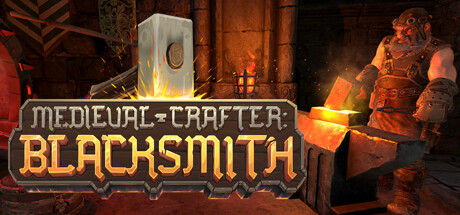
Game version 1.0.3. Product key provided by the developer.
Overview
Tirelessly working at the forge with all your tools is the core aspect of the game and such is made abundantly clear right from the beginning. It knows what it is and does not shy from forgoing anything but a barebones tutorial story just to get you acquainted with the mechanics. You are then let loose in your quest to craft progressively stronger equipment.
Yet even this simplistic gameplay loop seems to have been too ambitious of a goal. For reasons explored further below, to be a blacksmith in this game is a mind-numbing and unrewarding experience in great part due to it being an unfinished product, contrary to what leaving Steam's Early Access stage might imply.
Visuals
The main menu greets you with the inside of a blacksmith's workshop, giving you a glimpse into what you will soon be familiar with in the game. A building's interior, the player model, equipment, tools. It's a fine window to have as the first thing the player sees.
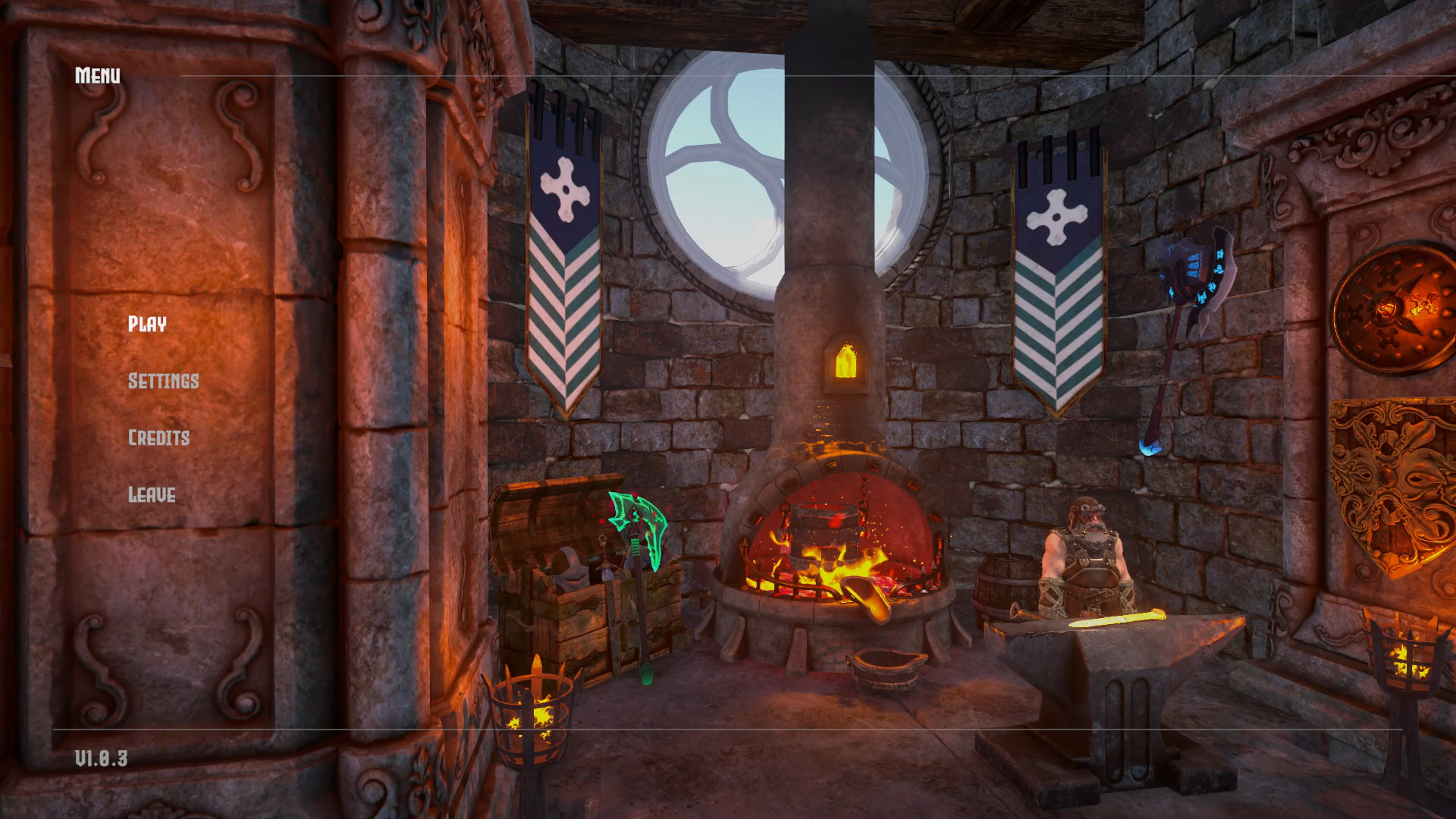
Cool shields, shame you can't craft them.
The armor sets all look simple and clean, the type that you might find in any regular old medieval setting. The weapons, bar a few exceptions among the lower-tier ones, look very exotic and downright fantastical for the most part, like they're straight out of a cartoony MMORPG. This clash of aesthetics does not mix well, and the first few times I noticed this jarring mismatch in the equipment my fighters were wearing, I actually had to check whether I had given them the correct armor. I did, but it was still hard to believe the weapon and the armor were of the same quality tier. This lack of aesthetic cohesion leaves a sour taste after all the work put into crafting the gear, only to see this disappointing end result.
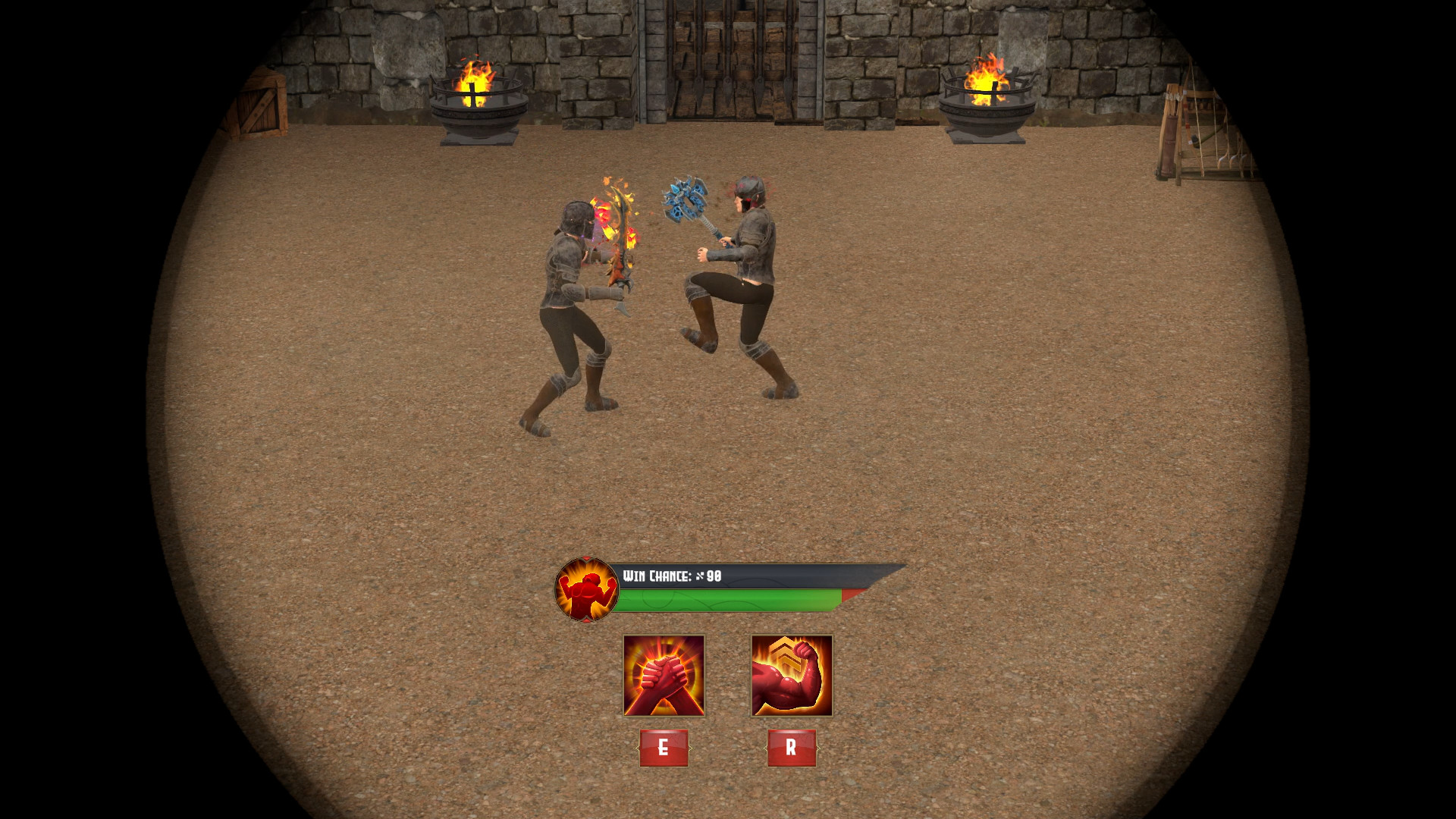
It's okay, fire beats ice. Oh, what's that? Elements don't matter? Oh, well at least they look cool... Wait, where are their leggings?
The texture work is mediocre, with some particular NPCs looking downright unfinished as their half-open mouths and fluoride stares leave me holding my wallet a little bit tighter when making my way to the forge, tiptoeing my way to avoid the JPG puddles lest I be absorbed into the file. And there are some glitched textures such as on one of the hammer heads, which is kind of hard to miss when it's in front of your face.
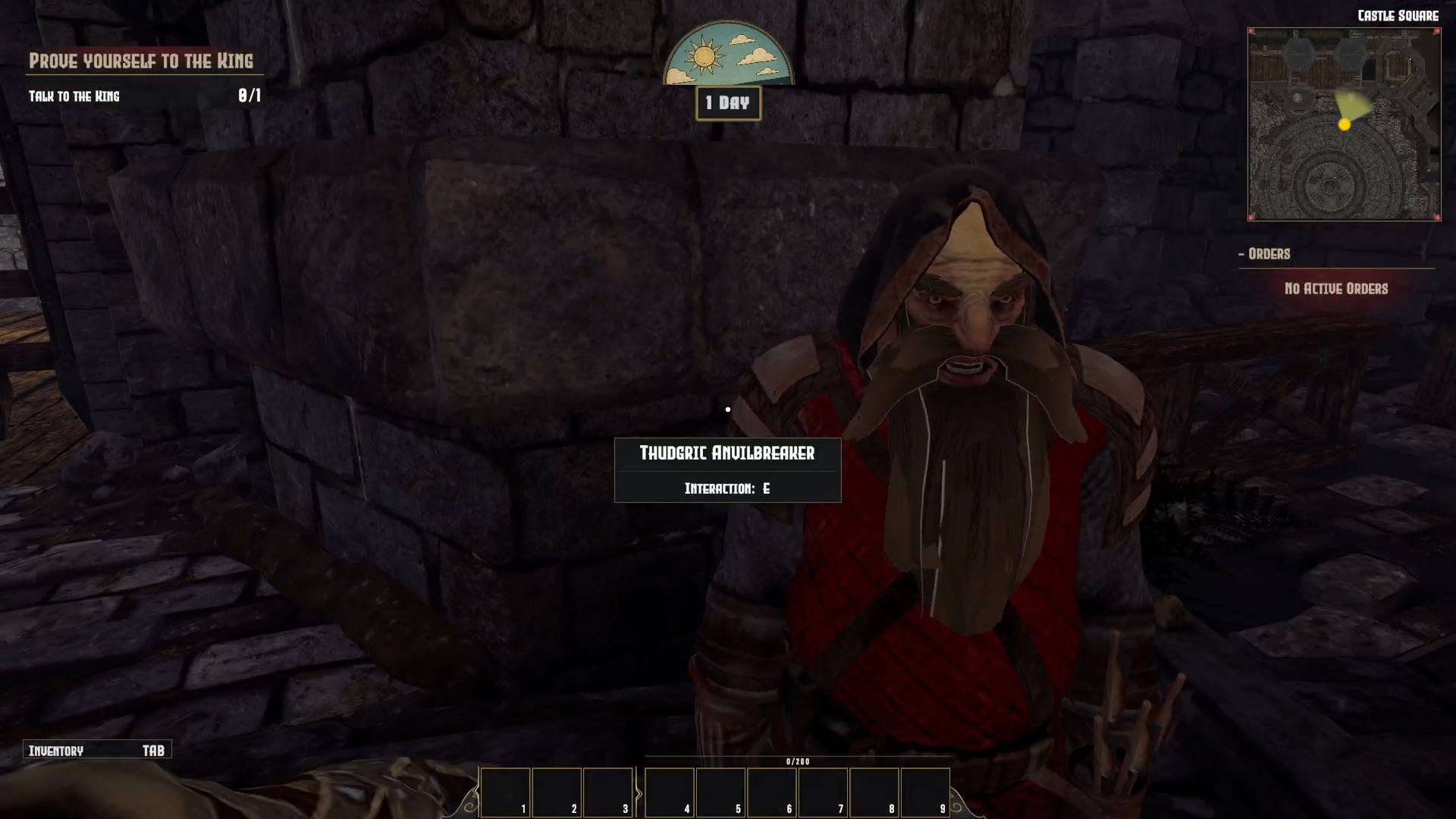
The Royal Blacksmith. No wonder he's retiring.
The animations are also nothing to write home about. One exception is the walking animations; they leave me with no choice but to believe someone spilled oil all over the floor seeing how easily everyone slides across the cobblestone.
But for all these flaws, I must say the visual design is quite decent. With proper texture work and some better looking NPCs, the town square might actually look slightly deserving of being the center of the kingdom as it's supposed to be, especially with the enormous statue in the middle. The village where you sleep, with its occasional broken fences and bountiful green, might have been a good spot to take a breather and relax in. The ancient forest where you enchant equipment might have looked as magical as it's supposed to be, instead of just another patch in the woods.
Unfortunately, the visuals are clearly an afterthought, though thanks to the solid design behind the locations, there's a foundation here that could easily be improved upon.
Audio
Despite there not being much audio overall, what little there is ended up being much more polished than the visuals or the writing. There's a few ambient tracks that are adequately immersive in a medieval fantasy way, helping you feel the tone of the setting. The main activity of the game, smithing, is accompanied with satisfactory sound effects for most of your actions, be it striking, quenching, fanning the flames, etc. And regarding voicing, while the dwarven smith the player controls is the only voiced character, he is brought to life quite well, his voicelines triggering according to what he's doing or who he's talking to. I actually chuckled a bit when I was removing equipment from my elf adventurer and suddenly heard a gruff voice saying, "Never trust an elf."
The only audio-related annoyance I can point to is the loud CLANG sound effect that plays every time you change locations. Not changing the entire zone, no, just simply going from the inside of the smithy to the outside, for example. It quickly becomes excessive.
Writing
As a simulator video game, not much is expected from the literary department, as that's not a selling point in these types of games anyway. And accordingly, there is no story at all outside of the tutorial. The Royal Blacksmith is retiring and the King summons you to learn from him and take over his smithy. That's it, that's how the game starts, no beating around the bush. This retiring dwarven smith then takes you as his apprentice and shows you the ropes. After he's done his job, you never hear from him again, nor from the king or anyone else for that matter. The story is effectively over, and you are free to do as you please. You are then presented with a questlog giving you generic progression objectives that guide you along until you complete all content available in the game.
Gameplay
On to the meat of the matter. True to its name, this game has you craft medieval equipment in your smithy, primarily using your mouse to interact with the tools at your disposal. This involves acquiring raw metal either from the mines, vendors or as rewards from adventuring, melting it into the appropriate shape, and assembling it together with other materials.
Being a simulator type game, I never expected significant depth to its mechanics. And yet even with these low expectations, the minigames involved managed to surprise me with how horribly simplistic they are. Only forging and sharpening offer any semblance of a challenge. Forging requires you to hit specific spots on the metal to shape it correctly, while sharpening requires a properly angled, even application across the blade lest you lower the rarity. The remainder of the mechanics in your smithy just involve a lot of mindless drag and drop, incessantly and unabashedly.
A short core loop, back and forth. Back and forth. More customers, more items, back and forth.
This would be less of an issue if there were some way to speed up the process, and while technically there are nodes in your tiny skill tree that speed up forge heating and mining, I found the difference to be rudimentary. The overwhelming majority of the crafting process remains a slog. On top of that, the enchantment table is unnecessarily divorced from the rest of the workshop. Making me walk all the way there for that final part of the crafting process each and every time feels like the game was intentionally going out of its way to annoy me with filler segments. At a certain point I just stopped enchanting my gear; the difference it made in the final product just wasn't worth the trek.
All of this process has a purpose: the equipment. The great final product. Where does this product go? Well, it depends on your goal. If you want to make money, which is needed to hire adventurers, buy materials and several other things, you need to sell it. And there is only one main source of money: customers. There are customers that request specific items with specific stats, and there are others that just buy whatever you put on your racks to sell. The former, with its elevated requirements, should naturally reward you more handsomely, right? Well, this is not the case.
Despite having stricter criteria, the customers wanting special orders do not, in fact, pay more handsomely than the ones that just buy things off the shelf. The only upside is that they also offer a small amount of materials as rewards, which is honestly virtually worthless unless they're offering particularly rare materials, and those offers only start appearing much, much later. So for the vast majority of the game, you are actively encouraged to refuse customer orders and just pump out whatever is more expensive to sell and profit quickly. There is no difference between the speed at which items of different price tags are sold. You'd think cheaper equipment would fly off the shelves and more expensive parts would have fewer potential buyers, but this was not my experience. Once again, the game shows itself more simplistic in practice than in theory.
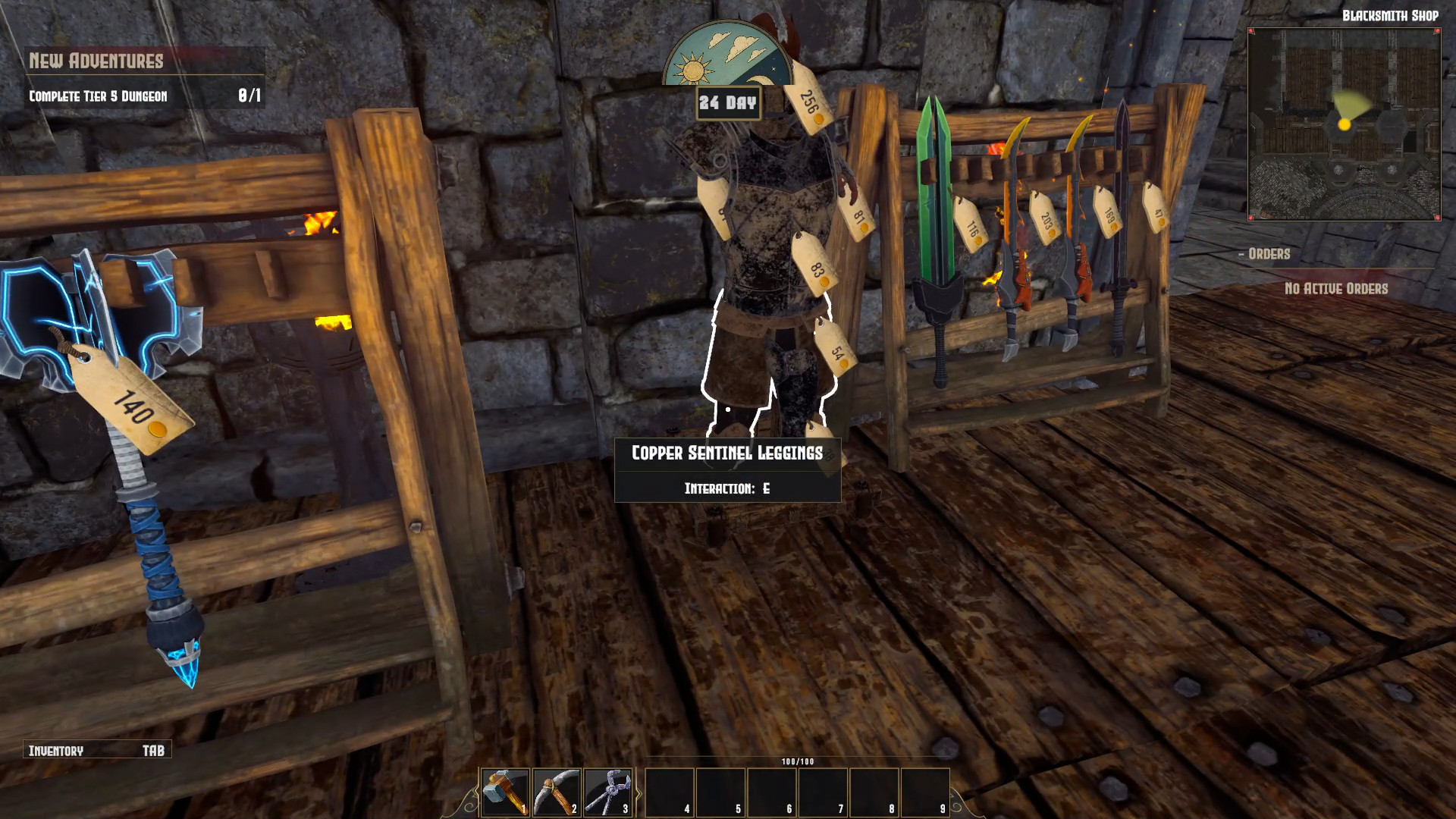
Hope these racks are fireproof...
Okay, on to adventurers then. Your hirelings that actually fight in the dungeons and the arena, your minions. You hire them at an increasingly higher price and they each have their own classes and personal traits, the former affecting their base stats and the latter their chance of success in specific dungeons. Yet, in practice, these aspects are mostly reduced to flavor text. Their equipment will make up for over 80% of their final stats, making classes and traits practically worthless.
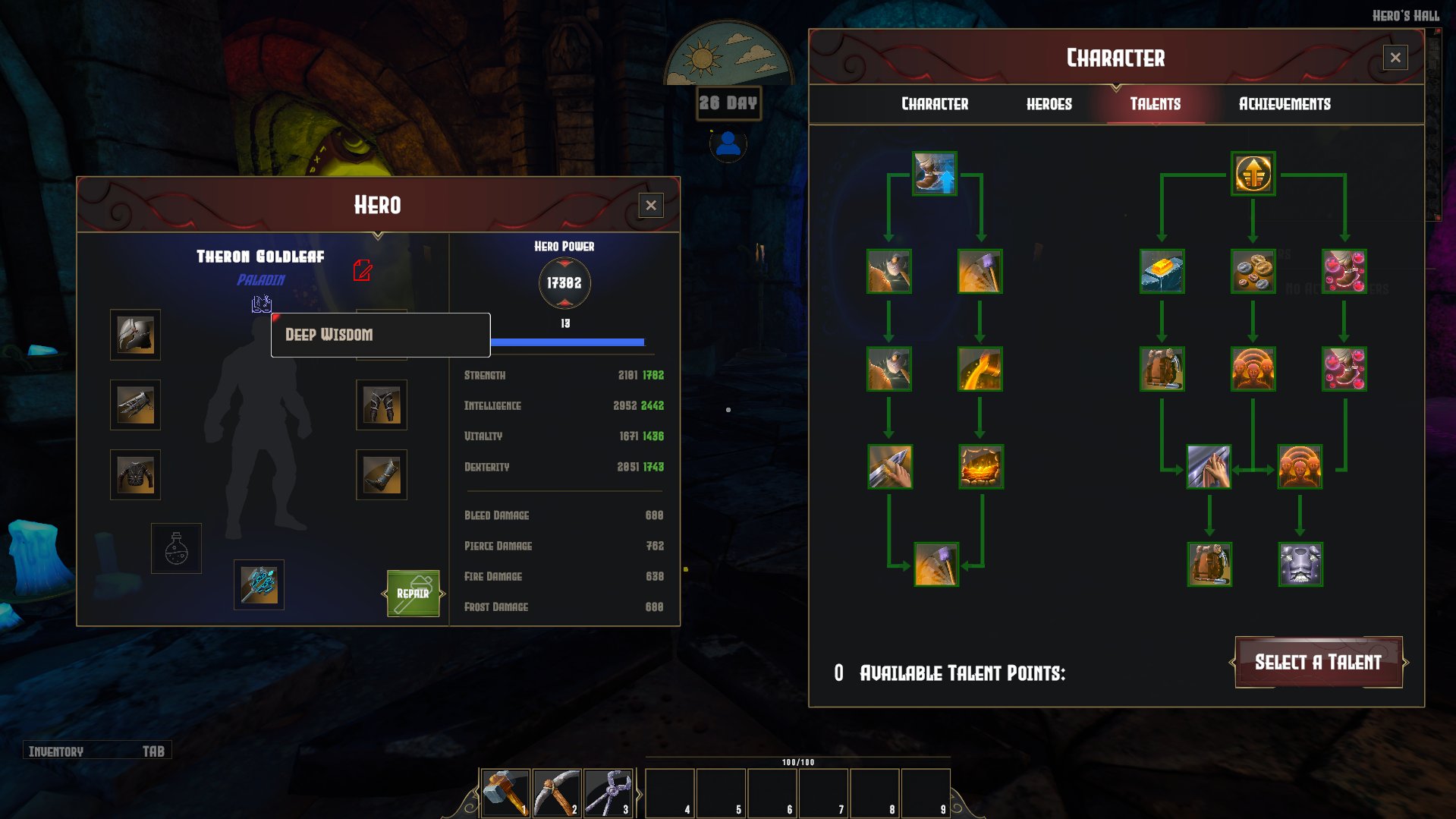
Ah yes, your typical Paladin. Known for his high... intelligence and low vitality?
This simplicity is reflected in how little thought is needed to clear the dungeons, which range from Tier 1 to Tier 5 in order of difficulty, similarly to equipment rarity in order of quality. An adventurer's stats all contribute to a final number which makes up his Hero Power. Each dungeon has a Required Hero Power value, and as long as you hit that minimum, be it with a single adventurer or through a party of up to 3, you clear the dungeon, no questions asked, nothing else involved. No need to care about classes, traits, specific stats (of which there are several) or anything else. Just off the top of my head, even something as rudimentary as needing an 800 fire damage weapon for clearing an ice dungeon would make the adventuring infinitely more engaging than it currently is. As it stands, just make higher tier equipment and you're done.
Not to mention that the Tier 5 (and final) dungeon is beatable with Tier 3 equipment. So not only is the main goal of the game tediously straightforward, there is also no point to crafting Tier 4 and 5 equipment at all, which comprises 40% of the gear in this blacksmithing game. Allow me to reiterate: The endgame gear has no endgame content to be used on. Coincidentally, when browsing items to forge, items of Tier 3 to 5 all have the same rarity color, yellow, and rarity classification, "Legendary", despite there being a vast stat difference between them. This leads me to believe Tiers 4 and 5 were very hastily and recently added to the game with little thought as to how they would add to the experience.
Well, there must be some challenge in the Arena, right? There is, but it's also shoddily implemented. The arena tournament comes in 4 versions of increasing difficulty, each with an appropriate minimum Hero Power required. Problem is, the combatants always scale to your adventurer's Hero Power, no matter the stage selected. So if you picked a 2000 power stage and signed up an 8000 power adventurer, suddenly you're equally matched with your opponents. And since the outcome of the fight is determined by a flat percentage reflecting the discrepancy in Hero Power between your adventurer and your opponent, no matter how much you improve, how good your equipment is, how strong your adventurer is, the enemy will always scale up to your power and make each arena fight outcome a 50-50 coin flip.
I won by exploiting the system and signing up my adventurer without equipment, then equipping him after the opponent had already scaled, but the design choice is still beyond absurd. Or was it even a design choice? Why would you have different arena tiers if the enemy always scales? Might this scaling be an error in the system? Who knows.
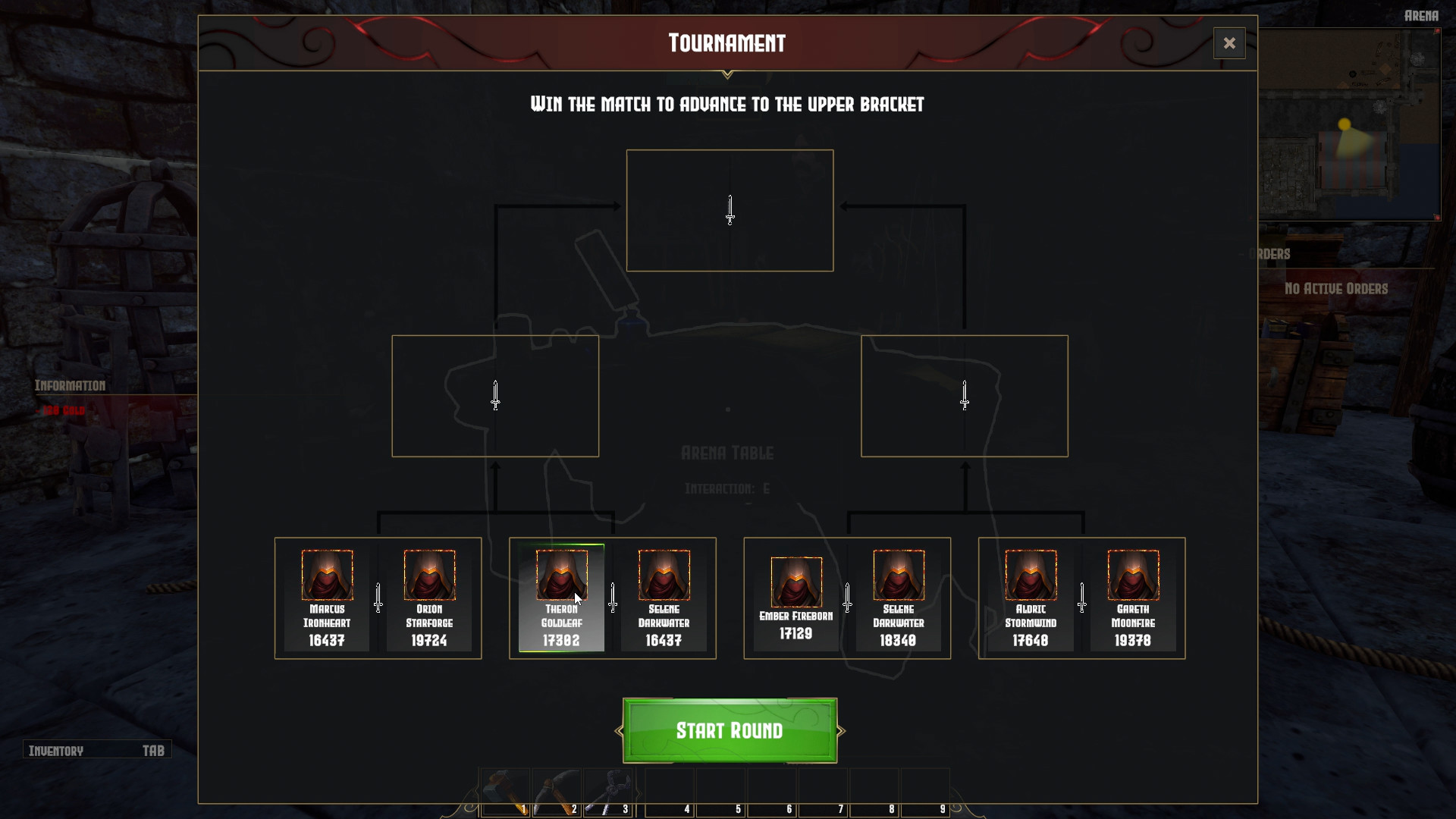
Your small 2000 Hero Power local tournament, sir.
Okay, so no challenge in the mechanical aspects of the crafting procedure, no challenge in the end goals of the game itself... surely, there must be something engaging about this title? Oh look, there's a day and night cycle. You have to go to bed after a certain hour, as there won't be shopkeepers or customers around to trade with anymore. Maybe management may be the real game here. Buying materials and selling products, a good shopkeeper may have to balance a tight budget to meet strict deadlines, right?
Well, no. There is no kind of overarching time limit so you are free to endlessly mine metals and just wait for shops to restock. The only kind of deadline to put pressure on you is from customers with specific requests, and those are incredibly generous anyway, not to mention completely optional. So there's a day-night cycle and you have to go to bed for... no reason. I guess +1 roleplay points. Another aspect of the game that could have been far more fleshed out than it is.
Oh and there's a random chair inside the castle that seems to be interactable but is not, surrounded by an invisible wall that staves off curiosity. And it's not hidden either, just sitting there in a huge open room with purple flames. This, along with all other examples provided above, lead me to believe this game was released from Early Access far, far too prematurely.
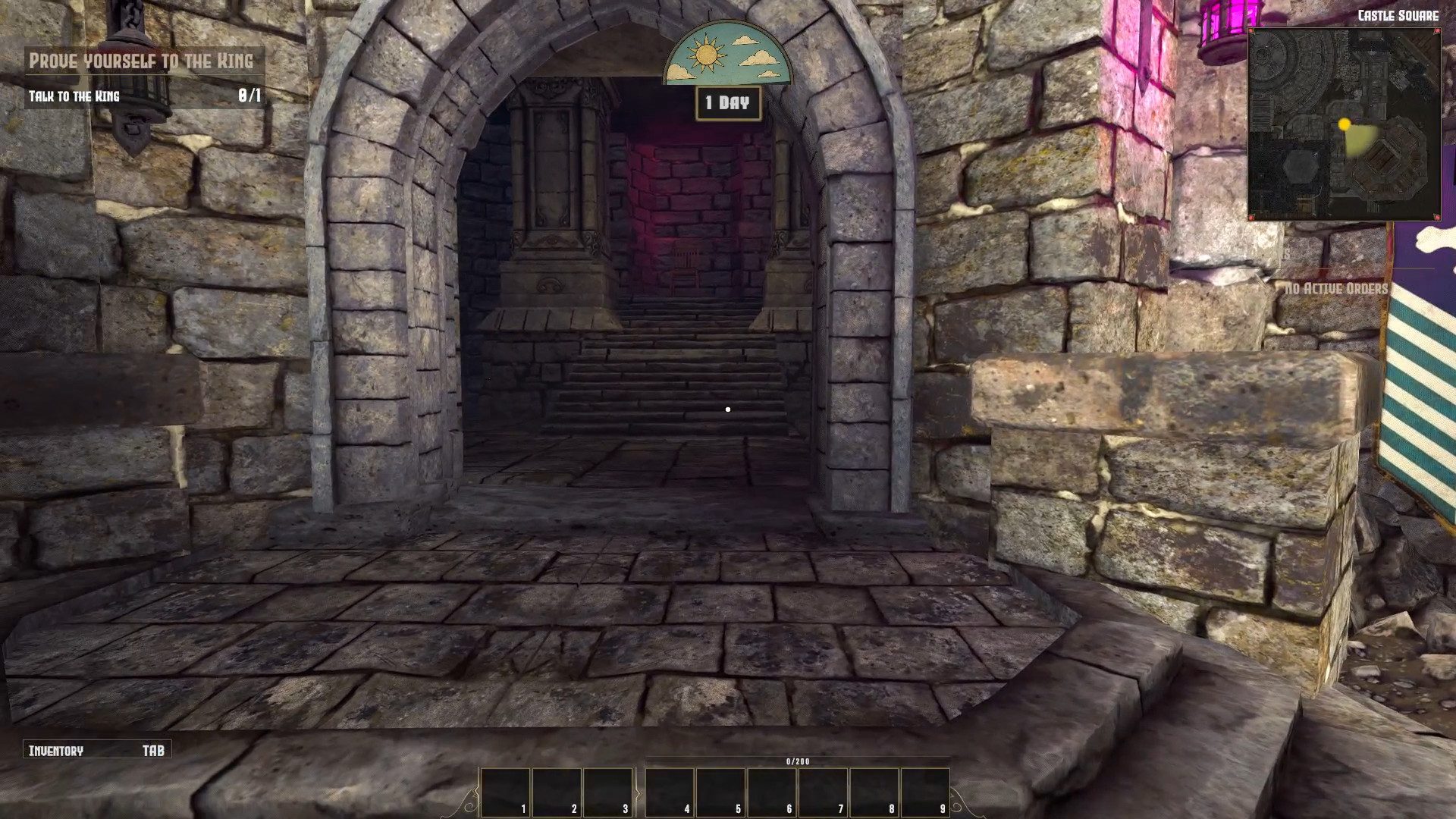
It's just... sitting there. Menacingly.
Final Thoughts
Completing the two major goals you set out to achieve, clearing both the dungeons and the arena with your adventurers wielding the fruits of your labour, feels incredibly unfulfilling, and neither the crafting procedure nor the smithy's management feel challenging in the slightest. In a game focused around progression, the only paltry approximation of it is in the numbers and the weapons' appearance. The final dungeon is just like the first dungeon with a higher power requirement, while the final arena stage is functionally the same as the first stage. After you're done with the couple hour tutorial in the beginning, you have every tool unlocked, so there is no difference between the gameplay loop during hour 3 and hour 12. Honestly if you completed the tutorial, you've essentially completed the game, because there is nothing new, different or challenging to look forward to.
It's not all bad, seeing as I scavenged some enjoyment out of the shop and adventuring management aspect, optimizing my profits and progression in as little time as possible in lieu of a hard deadline. That and the vague notion that this was a short game probably pulled me through the experience. And while the journey to finish the questlog was brief, it deserved to be far shorter with how little meaningful content there actually is.
To be honest, I really wanted to like this game. Seeing how you are allowed to have up to 7 adventurers and dungeons could only take 3 participants at most, I was kinda hoping to later unlock some new adventure type that incorporated a larger party, maybe like raids or dragon hunts or town defenses or something, maybe those would be the real challenge and have some new mechanics I can't just stat-check or would force me to consider class synergy of some kind in order to overcome.
But no. Tier 5 Dungeontm is the best we got. I like this game's premise decently enough, but it was just not executed well at all.
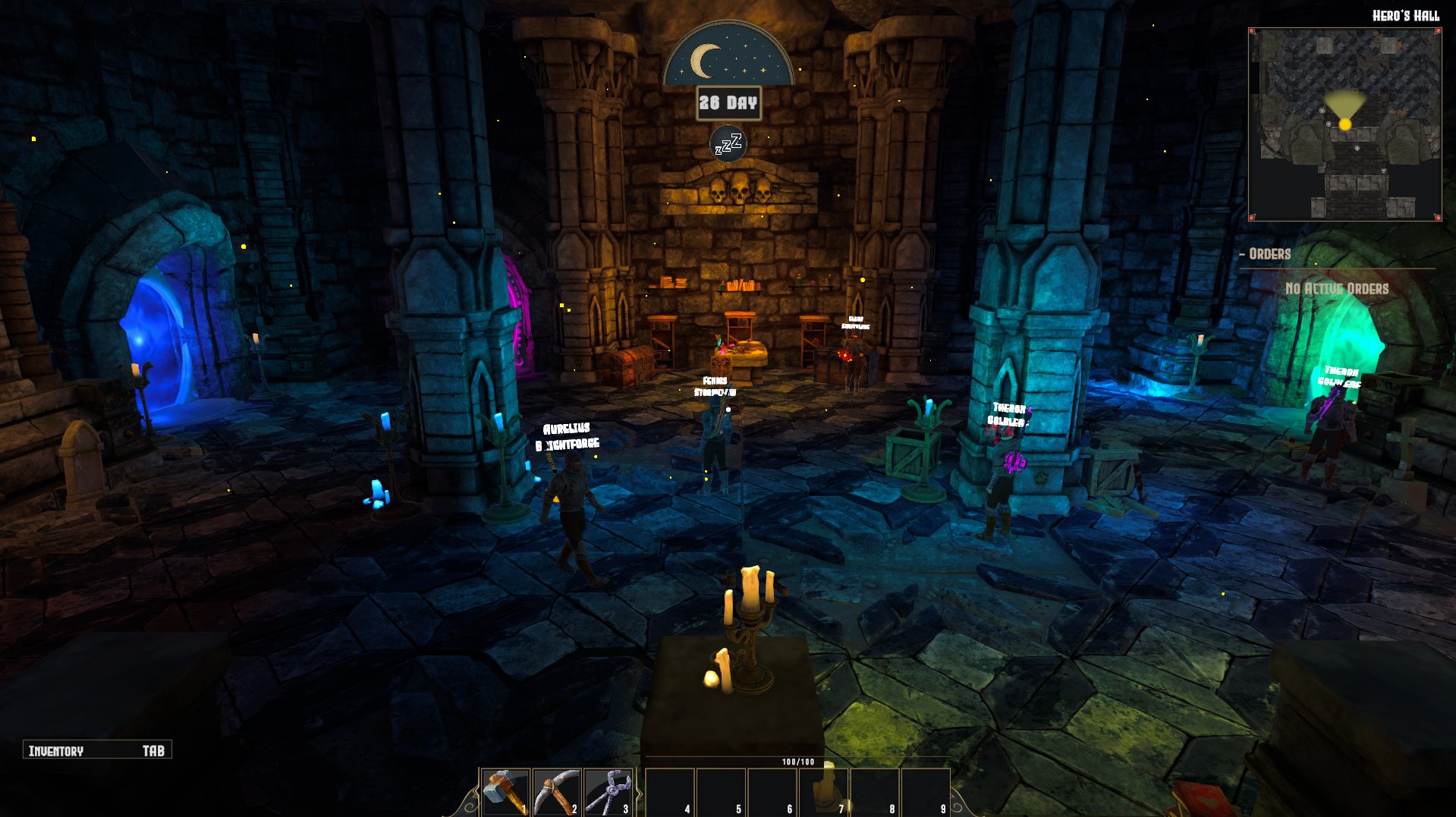
Good night, my dear personal band of murderers-for-hire. You deserved more exciting adventures.
A lot of its shortcomings would have made much more sense if this were an Early Access title, but it is not. I truly am at a loss as to who might be the target audience for this. The crafting process is both too involved to let the shopkeeping aspect take the spotlight, possibly allowing this to be more of a management simulator, and too shallow to be the satisfying crafting simulator it presents itself as. It feels as if the developers did not know which direction to go with, resulting in a half-hearted mix that is neither realistic and immersive as a simulator is supposed to be, nor is it fun and engaging as a game is supposed to be. The gameplay is not stimulating, progression is shallow and unrewarding, and the world looks like a half-baked amalgamation of free 3D assets. Maybe players completely enamored with blacksmithing will enjoy this more than I did. Even then, surely other titles are more deserving of quenching that thirst.
Overall this is quite the Low Quality game, one which truly makes me feel like indie game developers might be relying on AI a bit too much.
Visuals - 4/10
Audio - 6/10
Story - N/A
Gameplay - 3/10
Overall - 3/10








 Still haven't played the thing past the intro, but that is an alluring development