


Dungeons & Dragons 4th edition listed power sources for each class. (Divine for Clerics, Arcane for Wizards, and so on.) These were largely just flavor because they didn't have an impact on mechanics. There were no feats that said "martial classes only" or "+1 to elemental power source attacks". While other editions have been less explicit, there have been similar groupings of classes via shared mechanics/theme/resource systems.
In this post, I argue that Bards are actually Psionic characters and have been since at least 3rd edition.
Fact 1: The bard's unique abilities all deal with the mind (inspire courage/competence/greatness/heroics, suggestion, vicious mockery, cutting words)
Fact 2: Bards are known for their versatility, which is also a hallmark of psionics classes. 5e took this to the extreme, by default they have access to both Power Word: Kill and Power Word: Heal. Additionally, they can learn spells from any spell list. When bards cast these cross-class spells they count as "bard spells".
Fact 3: Magic music is weird. Psionics is weird.
Fact 4: Bards don't follow the generally accepted divide between arcane and divine magic, because they can heal and identify/sleep/knock, implying that what they are doing is something else.
Fact 5: Bespoke resources. A hallmark of psionics classes are unique resources (power points, psi crystals), depending on edition the bard will have spells per day, cantrips known, and spells known like a caster, plus rounds of bardic music or inspiration dice.
Fact 6: Psionics is basically just Jedi force powers. Almost everything the bard can do are things the force can do in the Star Wars expanded universe.
Fact 7: Wizards of the Coast doesn't know what to do with bard spellcasting. 1e they were a form of druid caster. 2e they were rogues with half-level arcane casting. 3e they were a jack of all trades with half-level arcane casting and healing. 4e they were considered arcane leaders that could heal. 5e they became full casters able to cast 9th level spells but also had options that allowed them to fight with extra attacks like a fighter. Saying bard casting is psionic neatly handwaves all of the consistency problems because psionics is weird.
Fact 8: Bards are quite popular for a class that doesn't always make it into the first player's handbook. Psionics also has an enduring popularity given the limited attention it receives from official sources.
Fact 9: Bards are good at too many things, which is also true of psionics characters. Though the latter may largely be a consequence of power creep in later splat books, it is also related to the value of being able to tailor their actions to a particular situation due to their inherently flexible resources and powers.
TLDR: Bards should use power points instead of spell slots and bard music charges.
We have a Steam curator now. You should be following it. https://store.steampowered.com/curator/44994899-RPGHQ/
D&D Bards are a psionic class
-
J1M

- Turtle

- Posts: 5214
- Joined: Feb 15, '23
-
Geolocation
Adventurer's Guild
-
rusty_shackleford

- Site Admin
- Posts: 46432
- Joined: Feb 2, '23
- Gender: Watermelon
-
Geolocation
Adventurer's Guild
bards are affected by antimagic tho
Thank you for your attention to this matter!
Steam friend code: 40552640 https://steamcommunity.com/friends/add | email: [email protected]
Having trouble running an old Windows game?
Rusty's Stuff Collection
Steam friend code: 40552640 https://steamcommunity.com/friends/add | email: [email protected]
Having trouble running an old Windows game?
Rusty's Stuff Collection
-
J1M
- Turtle
- Posts: 5214
- Joined: Feb 15, '23
-
Geolocation
Adventurer's Guild
Fact 10: Bardic music and inspiration are not affected by anti-magic as of 5e.
Last edited by J1M on February 23rd, 2026, 22:22, edited 1 time in total.
-
rusty_shackleford
- Site Admin
- Posts: 46432
- Joined: Feb 2, '23
- Gender: Watermelon
-
Geolocation
Adventurer's Guild
If I were forced to reduce D&D down to three classes, I'd combine the mage/cleric and have it be fighter / magic-user / bard
Thank you for your attention to this matter!
Steam friend code: 40552640 https://steamcommunity.com/friends/add | email: [email protected]
Having trouble running an old Windows game?
Rusty's Stuff Collection
Steam friend code: 40552640 https://steamcommunity.com/friends/add | email: [email protected]
Having trouble running an old Windows game?
Rusty's Stuff Collection
-
WhiteShark

- Site Moderator
- Posts: 5056
- Joined: Feb 2, '23
-
Geolocation
Adventurer's Guild
I'm willing to accept these terms if we can also agree that Martial is a badly defined power source.
The true defining characteristic of Martial is that it is internal. Every other power source in D&D 4e, including Psionic, is located outside the character. Martial alone comes from within.
We also find that Martial must either not be common to all mortals, or the training to develop it must be something much more specialized than the description would lead us to believe. If it were universal and developed by normal training, every trained warrior of any power source would also have access to Martial. This could go either way, but, given 4E's lack of information on class and level demography, I prefer to rule that it is a heritable trait, much like the gift of sorcery: the vast majority simply don't have the potential to rise to demigodhood under their own power.
With a revised definition like this in mind, I've seen suggestions to rename Martial. One 4E enthusiast I know proposed Arete, the Greek word for excellence, a full realization of potential. I'm not sure it's strictly necessary, but renaming it would neatly avoid the problem of those unfamiliar with D&D thinking fighters are meant to be purely mundane, natural warriors because they're powered by 'Martial'.
Do non-Martial characters who fight with physical weapons not use strength and willpower? Do they not train? Are they not dedicated? Hard to imagine a paladin who isn't strong, determined, trained, and dedicated. If those are the elements of Martial power, then, from a lore perspective, paladins and similar should either be twice as powerful (owing to their dual power sources) or hybrids that only partially draw on each.4E Player's Handbook wrote:Martial powers are not magic in the traditional sense, although some martial powers stand well beyond the capabilities of ordinary mortals. Martial characters use their own strength and willpower to vanquish their enemies. Training and dedication replace arcane formulas and prayers to grant fighters, rangers, rogues, and warlords, among others, their power.
The true defining characteristic of Martial is that it is internal. Every other power source in D&D 4e, including Psionic, is located outside the character. Martial alone comes from within.
We also find that Martial must either not be common to all mortals, or the training to develop it must be something much more specialized than the description would lead us to believe. If it were universal and developed by normal training, every trained warrior of any power source would also have access to Martial. This could go either way, but, given 4E's lack of information on class and level demography, I prefer to rule that it is a heritable trait, much like the gift of sorcery: the vast majority simply don't have the potential to rise to demigodhood under their own power.
With a revised definition like this in mind, I've seen suggestions to rename Martial. One 4E enthusiast I know proposed Arete, the Greek word for excellence, a full realization of potential. I'm not sure it's strictly necessary, but renaming it would neatly avoid the problem of those unfamiliar with D&D thinking fighters are meant to be purely mundane, natural warriors because they're powered by 'Martial'.
-
WhiteShark
- Site Moderator
- Posts: 5056
- Joined: Feb 2, '23
-
Geolocation
Adventurer's Guild
I think a cleric with the right domains in 3.5 could do all those things, but it is true that arcane almost never gets a way to heal.J1M wrote: ↑ February 23rd, 2026, 22:06Fact 4: Bards don't follow the generally accepted divide between arcane and divine magic, because they can heal and identify/sleep/knock, implying that what they are doing is something else.
I don't this one is a strong argument. If we look at 3.5, tons of classes got unique resources: cleric's Turn Undead, paladin's Lay on Hands, barbarian's Rage, those special abilities wizards could get in place of having a familiar, druid's Wild Shape, etc.J1M wrote: ↑ February 23rd, 2026, 22:06Fact 5: Bespoke resources. A hallmark of psionics classes are unique resources (power points, psi crystals), depending on edition the bard will have spells per day, cantrips known, and spells known like a caster, plus rounds of bardic music or inspiration dice.
-
J1M
- Turtle
- Posts: 5214
- Joined: Feb 15, '23
-
Geolocation
Adventurer's Guild
There's at least a couple of prestige classes that break that barrier too. Plus a couple of 5e subclasses.WhiteShark wrote: ↑ February 26th, 2026, 03:44I think a cleric with the right domains in 3.5 could do all those things, but it is true that arcane almost never gets a way to heal.J1M wrote: ↑ February 23rd, 2026, 22:06Fact 4: Bards don't follow the generally accepted divide between arcane and divine magic, because they can heal and identify/sleep/knock, implying that what they are doing is something else.I don't this one is a strong argument. If we look at 3.5, tons of classes got unique resources: cleric's Turn Undead, paladin's Lay on Hands, barbarian's Rage, those special abilities wizards could get in place of having a familiar, druid's Wild Shape, etc.J1M wrote: ↑ February 23rd, 2026, 22:06Fact 5: Bespoke resources. A hallmark of psionics classes are unique resources (power points, psi crystals), depending on edition the bard will have spells per day, cantrips known, and spells known like a caster, plus rounds of bardic music or inspiration dice.
Fair point. I could have worded that better. I thought most of those examples have more than one class that uses them the way that Turn Undead or Channel Divinity show up on both the Cleric and Paladin? Sorcerer and Wizard can have a familiar. Druid and Shifter both have Wild Shape. But this has been weakened in 5e where everyone gets something with a special name to restore a couple of spell slots.
Fact 11: 4e made the monk a psionic class, showing that it is indeed possible for classes to have been secretly psionic in previous versions!
Last edited by J1M on February 26th, 2026, 03:57, edited 2 times in total.
-
J1M
- Turtle
- Posts: 5214
- Joined: Feb 15, '23
-
Geolocation
Adventurer's Guild
I generally agree. I think like "at-will" "powers", the exact terms chosen to describe these things and the martial power source allowed bad-faith nit-picks to appear as legitimate criticism.WhiteShark wrote: ↑ February 26th, 2026, 03:38I'm willing to accept these terms if we can also agree that Martial is a badly defined power source.
Do non-Martial characters who fight with physical weapons not use strength and willpower? Do they not train? Are they not dedicated? Hard to imagine a paladin who isn't strong, determined, trained, and dedicated. If those are the elements of Martial power, then, from a lore perspective, paladins and similar should either be twice as powerful (owing to their dual power sources) or hybrids that only partially draw on each.4E Player's Handbook wrote:Martial powers are not magic in the traditional sense, although some martial powers stand well beyond the capabilities of ordinary mortals. Martial characters use their own strength and willpower to vanquish their enemies. Training and dedication replace arcane formulas and prayers to grant fighters, rangers, rogues, and warlords, among others, their power.
The true defining characteristic of Martial is that it is internal. Every other power source in D&D 4e, including Psionic, is located outside the character. Martial alone comes from within.
We also find that Martial must either not be common to all mortals, or the training to develop it must be something much more specialized than the description would lead us to believe. If it were universal and developed by normal training, every trained warrior of any power source would also have access to Martial. This could go either way, but, given 4E's lack of information on class and level demography, I prefer to rule that it is a heritable trait, much like the gift of sorcery: the vast majority simply don't have the potential to rise to demigodhood under their own power.
With a revised definition like this in mind, I've seen suggestions to rename Martial. One 4E enthusiast I know proposed Arete, the Greek word for excellence, a full realization of potential. I'm not sure it's strictly necessary, but renaming it would neatly avoid the problem of those unfamiliar with D&D thinking fighters are meant to be purely mundane, natural warriors because they're powered by 'Martial'.
Some good-faith thoughts on your post:
I am fine with the idea that in the fantasy story people are capable of heroic actions. All people even, but there does seem to be a really large portion of the TTRPG market that wants those filthy peasants to know their ******* place and you'd have to explicitly say in setting X everyone has inherent potential inside them like the force in star wars.
I don't agree Martial has to be a genetic power source. I think it is fine to say that everyone can have martial prowess, but most people's is so low that it rounds to zero. Something that I've assumed is equally true about the other power sources. I'm also fine with the idea of classes having secondary power sources or the idea of a different character building system that involves ranking up martial and divine in order to be a paladin. Here's a thread I made about that last year: viewtopic.php?t=3520-deconstructed-class-system
Agree renaming Martial to something else for any future game is probably a good idea.
Finally, I would argue that Psionic powers also come from an internal source. I made a diagram!
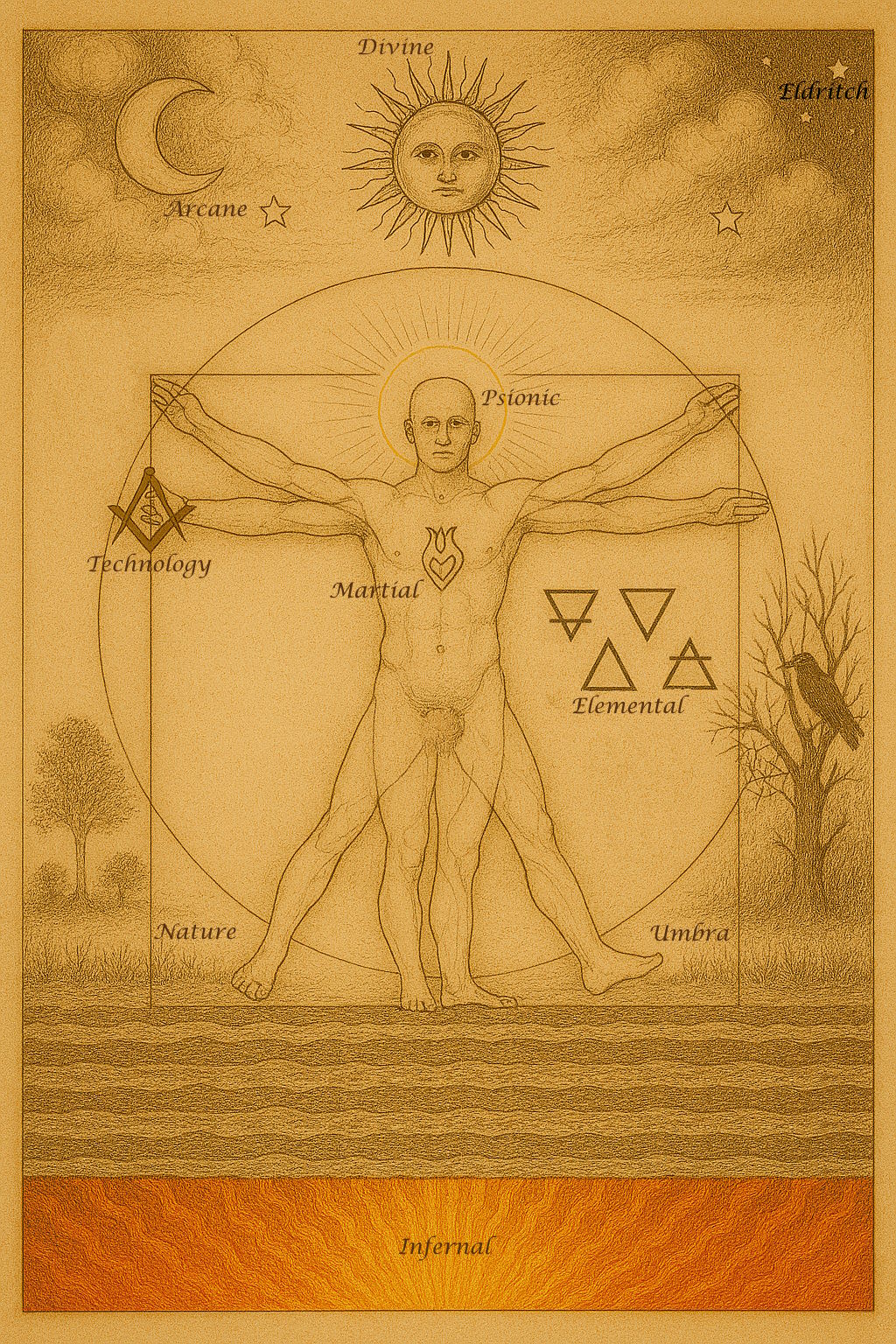
-
WhiteShark
- Site Moderator
- Posts: 5056
- Joined: Feb 2, '23
-
Geolocation
Adventurer's Guild
In any other setting, I would agree with you, but that is not the case in 4E. Indeed, while writing my post, I initially planned to make the same assertion, but, when I double checked the description in Player's Handbook 3, it says it's either energy from the Far Realm, 'the world's response to the intrusion of the Far Realm', or a power particular to Ioun (which would make it Divine...):J1M wrote: ↑ February 26th, 2026, 04:23Finally, I would argue that Psionic powers also come from an internal source. I made a diagram!
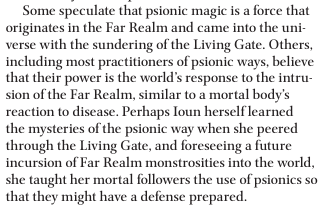
I think there are a couple reasons for that. For one, in D&D 3.5, there was the existence of NPC classes. Why would anyone ever choose to be a warrior over a fighter, or an adept over a wizard? Combined with the demographics table, it gives the impression that most people in the game world aren't capable of anything more. D&D 4E lacks the demographic information, but it likewise gives the impression that the PCs are Very Important in a world of scattered, mostly impotent mortals (see: the Points of Light setting). If anyone could advance in power the same way a PC can, it would seem logical that such a dangerous world would produce a lot more high level characters, which in turn would lessen the importance of the PCs.J1M wrote: ↑ February 26th, 2026, 04:23I am fine with the idea that in the fantasy story people are capable of heroic actions. All people even, but there does seem to be a really large portion of the TTRPG market that wants those filthy peasants to know their ******* place and you'd have to explicitly say in setting X everyone has inherent potential inside them like the force in star wars.
Regarding the Force, I'm not sure if I'm misreading you, that's a pretty clear example of rare, hereditary power. The Force emanates from all life, but the vast majority aren't even Force-sensitive, let alone capable of learning to harness it like a Jedi. That's why the Jedi search out Force-sensitive youths and take them in for training.
Last edited by WhiteShark on February 26th, 2026, 18:40, edited 1 time in total.
-
Stack of Turtles

- Posts: 7378
- Joined: May 7, '24
- Location: Soon-to-be Iran
-
Geolocation


The filthy peasants who don't have magic powers SHOULD learn their ******* place.
VAE VICTIS
-
J1M
- Turtle
- Posts: 5214
- Joined: Feb 15, '23
-
Geolocation
Adventurer's Guild
Interesting, but 4e did lots of wacky things with the cosmology for the sake of symmetry and simplification that were later walked back. How differently are psionics handled in other settings/editions?WhiteShark wrote: ↑ February 26th, 2026, 18:39In any other setting, I would agree with you, but that is not the case in 4E. Indeed, while writing my post, I initially planned to make the same assertion, but, when I double checked the description in Player's Handbook 3, it says it's either energy from the Far Realm, 'the world's response to the intrusion of the Far Realm', or a power particular to Ioun (which would make it Divine...):J1M wrote: ↑ February 26th, 2026, 04:23Finally, I would argue that Psionic powers also come from an internal source. I made a diagram!
I think there are a couple reasons for that. For one, in D&D 3.5, there was the existence of NPC classes. Why would anyone ever choose to be a warrior over a fighter, or an adept over a wizard? Combined with the demographics table, it gives the impression that most people in the game world aren't capable of anything more. D&D 4E lacks the demographic information, but it likewise gives the impression that the PCs are Very Important in a world of scattered, mostly impotent mortals (see: the Points of Light setting). If anyone could advance in power the same way a PC can, it would seem logical that such a dangerous world would produce a lot more high level characters, which in turn would lessen the importance of the PCs.J1M wrote: ↑ February 26th, 2026, 04:23I am fine with the idea that in the fantasy story people are capable of heroic actions. All people even, but there does seem to be a really large portion of the TTRPG market that wants those filthy peasants to know their ******* place and you'd have to explicitly say in setting X everyone has inherent potential inside them like the force in star wars.
Regarding the Force, I'm not sure if I'm misreading you, that's a pretty clear example of rare, hereditary power. The Force emanates from all life, but the vast majority aren't even Force-sensitive, let alone capable of learning to harness it like a Jedi. That's why the Jedi search out Force-sensitive youths and take them in for training.
-
WhiteShark
- Site Moderator
- Posts: 5056
- Joined: Feb 2, '23
-
Geolocation
Adventurer's Guild
This is how Complete Psionic (3.5) describes psionic power:
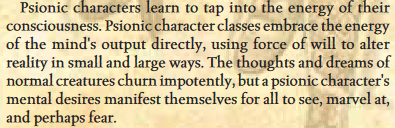
Eberron Campaign Setting (3.5) refers the topic to the Expanded Psionics Handbook (3.5), which gives a similar explanation:
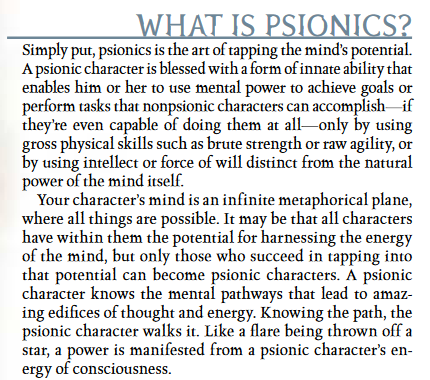
I'd say that's probably what anyone with genre familiarity would imagine when reading the word 'psionic'. After all, it's the assumption we both made. I'm not so familiar with Dark Sun nor Forgotten Realms, but I saw posts online saying it's the same in Dark Sun and that Forgotten Realms makes it distinct from magic but leaves it otherwise vague.
Eberron Campaign Setting (3.5) refers the topic to the Expanded Psionics Handbook (3.5), which gives a similar explanation:
I'd say that's probably what anyone with genre familiarity would imagine when reading the word 'psionic'. After all, it's the assumption we both made. I'm not so familiar with Dark Sun nor Forgotten Realms, but I saw posts online saying it's the same in Dark Sun and that Forgotten Realms makes it distinct from magic but leaves it otherwise vague.
-
J1M
- Turtle
- Posts: 5214
- Joined: Feb 15, '23
-
Geolocation
Adventurer's Guild
Shamelessly bumping this thread to ask if people think any other classes should be considered to be from the psionic power source. Both D&D 4e and Draw Steel (MCDM) consider the Monk to be psionic. When I first saw this it wasn't something I was expecting, but it is something that made a lot of sense.
I'd also consider Jedi powers to be psionic. Perhaps the most canonical representation of them.
I'd also consider Jedi powers to be psionic. Perhaps the most canonical representation of them.
-
rusty_shackleford
- Site Admin
- Posts: 46432
- Joined: Feb 2, '23
- Gender: Watermelon
-
Geolocation
Adventurer's Guild
fighters are psionic because their power source is internal
Thank you for your attention to this matter!
Steam friend code: 40552640 https://steamcommunity.com/friends/add | email: [email protected]
Having trouble running an old Windows game?
Rusty's Stuff Collection
Steam friend code: 40552640 https://steamcommunity.com/friends/add | email: [email protected]
Having trouble running an old Windows game?
Rusty's Stuff Collection
-
Kalarion

- Turtle
- Posts: 2253
- Joined: Feb 2, '23
-
Geolocation
Adventurer's Guild

Monks are psionic hybrids in Wizardry 8!
-
rusty_shackleford
- Site Admin
- Posts: 46432
- Joined: Feb 2, '23
- Gender: Watermelon
-
Geolocation
Adventurer's Guild
@Kalarion if they aren't psionic then explain how they can jump 60 feet in 5erusty_shackleford wrote: ↑ March 12th, 2026, 18:18fighters are psionic because their power source is internal
Thank you for your attention to this matter!
Steam friend code: 40552640 https://steamcommunity.com/friends/add | email: [email protected]
Having trouble running an old Windows game?
Rusty's Stuff Collection
Steam friend code: 40552640 https://steamcommunity.com/friends/add | email: [email protected]
Having trouble running an old Windows game?
Rusty's Stuff Collection
-
Tweed

- Turtle
- Posts: 6995
- Joined: Feb 2, '23
-
Geolocation
Adventurer's Guild
rusty_shackleford wrote: ↑ March 12th, 2026, 18:18fighters are psionic because their power source is internal
You do not have the required permissions to view the files attached to this post.
-
WhiteShark
- Site Moderator
- Posts: 5056
- Joined: Feb 2, '23
-
Geolocation
Adventurer's Guild
It's the Martial power source.rusty_shackleford wrote: ↑ March 13th, 2026, 16:06@Kalarion if they aren't psionic then explain how they can jump 60 feet in 5erusty_shackleford wrote: ↑ March 12th, 2026, 18:18fighters are psionic because their power source is internal
-
Kalarion
- Turtle
- Posts: 2253
- Joined: Feb 2, '23
-
Geolocation
Adventurer's Guild
Fighters don't skip leg day you PLEBrusty_shackleford wrote: ↑ March 13th, 2026, 16:06@Kalarion if they aren't psionic then explain how they can jump 60 feet in 5erusty_shackleford wrote: ↑ March 12th, 2026, 18:18fighters are psionic because their power source is internal
-
rusty_shackleford
- Site Admin
- Posts: 46432
- Joined: Feb 2, '23
- Gender: Watermelon
-
Geolocation
Adventurer's Guild
Being able to jump 60 feet is clearly supernatural and therefore an internal power source, ergo psionics
Thank you for your attention to this matter!
Steam friend code: 40552640 https://steamcommunity.com/friends/add | email: [email protected]
Having trouble running an old Windows game?
Rusty's Stuff Collection
Steam friend code: 40552640 https://steamcommunity.com/friends/add | email: [email protected]
Having trouble running an old Windows game?
Rusty's Stuff Collection
-
Oyster Sauce

- Site Moderator
- Posts: 11581
- Joined: Jun 2, '23
-
Geolocation
Adventurer's Guild
Why can't really good music just be magical without leeching off some other power source? It's musagic.
-
WhiteShark
- Site Moderator
- Posts: 5056
- Joined: Feb 2, '23
-
Geolocation
Adventurer's Guild
Yeah, you could make it a unique power source. I thought about that, but it didn't feel right when every other power source has at least a couple classes that draw from it.Oyster Sauce wrote: ↑ March 14th, 2026, 00:22Why can't really good music just be magical without leeching off some other power source? It's musagic.
-
Tweed
- Turtle
- Posts: 6995
- Joined: Feb 2, '23
-
Geolocation
Adventurer's Guild
Rusty actually advocating for this...rusty_shackleford wrote: ↑ March 13th, 2026, 17:14Being able to jump 60 feet is clearly supernatural and therefore an internal power source, ergo psionics
You do not have the required permissions to view the files attached to this post.
-
Stack of Turtles
- Posts: 7378
- Joined: May 7, '24
- Location: Soon-to-be Iran
-
Geolocation
The martial power source also runs on the theme music you hear inside your head when you do something really cool.WhiteShark wrote: ↑ March 14th, 2026, 01:09Yeah, you could make it a unique power source. I thought about that, but it didn't feel right when every other power source has at least a couple classes that draw from it.Oyster Sauce wrote: ↑ March 14th, 2026, 00:22Why can't really good music just be magical without leeching off some other power source? It's musagic.
VAE VICTIS
-
J1M
- Turtle
- Posts: 5214
- Joined: Feb 15, '23
-
Geolocation
Adventurer's Guild
-
rusty_shackleford
- Site Admin
- Posts: 46432
- Joined: Feb 2, '23
- Gender: Watermelon
-
Geolocation
Adventurer's Guild
I cast fist
Thank you for your attention to this matter!
Steam friend code: 40552640 https://steamcommunity.com/friends/add | email: [email protected]
Having trouble running an old Windows game?
Rusty's Stuff Collection
Steam friend code: 40552640 https://steamcommunity.com/friends/add | email: [email protected]
Having trouble running an old Windows game?
Rusty's Stuff Collection