


Should RPGs cover longer periods of time? Can you list any that actually do?
Are you fine with such narrative-breaking character growth in such a short period of time for the sake of it being a game?


 Do (most) RPGs not cover enough time?




Romancing Saga 2 has you play as a dynasty of emperors locked in a generational struggle with 7 demon lords. The first emperor (a preset character) dies, and then you play as his descendant (with his retainer families as party members). Each time you wipe or complete a major objective like conquering a territory or killing a demon lord, the game timeskips to the next emperor and his generation of retainers. So permadeath is backed into the narrative, with the skills/abilities you learn being passed down to future generations. This repeats until you have killed almost all of the demon lords, at which point you reach the final emperor's generation and if you wipe, you game over for real. Each time you switch to a new generation, decades or hundreds of years pass, and there is missable stuff like a region being wiped out by a volcanic eruption if you took too long to get there and do stuff.Should RPGs cover longer periods of time? Can you list any that actually do?


I played SaGa Frontier 2 which takes place over 100 years while characters age, born/die, etc., It was very good. Probably the best game I had for the PS1, or close to it.Val the Moofia Boss wrote: ↑ January 30th, 2026, 02:27Romancing Saga 2 has you play as a dynasty of emperors locked in a generational struggle with 7 demon lords. The first emperor (a preset character) dies, and then you play as his descendant (with his retainer families as party members). Each time you wipe or complete a major objective like conquering a territory or killing a demon lord, the game timeskips to the next emperor and his generation of retainers. So permadeath is backed into the narrative, with the skills/abilities you learn being passed down to future generations. This repeats until you have killed almost all of the demon lords, at which point you reach the final emperor's generation and if you wipe, you game over for real. Each time you switch to a new generation, decades or hundreds of years pass, and there is missable stuff like a region being wiped out by a volcanic eruption if you took too long to get there and do stuff.
Same team of designers, going back to Akitoshi Kawazau designing Final Fantasy 2 which had the WRPG-esque system where you level up skills. Sakaguuchi didn't want to do that anymore for FF3 so Kawazu got to pick his people and go off and make his own games called the SaGa series. One of his team members, Hiroshi Takai, went on to direct The Last Remnant which is a high production value SaGa game in all but name. And then he joined Yoshida in assistant directing FF14 before going off to make FF16, though unfortunately that didn't play anything like TLR or SaGa or JRPGs in general and was just an action game.rusty_shackleford wrote: ↑ January 30th, 2026, 02:40I played SaGa Frontier 2 which takes place over 100 years while characters age, born/die, etc., It was very good. Probably the best game I had for the PS1, or close to it.Val the Moofia Boss wrote: ↑ January 30th, 2026, 02:27Romancing Saga 2 has you play as a dynasty of emperors locked in a generational struggle with 7 demon lords. The first emperor (a preset character) dies, and then you play as his descendant (with his retainer families as party members). Each time you wipe or complete a major objective like conquering a territory or killing a demon lord, the game timeskips to the next emperor and his generation of retainers. So permadeath is backed into the narrative, with the skills/abilities you learn being passed down to future generations. This repeats until you have killed almost all of the demon lords, at which point you reach the final emperor's generation and if you wipe, you game over for real. Each time you switch to a new generation, decades or hundreds of years pass, and there is missable stuff like a region being wiped out by a volcanic eruption if you took too long to get there and do stuff.
(I assume they're somehow related)

Dragon Quest V
asf wrote:weeb
Dragon Age 2 spanned 9 years and I like that a lot more, as it goes with what you said of keeping the character growth more narratively plausible, as opposed to the norm is in most RPGs.rusty_shackleford wrote: ↑ January 30th, 2026, 02:11Should RPGs cover longer periods of time? Can you list any that actually do?
Are you fine with such narrative-breaking character growth in such a short period of time for the sake of it being a game?
asf wrote:weeb

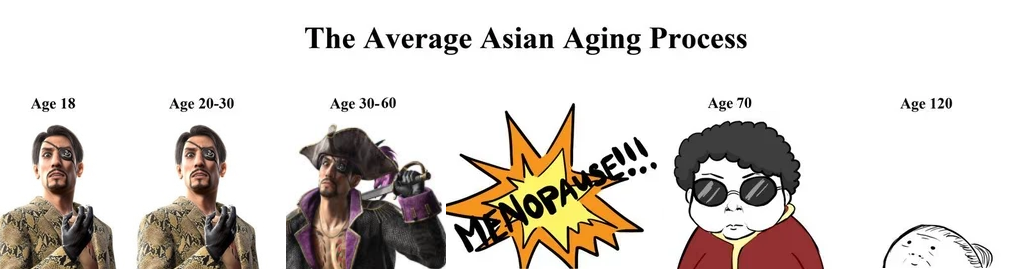
That's just normal for the Japanese.methoxetamine wrote: ↑ January 30th, 2026, 03:43Though they refuse to age the characters so 60 year old Pirate Majima looks exactly like he did in 1988..
methoxetamine wrote: ↑ January 30th, 2026, 03:43Though they refuse to age the characters so 60 year old Pirate Majima looks exactly like he did in 1988..

Do we only count RPGs that even HAVE time in them? Most RPGs do not actually have any real sense of time, with the setting effectively frozen in stasis, at best having day/night cycles. If so, does Crusader Kings count as an RPG? Otherwise, I can only think of RPG-7, which covers several story arcs from the Cold War all the way up to the latest Ukraine War expansion.rusty_shackleford wrote: ↑ January 30th, 2026, 02:11Should RPGs cover longer periods of time? Can you list any that actually do?
This is what I mean by "no real sense of time", yes. They put a calendar and clock in there, but it has no meaning because the world is frozen in stasis. A clock moves, but there is no great significance to the passage of time.stormvermin wrote: ↑ January 30th, 2026, 14:13The TES games have their own calendar and you can always open up the menu to see, the day, month, year, and just how much time has passed since beginning the game. It's all set dressing though as the passage of time means nothing and affects nothing. Sadly, even seasons aren't reflected in game which has always bothered me.


M&B WarbandNorfleet wrote: ↑ January 31st, 2026, 09:31This is what I mean by "no real sense of time", yes. They put a calendar and clock in there, but it has no meaning because the world is frozen in stasis. A clock moves, but there is no great significance to the passage of time.stormvermin wrote: ↑ January 30th, 2026, 14:13The TES games have their own calendar and you can always open up the menu to see, the day, month, year, and just how much time has passed since beginning the game. It's all set dressing though as the passage of time means nothing and affects nothing. Sadly, even seasons aren't reflected in game which has always bothered me.
Of course, time in a game frequently comes down to one of several flavors, sometimes multiple at once:
1. The player is put on a deadline. You MUST perform this action by a specific time or the game otherwise goes to ****, or you miss out. The Fallout 1 deadline was greeted with some level of dissatisfaction by many. While we can't deny it's thematic and appropriate, it's also not something that is clearly universally liked. Some sandbox games with story threads in them run with or without the player's involvement. Elite 3, for instance, had a story arc that will proceed whether or not the player gets involved with any portion of it.
2. It's a resource to optimize the usage of: Something happens, produces, recharges, or spawns on this timer and the player must optimize their usage of it. The time-management genre is big on this one, where you have to raise your levels/stats/resources through a limited set of time intervals to achieve some ending or objective. Can be combined with #1 in various "President" or "Trainer" games, or just open-ended like a Sims game, or combined with #3 below in something like Factorio, where you want to produce things-per-minute while enemies gradually grow nastier.
3. Time functions as a scaling factor, where the game gets harder as time goes on, even in the absence of specific deadlines or use as a limiting resource. Pirates, for instance, does this: Your character gets old and the game thus gets harder as time passes. While no hard deadline exists, time is increasing the difficulty of the game. Tower/wave defense games also behave this way.
There's relatively few games where time just IS, and things are just continuously happening without a defined trajectory of good/bad/missing out, and pretty much all of these are some version of sandbox. Crusader Kings stands out here (although the game DOES have an end date, and many people feel initial pressure from it to thus choose the earliest start date, in practicality, it's not actually relevant), where time exists and is clearly relevant, but you're not trying to optimize its usage for a deadline, there are not story beats you miss out on if you are a slowpoke, and the game isn't making life worse for you as time passes.
The time in M&B doesn't really matter outside of the early game and some overhauls. In the earlygame, you may need to do some time sensitive quests like find the village chief's kidnapped daughter, or to split from the kingdom's army and go herd some cattle to them, but those are quests you'll only do a few times. By default, the kingdoms will never defeat each other on their own without player interference, so you can just timelapse the game and aside from some border cities changing hands back and forth, there won't be any substantial changes. With mods like Persino, you get soft deadlines like a huge foreign invasion of elites at the 500 day mark and so on.TKVNC wrote: ↑ February 1st, 2026, 22:50M&B WarbandNorfleet wrote: ↑ January 31st, 2026, 09:31This is what I mean by "no real sense of time", yes. They put a calendar and clock in there, but it has no meaning because the world is frozen in stasis. A clock moves, but there is no great significance to the passage of time.stormvermin wrote: ↑ January 30th, 2026, 14:13The TES games have their own calendar and you can always open up the menu to see, the day, month, year, and just how much time has passed since beginning the game. It's all set dressing though as the passage of time means nothing and affects nothing. Sadly, even seasons aren't reflected in game which has always bothered me.
Of course, time in a game frequently comes down to one of several flavors, sometimes multiple at once:
1. The player is put on a deadline. You MUST perform this action by a specific time or the game otherwise goes to ****, or you miss out. The Fallout 1 deadline was greeted with some level of dissatisfaction by many. While we can't deny it's thematic and appropriate, it's also not something that is clearly universally liked. Some sandbox games with story threads in them run with or without the player's involvement. Elite 3, for instance, had a story arc that will proceed whether or not the player gets involved with any portion of it.
2. It's a resource to optimize the usage of: Something happens, produces, recharges, or spawns on this timer and the player must optimize their usage of it. The time-management genre is big on this one, where you have to raise your levels/stats/resources through a limited set of time intervals to achieve some ending or objective. Can be combined with #1 in various "President" or "Trainer" games, or just open-ended like a Sims game, or combined with #3 below in something like Factorio, where you want to produce things-per-minute while enemies gradually grow nastier.
3. Time functions as a scaling factor, where the game gets harder as time goes on, even in the absence of specific deadlines or use as a limiting resource. Pirates, for instance, does this: Your character gets old and the game thus gets harder as time passes. While no hard deadline exists, time is increasing the difficulty of the game. Tower/wave defense games also behave this way.
There's relatively few games where time just IS, and things are just continuously happening without a defined trajectory of good/bad/missing out, and pretty much all of these are some version of sandbox. Crusader Kings stands out here (although the game DOES have an end date, and many people feel initial pressure from it to thus choose the earliest start date, in practicality, it's not actually relevant), where time exists and is clearly relevant, but you're not trying to optimize its usage for a deadline, there are not story beats you miss out on if you are a slowpoke, and the game isn't making life worse for you as time passes.

We see here that an ATTEMPT was made to have a world happening in the background, but the equilibrium is a bit too strong, and thus a sense of timelessness results. And, of course, if one side COULD win, the game probably doesn't have any mechanisms to cover what happens.Val the Moofia Boss wrote: ↑ February 1st, 2026, 22:54The time in M&B doesn't really matter outside of the early game and some overhauls. In the earlygame, you may need to do some time sensitive quests like find the village chief's kidnapped daughter, or to split from the kingdom's army and go herd some cattle to them, but those are quests you'll only do a few times. By default, the kingdoms will never defeat each other on their own without player interference, so you can just timelapse the game and aside from some border cities changing hands back and forth, there won't be any substantial changes. With mods like Persino, you get soft deadlines like a huge foreign invasion of elites at the 500 day mark and so on.
Maybe the unmodded native, but practically anything else has Kingdoms destroying one-anotherVal the Moofia Boss wrote: ↑ February 1st, 2026, 22:54The time in M&B doesn't really matter outside of the early game and some overhauls. In the earlygame, you may need to do some time sensitive quests like find the village chief's kidnapped daughter, or to split from the kingdom's army and go herd some cattle to them, but those are quests you'll only do a few times. By default, the kingdoms will never defeat each other on their own without player interference, so you can just timelapse the game and aside from some border cities changing hands back and forth, there won't be any substantial changes. With mods like Persino, you get soft deadlines like a huge foreign invasion of elites at the 500 day mark and so on.TKVNC wrote: ↑ February 1st, 2026, 22:50M&B WarbandNorfleet wrote: ↑ January 31st, 2026, 09:31
This is what I mean by "no real sense of time", yes. They put a calendar and clock in there, but it has no meaning because the world is frozen in stasis. A clock moves, but there is no great significance to the passage of time.
Of course, time in a game frequently comes down to one of several flavors, sometimes multiple at once:
1. The player is put on a deadline. You MUST perform this action by a specific time or the game otherwise goes to ****, or you miss out. The Fallout 1 deadline was greeted with some level of dissatisfaction by many. While we can't deny it's thematic and appropriate, it's also not something that is clearly universally liked. Some sandbox games with story threads in them run with or without the player's involvement. Elite 3, for instance, had a story arc that will proceed whether or not the player gets involved with any portion of it.
2. It's a resource to optimize the usage of: Something happens, produces, recharges, or spawns on this timer and the player must optimize their usage of it. The time-management genre is big on this one, where you have to raise your levels/stats/resources through a limited set of time intervals to achieve some ending or objective. Can be combined with #1 in various "President" or "Trainer" games, or just open-ended like a Sims game, or combined with #3 below in something like Factorio, where you want to produce things-per-minute while enemies gradually grow nastier.
3. Time functions as a scaling factor, where the game gets harder as time goes on, even in the absence of specific deadlines or use as a limiting resource. Pirates, for instance, does this: Your character gets old and the game thus gets harder as time passes. While no hard deadline exists, time is increasing the difficulty of the game. Tower/wave defense games also behave this way.
There's relatively few games where time just IS, and things are just continuously happening without a defined trajectory of good/bad/missing out, and pretty much all of these are some version of sandbox. Crusader Kings stands out here (although the game DOES have an end date, and many people feel initial pressure from it to thus choose the earliest start date, in practicality, it's not actually relevant), where time exists and is clearly relevant, but you're not trying to optimize its usage for a deadline, there are not story beats you miss out on if you are a slowpoke, and the game isn't making life worse for you as time passes.
Mods don't really count, though. How does the game even normally react to kingdoms destroying each other? Is it basically a battle royale survivorship where eventually only one remains and the game becomes degenerate? Or is it more like Crusader Kings, where a giant empire ball CAN form, but it can also break up into giant civil wars and independence movements?TKVNC wrote: ↑ February 2nd, 2026, 08:14Maybe the unmodded native, but practically anything else has Kingdoms destroying one-another
In M&B, Lord NPCs want a minimum amount of land (usually at least one castle and one village), and the lords have different assigned personalities that cause them to dislike each other or try to frame each other, which leads to the king having to settle disputes. As the simulation goes on, eventually some lords will either leave their kingdom due to dissatisfaction, be framed for betrayal and flee, or get banished by the king. They then have a chance to go join another kingdom, or a chance to just permanently leave the realm (the game world) altogether. In any game that runs long enough, the game will become heavily depopulated of lords. I think about half will have left by the second or third year.Norfleet wrote: ↑ February 2nd, 2026, 19:04Mods don't really count, though. How does the game even normally react to kingdoms destroying each other? Is it basically a battle royale survivorship where eventually only one remains and the game becomes degenerate? Or is it more like Crusader Kings, where a giant empire ball CAN form, but it can also break up into giant civil wars and independence movements?TKVNC wrote: ↑ February 2nd, 2026, 08:14Maybe the unmodded native, but practically anything else has Kingdoms destroying one-another
Well, the base game is quite simplistic. So, not really. Lords will randomly defect, and take their castles with them, from time-to-time.Norfleet wrote: ↑ February 2nd, 2026, 19:04Mods don't really count, though. How does the game even normally react to kingdoms destroying each other? Is it basically a battle royale survivorship where eventually only one remains and the game becomes degenerate? Or is it more like Crusader Kings, where a giant empire ball CAN form, but it can also break up into giant civil wars and independence movements?TKVNC wrote: ↑ February 2nd, 2026, 08:14Maybe the unmodded native, but practically anything else has Kingdoms destroying one-another
Sad, but quite true.


