Norfleet wrote: ↑
December 28th, 2025, 23:11
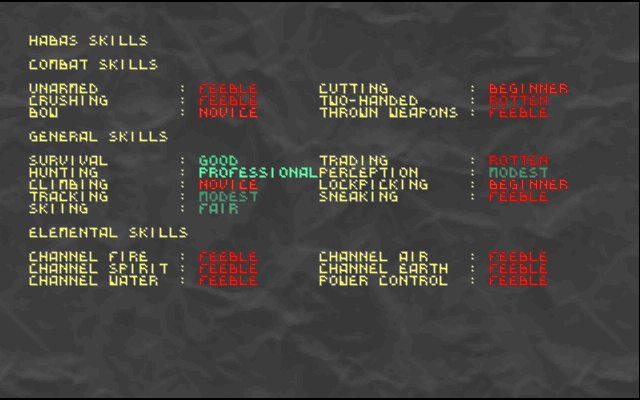
Is there such a thing as a well-designed skill check? At its core, skill checks are not exactly thrilling gameplay: You buy a number, probably blindly with no idea if that was enough. If you bought enough number to satisfy the developer, you pass. Otherwise, you fail it, and the points you put into it were wasted. Skill checks are just build taxes: You must pay this many points out of your buildspace in order to experience the content you paid for. They don't really add gameplay, because the player is not involved. They aren't based on interesting choices, because unless you consulted a guide for it, you're going in blind with no idea how much and what skills are required to see what you want to see, so are just guessing. If the notion of skill "checks" were simply removed and replaced with a binary toggle, "Has Ability (possibly tied to race/class instead)", would anything be lost? Certainly not in gameplay. If, instead of a "Disarm Trap" skill, that you put points into, you simply had "Thieves and Dwarves Can Disarm Traps", would anything have changed?
I just mentioned it: Skill checks that have a purpose in both the way your character is perceived and how it affects the world. A skill check is a simple thing, I'm repeating myself here but anyway, 1s and 0s. If you had more things to it then suddenly there's 1s 2s 3s and so on, by themselves a skill check is just an obstacle, but it can be more than that if you put more systems along it to enrich the game.
Bad skill checks are what Rusty mentioned, invisible barriers to annoy the player. The game should tell you to develop those skill before hand, not suddenly get in your way because "uh you're not high level enough". If the game is well designed, when you run into a wall you might not have one of the skills required to climb that wall, but perhaps you have explosives skill to blow the **** thing away, or maybe science to make a portal to cross it. The example is irrelevant, but it's a matter of dimension.
I wrote a whole definition of it but it ended up being a bit too long so I will repeat:
jdcp wrote: ↑
December 28th, 2025, 11:47
Had a detailed answer for this but **** it, I agree.
Still I must mention you just described what a bad skill check is.
@Norfleet It's very easy to rationalize what a good skill check is just with common sense and few of experience with games. That said I wanna answer some more stuff from you:
Norfleet wrote: ↑
December 28th, 2025, 23:11
If, instead of a "Disarm Trap" skill, that you put points into, you simply had "Thieves and Dwarves Can Disarm Traps", would anything have changed?
First of all this is a problem with how the game adresses the skill system, no the skill checks, but in gameplay terms no it wouldn't.
Norfleet wrote: ↑
December 28th, 2025, 23:11
Skill checks are just build taxes: You must pay this many points out of your buildspace in order to experience the content you paid for. They don't really add gameplay, because the player is not involved.
Yes, this is my main problem with how skills work in Fallout in general, and why I partially praise the skills in TES.
In Fallout you gotta allocate points when you level up, this is ********, as you said you're just doing an investment. In TES you gotta develop those skills (except for the main skills, but that's another topic)
Sadly they're both games the oppposite of each other, one let's you train those skills but offers little depth towards them besides combat, the other doesn't let you train them but offers more interesting outcomes with the skills.
One has good skill design, the other has good narrative design. Mix both and you get a pretty good RPG, given the other elements are fine tuned too.
A good skill check is one which the player has given effort to achieve, that he is aware he can deal with.
Unless a problem that needs to be solved with a skill check presents several skills that can resolve them, for example a wall you can either blow up (explosives, perhaps some magic too), climb (acrobatics or whatever), or make a portal to pass through it (magic or whatever) then yes it's a very boring design.
A good design let's you make the best out of it with the skills you have, and the way the game has designed it's progression must have prepared you for that moment, otherwise it's bad game design. A good skill check design rewards the player for developing their skills, a bad skill check penalizes for neglecting a single one (see speech skill, the worst thing ever made, where in some games you can't simply progress without it).
Not every discussion is solved with some honeyed words, but apparently for most games it's either that or brute force. It's stupid. That's a good example of bad skill design.
A good skill check design provides several solutions to a problem, some of them completely devoid of a skill (for example a closed door you can open with a key, blast away or lockpick).
If the game suddenly stops you because of a skill, then again it sucks.
One of the best uses of the skill check is when they let you use NPCs to solve those, for example if you have a thief in your party he can take care of a trap (to put a simple example) This is both good skill design and party design.
I don't like the class design, though I don't hate it, it's very against what I consider proper roleplaying. If you can categorize people entirely according to a single role, then they suddenly have no personality to me.
A thief is a thief, and nothing else. Which is why I use a custom class always if the game lets you.
STILL I "BAD" (as I call them) SKILL CHECKS DO STILL SERVE A PURPOSE:
jdcp wrote: ↑
December 28th, 2025, 11:28
So yes they suck alone, but they can be a medium to tell a game's narrative in different ways so that every player can have different outcomes according to the things they value the most out of themselves, in that sense, they succeed.
It's easier to call them one-dimensional instead of bad, but I prefer to call them just bad because well, they're both unfair and lackluster, completely devoid of fun.
But they do serve a purpose, which is that imaginary wall to stop you from going too far, it's game design 101.