We have a Steam curator now. You should be following it. https://store.steampowered.com/curator/44994899-RPGHQ/
Chat client updated, if you have issues using chat press CTRL + SHIFT + R to force a hard refresh.

Looking Glass Interviews, Articles, and Oddments

For discussing role-playing video games, you know, the ones with combat.
Ignore Topic
User avatar
rusty_shackleford
Site Admin
Posts: 45473
Joined: Feb 2, '23
Gender: Watermelon

Geolocation

Adventurer's Guild

Looking Glass Interviews, Articles, and Oddments

Post by rusty_shackleford »

rusty_shackleford wrote: November 21st, 2025, 23:23
If anyone is aware of anything not listed here, feel free to share it. I'll put it in the table if it's from 2005 or earlier, otherwise I'll just consider it an Oddment.
All content is in the process of being tagged at the beginning of the post.

Most will be surprised to learn that "Immersive sim" is in fact a well-defined term, the Looking Glass boys were more than willing to tell you all about it if you just checked their website.

https://web.archive.org/web/19970618124 ... festo.html
Our Manifesto
(A Rant from Tim and Mahk)
We're role-playing gamers, fantasy/sci-fi fans, and computer game developers. We play all the same games you do, and we know as well as you do that "Computer Role-Playing Game" is a contradiction in terms.

Sitting around the table at a gaming "run" is a social activity and an exercise in imagination. Players express their imaginations through their social interactions and their creative approach to the problems of an adventure. The problem with the whole notion of the "computer role-playing game" is that this cannot happen the same way in a computer game. The social interaction which can be offered by a computer is pretty hollow, and most games don't provide a whole lot to replace it. The tedious mazes of pre-scripted menu options that some games (including our own!) have tried to pass off as "conversations" certainly don't cut it.

This probably sounds like we don't think role-playing can work on computers, but we do. It's a hard technical and design problem, but we like hard problems or we wouldn't be in this business. What many games have done, which isn't hard, is to copy the forms of a paper role-playing game, which keeps all the sheets of paper from the gaming table at the expense of all the people around it. A computer game can have all the trappings of a paper role-playing game (the Tolkienesque dwarves and elves, the "character classes," "to-hit rolls," and "experience levels"), but without role-playing it's not an RPG. It's computer strategy game about paper RPG's. Some of them are okay.

The point of all this talk about computer role-playing games is not to claim that this project of ours is or isn't an RPG. The point is that great games don't happen by shoe-horning your design into a rigid category made up by some magazine. We've spent years in pursuit of a truly immersive experience, and we see a continuous line of development from Underworld through System Shock to the Dark Project. We touched off a lot of discussion on the 'net (and yes, we were reading it all) about whether System Shock was an RPG, or a Doom clone, or whatever. Like as not the same people who thought System Shock was a Doom clone will think that this game is a Quake clone. And they'll be just as wrong.

What it will be is one thing that Shock was, which is a damned fine game, the like of which nobody else could (or would) do.
► Show Spoiler
https://web.archive.org/web/19970618130 ... howdo.html
How Do We Do It?
Adapting a paper game genre to the computer requires the designers to change the way they think about the genre and discover the power of the computer as a medium. Role-playing is about imagining yourself in a situation, maybe a strange, wonderful situation, and expressing yourself in relation to that situation. The social avenue of expression we have at a weekend party game might be lacking, but the power of the computer to free our imaginations is great. You don't have to imagine the fantasy world you're supposed to be in because you can see it, hear it, and in some ways almost feel it. This feeling of being there is essential to the role-playing game, and it's what Looking Glass' "immersive reality" philosophy is all about.

That's the hard technical problem. The hard design problem is to put the computer in the role of the single, most important person at the gaming table -- the "game master" or referee. A good game master is creative enough to invent a compelling situation, and flexible enough to adjudicate whatever response the players can come up with. Inventing the situation is our job as writers; the response to the player we have to leave up to the computer.

The common approach to this problem involves scripting a variety of object behaviors, so as to construct puzzles for the player to solve. This is fun up to a point, but it generally disallows the element of improvisation which is such an important part of an RPG's creative challenge. To unlock this potential in our games requires designing not just puzzles and quests, but interacting systems which the player can experiment with. These systems include things like the physics simulation and player movement, combat, magic, and skills, and our "Act/React" concept of object interaction. By setting up consistent rules for each such system, and designing interactions between them in a common-sense but controlled way, we end up with what is in essence one big system.

Because of the way this big system is constructed, it remains fairly manageable (so we can ship games as close to on time as ever happens in this business). But paradoxically, the connections between subsystems lead to interactions of interactions, and these multiply to the point where even we the designers don't fully understand the big system. This is the essence of the concept of "emergent behaviors," a notion we picked up from the fields of Artificial Life and Systems Analysis, and about which there's probably lists of Ph.D. theses as long as your arm. (No ****, we really think about stuff like this. Why should the 3D graphics guys get all the fun playing with brain-grinding science?)

This "emergent behaviors" business happens unintentionally in all sorts of projects, but if you're aware of it it's something that you can purposefully design for. We actually like it when our playtesters manage to defeat a problem in a way that we never thought of, despite the bugs it sometimes causes, because game-design-wise these emergent behaviors are like free money from heaven. Once your players can surprise you like this, you know for **** sure they're being creative. Bet you didn't think I was ever going to tie this back into the old "personal expression through creative improvisation" theme, eh?

Contemporary Interviews & Articles
[This is a WIP]
I am purposely imposing a hard 2005 publish date cutoff on content. Anything after is too far removed from the events that happened.
Ion Storm-related content is included due to a significant overlap, but is clearly marked as such. I consider Spector to be Ion Storm, and not LGS.
AuthorAffiliationTitle / SubjectPrimary TopicSource OriginYearLinkNotes
Paul NeurathLooking GlassThe Story of Ultima UnderworldDevelopment / HistoryPaul Neurath2000viewtopic.php?p=316653-looking-glass-in ... ts#p316653Neurath chronicles the development of Ultima Underworld, detailing the technical implementation of real-time texture mapping, the distributed approach to level design, and the crucial production oversight provided by Warren Spector.
Doug ChurchLooking GlassDoug Church InterviewDesign TheoryBook: Game Design: Theory and Practice2004https://rpghq.org/looking-glass/church-interview/
Doug ChurchLooking GlassFormal Abstract Design Tools (FADT)Design TheoryGameDeveloper.com1999https://www.gamedeveloper.com/design/fo ... sign-toolsCreating a formal language to describe games
Tim StellmachLooking GlassScenario Design vs. Puzzle DesignLevel DesignBook: Secrets of the Sages2000viewtopic.php?p=316355-looking-glass-in ... ts#p316355Defining missions vs puzzles; allowing player improvisation; How fiction supports interactivity rather than leading it; etc.,
Randy SmithLooking GlassThe Role of User InterfaceUI / UXBook: Secrets of the Sages2000viewtopic.php?p=316356-looking-glass-in ... ts#p316356UI as the input bottleneck; UI quality vs Simulation quality
Marc LeBlancLooking GlassCoding Good AIAIBook: Secrets of the Sages2000viewtopic.php?p=316357-looking-glass-in ... ts#p316357AI as "babysitters" or "playmates" rather than realistic opponents
Harvey SmithIon StormPlayer Character ConceptsCharacter DesignGameDeveloper.com1999https://www.gamedeveloper.com/design/pl ... r-conceptsIncidental to LGS; part of related Ion Storm philosophy
Warren SpectorIon StormWho forgot the 'role' in Role-Playing Games?RPG MechanicsGameDeveloper.com1999https://www.gamedeveloper.com/design/wa ... ing-games-Influence on LGS likely overstated; Ion Storm era
Warren SpectorIon StormRemodeling RPGs for the New MillenniumRPG MechanicsGameDeveloper.com1999https://www.gamedeveloper.com/design/re ... millenniumMoving away from paper/dice roots
Irrational GamesLooking GlassSystem Shock 2 Post-mortemPost-mortemGameDeveloper.com1999https://www.gamedeveloper.com/design/po ... shock-2-i-
Looking Glass StudiosLooking GlassThief: The Dark Project Post-mortemPost-mortemGameDeveloper.com1999https://www.gamedeveloper.com/design/po ... project-i-
Ion StormIon StormDeus Ex Post-mortemPost-mortemGameDeveloper.com2000https://www.gamedeveloper.com/design/po ... deus-ex-i-
Paul Neurath / Doug ChurchLooking GlassUltima Underworld II InterviewDevelopment / HistoryGame Bytes1993viewtopic.php?p=316358-looking-glass-in ... ts#p316358Merger of Blue Sky & Lerner; "dynamic creation" iterative design; evolution of the 3D engine; early immersive simulation philosophy
Harvey Smith / Randy SmithIon StormPractical Techniques for Implementing Emergent GameplaySystem Design / EmergenceGDC2004viewtopic.php?p=316363-looking-glass-in ... ts#p316363Applying the MDA framework to emergence; creating indirect connections between mechanics; using stimulus systems instead of hard-coding; distinguishing between reactive and proactive (meaningful) emergence
Doug Church / Warren SpectorLooking GlassPractical Game Analysis with Doug and WarrenGame designGDC2002viewtopic.php?p=316364-looking-glass-in ... ts#p316364[TODO]
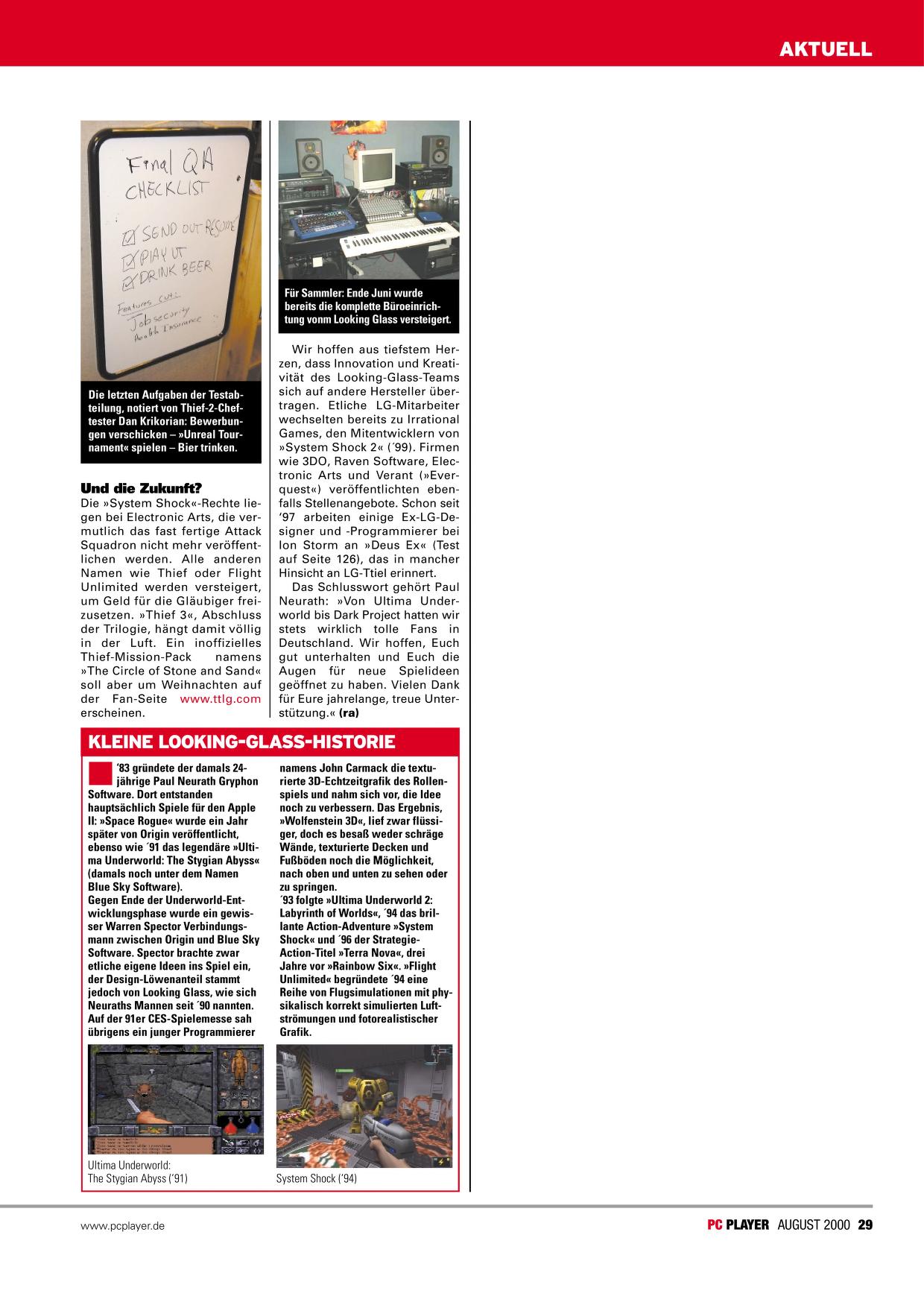
Paul NeurathLooking GlassALL THE BEST, LOOKING GLASS!Development / HistoryPC Player German Magazine August 20002000viewtopic.php?p=316657-looking-glass-in ... ts#p316657

Subsequent Material

Interviews, articles, and related material that is published after the 2005 cutoff date.
[TODO]

Oddments

Things that are either not interviews/articles
[TODO]


TODO:
Podcasts I need to transcribe:
https://gambit.mit.edu/updates/2011/02/ ... tervie.php
https://gambit.mit.edu/updates/2011/05/ ... rvie_2.php (it's post-2005 but maybe interesting nonetheless)


Fair Use Notice
This research article includes excerpts from copyrighted works. These are used for the purpose of commentary, criticism, and educational research. This constitutes a 'fair use' of any such copyrighted material as provided for in Title 17 U.S.C. section 107 of the US Copyright Law. All original content remains the property of their respective owners.
Last edited by rusty_shackleford on December 10th, 2025, 00:07, edited 18 times in total.
Thank you for your attention to this matter!
Steam friend code: 40552640 https://steamcommunity.com/friends/add | email: [email protected]
Having trouble running an old Windows game?
Rusty's Stuff Collection
User avatar
rusty_shackleford
Site Admin
Posts: 45473
Joined: Feb 2, '23
Gender: Watermelon

Geolocation

Adventurer's Guild

Post by rusty_shackleford »

Article in the 2000 book "Game Design: Secrets of the Sages"
TIM STELLMACH, LOOKING GLASS STUDIOS

As senior game designer at Looking Glass Studios, Tim Stellmach's latest and arguably most impressive work is Thief: The Dark Project and Thief 2. For these titles, Stellmach was responsible for training and managing junior designers and overseeing the design of gameplay systems and missions. Who better to invite to talk about mission design? After all, Gamecenter, a popular Internet e-zine, awarded Thief: The Dark Project the "Best Story Line" award for 1998. That's right—an action game, of all things. And tightly woven in the story are the individual player missions, so let's begin.

Stellmach first defines scenario design and how he approaches it. In this segment, he also explains the differences between scenario design and puzzle design (discussed in Chapter 5).
"I'd say the most important thing is just healthy amounts of playing time and willingness to adjust your work," says Stellmach. He also warns there's such a thing as getting "too close" to your work to make an accurate judgment. (Used with permission by Looking Glass Studios, Inc.)
In any mission-based game, scenario design involves a mission objective, a description of the space in which the mission occurs, some obstacles, and the tools for overcoming those obstacles. Note that the actual solutions to the player's problems aren't on that list! That's the difference between a scenario and a puzzle. A puzzle has a solution designed into it, and that's really the only valid way of approaching the puzzle. One thing you see in a lot of games is missions designed as a set of puzzles the player has to "solve" in order to achieve the objective. There are games where that really is the point, of course, but you have to question that assumption. Can you design more than one solution? Could you enrich your game by making an environment in which the player can experiment and improvise?
The "campaign" in Thief is a work of fiction that holds the missions together and motivates them. Most fiction games involve a predetermined sequence of missions, so the campaign doesn't serve any interactive function. Instead it serves the interactivity in a support role. The fiction enhances the individual mission objectives by making them part of a story the player cares about. Success is its own reward, of course, but with a compelling fiction the player also feels like his success has achieved something meaningful.
Stellmach explains how to wrestle with mission design for a game and speaks on the common problems inherent in creating a successful game:
Well, design in the first place implies setting goals, and planning and implementing solutions. People tend to forget what it means to do things "by design." It's important to stress the role of planning because in a creative business it's all too easy to get swept up in your ideas and just improvise as you go along. Generally this leads to work that's sloppier and less focused than what you're really capable of. Think about what you're trying to do overall before you even begin work on any individual part. Don't go off half-cocked.

A corollary to this rule is to organize your work in iterations. Any job that's too big to understand all at once should be broken up into phases, each of which improves on the previous step. It's not actually possible to know exactly what you want to do from the beginning, so you have to be able to grip the problem as you go along, and adapt your plan. In designing a mission, this means starting with a written plan, doing a general floor plan of the area first, and not working in details until they're necessary. The more detailed a construct is, the harder it is to rework, and everything you do will need to be reworked at some point. Plan ahead for prototypes and demos. Nothing is more useful in understanding the thing you're making than a working model.

That's all about getting work done in the first place—not wasting your time or straying off-track. To get good work done, I'd say the most important thing is just healthy amounts of playing time and willingness to adjust your work. This applies particularly to very communicative with other play testers. There is no way for you to maintain your objectivity while working on a game day to day, for months at a time. When in doubt, the other guy is probably right, because you're too close to the thing to see it clearly. Build relationships with play testers who are good critics and good communicators.
Thief: The Dark Project was quite a unique action game in that the emphasis was not on annihilating everything in sight. Rather, its focus was on cunning stealth and subtle operation. Asked to comment on hurdles in light of the game's mission design, Tim replies:
The biggest obstacle was the amount of Thief that we were inventing ourselves. Nobody had done a first-person action-adventure game before where things like hiding in shadows and creeping around were so important. Or one where sound was really so basic to understanding the environment around you, rather than just being window dressing on a world that's essentially visual.

It's hard to design missions around gameplay experiences you haven't really seen before. In production, it wasn't even really clear to us which parts of playing the thief character people would respond to. So there's all sorts of opportunities, not just to sneak around, but to pick pockets, ambush guards, defeat traps, and scout around eavesdropping and such. That led to a lot of richness in the game, but at times it was hard to get a grip on it all.

The key to dealing with this was a lot of game playing and critique up front to get a better understanding of the gameplay we wanted to see. Even many of the most original ideas have emerged as elements of a lot of previous work in them; there's no such thing as working in a creative vacuum. So there's elements of System Shock, Prince of Persia, GoldenEye 007, and a lot of other games in there. And we thought about similar-seeming games we didn't want to emulate, and what we wanted to do differently, and that helped us focus. We asked a lot of sort of goal-level questions like "What are the tactical situations that make stealth necessary?" and "What are the emotional buttons those situations push, and how do we capitalize on that?"
In closing, Stellmach confirms that this all boils down to the antecedent strategies: plan ahead, get the gameplay prototyped as early as possible, and get as much feedback from players as you can.
Thank you for your attention to this matter!
Steam friend code: 40552640 https://steamcommunity.com/friends/add | email: [email protected]
Having trouble running an old Windows game?
Rusty's Stuff Collection
User avatar
rusty_shackleford
Site Admin
Posts: 45473
Joined: Feb 2, '23
Gender: Watermelon

Geolocation

Adventurer's Guild

Post by rusty_shackleford »

Article in the 2000 book "Game Design: Secrets of the Sages"
RANDY SMITH, LOOKING GLASS STUDIOS

In his three years at Looking Glass Studios, arguably one of the most sought-after and respected game design companies in the United States, Randy Smith's job responsibilities have included game design, mission building, and scripting for Thief and Thief 2.

Here, he discusses the role of a solid user interface and its place in the overall game-design process:
The vast majority of work in video game development goes into the simulation and how the game communicates the state of the simulation to the users. In general, the only channels a video game uses for this communication are the pixels on the screen and the audio from the speakers. Developers toil endlessly to make sure the output of these channels is as rich and flawless as possible, and critics nit-pick the smallest inadequacies. This is all well understood and accepted.

The user interface is the inverse of that communication. It's the sum of the users' channels to communicate to the game. With it, the users exert control over the simulation and express their intention. As the simulation's input bottleneck, the user interface inherently limits the users' ability to merge with the game, and therefore, just like the simulation's output, it should be as rich and flawless as possible.
With a good user interface, the users can concentrate on their simulated presence in the game environment, which is (presumably) where the gameplay is centralized. As the quality of the user interface decreases, the users must spend more time thinking about their input channels to the simulation and less time enjoying the simulation itself. A poor user interface can limit the users' ability to express themselves to the point where they have a negative experience, even if the underlying simulation and its output are truly fantastic.
Thank you for your attention to this matter!
Steam friend code: 40552640 https://steamcommunity.com/friends/add | email: [email protected]
Having trouble running an old Windows game?
Rusty's Stuff Collection
User avatar
rusty_shackleford
Site Admin
Posts: 45473
Joined: Feb 2, '23
Gender: Watermelon

Geolocation

Adventurer's Guild

Post by rusty_shackleford »

Article in the 2000 book "Game Design: Secrets of the Sages"
MARC LEBLANC, LOOKING GLASS STUDIOS

Marc "MAHk" LeBlanc has been making games at Looking Glass Studios since 1992, with impressive design and programming credits including Ultima Underworld II, System Shock 1 and 2, Flight Unlimited, and Thief: The Dark Project. Currently, he is the lead engineer on Looking Glass Studios' RPG Engine Team.

Here, LeBlanc talks about coding good AI. Is there a "secret" to creating it? His response is as follows:
It's a secret truth of game AI (so secret, in fact, that most game AI programmers fail to acknowledge it, much to their own peril) that intelligence and realism are not the goals. Game characters do not need to be perfect simulations of human behavior. Nor do they need to be ruthlessly competent opponents. Those things aren't even desirable. Game AIs need to be good babysitters. Or good playmates. The AI is there to cooperate with the player in entertaining ways.
LeBlanc offers Thief: The Dark Project as a shining example of this advice:
The guards are canonical babysitters playing hide-and-seek with the player; they walk around constantly shouting about how they can't see you. If we wanted ruthless guards that searched and destroyed the player with maximum efficiency, we could have written them. They wouldn't have been any fun. Of course, game AI needs to be believable, but "believability" is not at all the same thing as "realism." Being believable is largely a matter of smoke and mirrors; it's about suspending disbelief, and if you give the player the right cues, then he'll cooperate with you.
Last edited by rusty_shackleford on November 21st, 2025, 04:46, edited 1 time in total.
Thank you for your attention to this matter!
Steam friend code: 40552640 https://steamcommunity.com/friends/add | email: [email protected]
Having trouble running an old Windows game?
Rusty's Stuff Collection
User avatar
rusty_shackleford
Site Admin
Posts: 45473
Joined: Feb 2, '23
Gender: Watermelon

Geolocation

Adventurer's Guild

Post by rusty_shackleford »

The following is an interview with Looking Glass Technologies on their forthcoming game, Ultima Underworld 2. Thanks,
Shadowcat!

ED. - We are VERY pleased to present this (lengthy) interview with Looking Glass Technologies, the developers of the
tremendous, Ultima Underworld series. Paul Neurath and Doug Church have been very gracious at this very busy time for
them and we want to thank them for all the time and effort they went through to do this. Because of the length of this
interview, it will be broken into two parts. [Both parts are combined in this file!!] As Ultima Underworld II now hits
the shelves, you should find this most interesting reading.

-------------------------------------------------------------------------

The Company ~~~~~~~~~~~

GB: Welcome guys! Why don't we start by giving us a little history lesson. How did Looking Glass get started? What's the
'company history'?

Paul: Looking Glass Technologies (LGT) emerged from two computer game development houses; Blue Sky Productions and
Lerner Research. Blue Sky created the original Ultima Underworld, and Lerner Research wrote such hit titles as Chuck
Yeager's Flight Trainer and F22. The two companies had worked closely for some time, sharing technology and game
concepts. When it got to the stage that we were sharing staff, it was decided that the cooperation should be formalized,
and so we merged. Blue Sky convinced the west coast based Lerner Research to move east, and we are all now enjoying the
effects of the blizzard of '92.

GB: Weren't you Blue Sky at one time? What happened to the name?

Paul: Yes, well at least half of us once went by that name. As I said earlier, Blue Sky Productions merged with Lerner
Research to form Looking Glass Technologies, and Blue Sky was no more. We jokingly call it our "stealth" marketing
strategy, and vow to change our name every year in order to maintain an aura of mystery.

Doug: There was also a Blue Sky Software who developed 'Hare Raising Havoc' for Disney Software, so we wanted a unique
identity from that group as well.

GB: Tell us about how your flagship product, Ultima Underworld I got started. What was the evolution of the Underworld
engine? What were some of the milestones you encountered? For such a small company, how did you manage to 'scoop' the
big guys?

Paul: The Underworld engine grew by spurts. The first milestone was a
1990 summer CES demo we cobbled together in 2 months to show off a prototype. It was fast, smooth, and had true texture
mapped walls, though the ceiling and floor were flat shaded and the corridors and rooms were all 10' high --- it
looked a lot like Wolfenstein-3D in fact.

We spent the next 18 months refining the engine. We tossed out the original 3D engine (which came from Space Rogue, an
ancient game by computer game standards) and created a new engine that would deal with slopes and pits and the like,
extended the texture mapper to floors and ceiling, and at the last moment added a lighting model. Getting the texture
mapper to look really good proved a bear, and we never got it to look quite as good as we had hoped (it has taken
Underworld II to get that right). So with eighteen more months we added some features and dropped the frame rate in
half. Is this evolution?

Actually, comparatively little of that time was spent on refining 3D technologies. Most was spent working on game
features, mechanics, and world building. It is truly amazing how much effort goes into creating a big fantasy game with
its host of characters, creatures, dungeons, and so on. In total the Underworld project took us 12 person years to
complete, and closer to a half million dollars than not. A big project by industry standards; for our 6 person company,
a huge one.

How then did we 'scoop' the big guys with Underworld? I believe it was achieved through a potent combination of talent
and focus. The Underworld team was graced with bright and creative individuals who were capable of rising to the
challenge of the project. Consider that the majority of the team had no prior industry experience; this was their first
game. I think that speaks worlds about their abilities.

The focus was to create the finest dungeon game, a game that was tangibly better than any of the long line of dungeon
games that came before it. We did not have a detailed plan of how this was to be accomplished. However, as we considered
each game feature, we put it up against an imaginary yardstick of what other games had achieved, and were not satisfied
until we found a better way. Knowing that they were aiming high, and that Underworld was breaking new ground, the team
was motivated to excel.

Bigger companies often find it difficult to maintain a high level of excellence from their teams. Bureaucracy, lack of
focus, staff turnover, and other distractions can dilute the best team's efforts. Size can be a disadvantage. As LGT
grows, we face the same hazards as the "big guys." We will try to avoid these hazards by keeping the development teams
self sufficient, entrepreneurial, and always focused on crafting the best games possible.

Doug: On Underworld, the most important thing was the dynamic creation of the game. What I mean is that there was no set
of rules which we followed, or pre-written plan. We started with the idea of a first- person dungeon simulation. We
initially had one tile height, and all tiles were empty or solid. We wanted chasms, though, and slopes, and angles, so
we added more tiles and heights and types.

As the game was worked on, people would suggest behaviours and systems, and we would all try and figure out how to do
it. For doors, for instance. We naturally wanted doors that opened. We thought about and figured out that we could just
instance the door as a sub-object of the frame, have the frame be a partial cut out of another texture map, and then
just rotate the door independently. Later, of course, we noticed that every other dungeon game has doors that either
slide up and down or slide back and forth. The automap was initially conceived of as being just a straightforward keep
where you have been. We then made it so that it actually mapped all things that you saw above a certain brightness. Then
the note-taking was added, and the ability to go to blank pages for notes, and making sure you could tell where you had
explored and where you hadn't yet been.

Any idea that someone on the design team could come up with was considered, even if only in jest. And of course, some of
those jests became reality. Smooth lighting was always mentioned as the obvious thing to do, but probably a real pain.
Same with transparencies. During alpha some of the programmers got together and tried to hack in the smooth lighting and
it improved the look of the game immensely. The concern was to release the best product we could, and one where we could
defend every aspect of it as something we thought was cool. It certainly isn't perfect, but there are many elements of
the game we are very proud of.

Some obvious milestones were the first polygon rendered scene, the first textured walls, first animating creatures,
first time we had smooth walking physics in, the beginning of terrain, the first time we could manipulate objects in the
world editor, the AI's getting activated, conversations, doors were quite a big deal, as the dungeon seemed a little odd
without them. It was a long project, and a lot of little steps went into making the project as a whole work together.

GB: Wow, you guys really had some amazing challenges, yet it all came together so well. So with this new LGT company,
who is directing future development now? Who are the principles?

Paul: Ostensibly myself and Ned Lerner, the other principle in LGT. It is my role as Creative Director to provide
overall direction and focus to our product development efforts. I am active in ferreting out new projects and fleshing
out game designs. Ned's focus is on simulations, and in developing emerging technologies. He's usually the first one to
jump at a new texture mapping algorithm or aerodynamic modelling technique.

However, it is the project teams themselves that provide the most direction. They make both the day to day
implementation decisions that are critical to success, and the big picture design decisions the guide the project
through completion. Some days I just sit back and watch.

GB: How many people work at LGT now?

Paul: Today, eighteen, tomorrow, the world! Actually, we will grow modestly over the next year to perhaps 30 people. We
also enjoy working with a half dozen or so freelancers who are spread throughout the country.

GB: Just what exactly is the relationship between Origin and LGT? Are you contracted exclusively to them? What about
future products?

Paul: Origin (now part of the EA family) is the publisher of Ultima Underworld and the upcoming Ultima Underworld II. We
develop the games, and Origin provides their publishing prowess and marketing muscle to help make them hits. It works
pretty well..

No, we are not contracted exclusively to Origin. We are what is known in the industry as a freelance development group.
Of course, we've never worked with anyone else besides Origin or EA.

We currently have three projects under discussion with Origin; two which are based on the Underworld engine, though one
is not a fantasy game. You haven't seen the last of us yet.

GB: How much of the game programming is done by LGT and how much is done by Origin? Art, sound, 'engine', storyline,
etc?

Doug: The game is developed by Looking Glass and published by Origin. They are responsible for marketing, sales,
distribution, and so on. We have to write the game. We also work closely with Warren Spector, our producer, who is sort
of our contact/manager at Origin. On both projects we have also had playtest done at both Origin and LGT, as well as by
several outside groups/people.

On UW2, we found ourselves behind on art, and Warren was able to co-opt several Origin artists for us, which was
essential in our having the product done. Basically, we come up with a game, plot, and engine, Warren looks the design
over and offers suggestions, we go do it, and he makes sure that Origin knows what we are up to, when we hope to be
done, and so on.

Again, there is no code or story developed at Origin -- it is all our fault.

GB: Hehe. Your fault, eh? Yes, for a serious lack of sleep and productivity around the world! What kind of budget issues
face a new developer like LGT?

Paul: Only expensive ones. Seriously, developing a competitive, powerhouse game for today's PC market requires a lot of
effort, which if paid for, is costly. Each year, game players want more features, better graphics, a richer game. To
have a successful title, you must meet or exceed these expectations. This can mean development budgets in excess of
$500,000 for a big FRP.

The question is, do game sales support these budgets? In many cases the answer is no. For a publisher to break even at
these costs, they must sell at least 25,000 units. For a developer, who receives some fraction of net revenue, the
break-even can be in excess of 75,000 units. In today's crowded market, only the top PC games sell over 75,000 units. As
a result, few freelance developers can afford to compete in today's PC game market, and more and more publishers are
having to do their own in- house development to take up the slack.

For LGT to be successful in the PC market, we must create constantly strong titles while keeping the budgets in line.
Average selling titles will not sustain us, nor will out-of-control budgets. As the PC market moves forward and game
players' expectations continue to rise, it remains to be seen how developers will fare. Some have predicted doom. I'm
not so glum, but it will clearly be a challenge.

GB: For a huge project like UW2, how is the team organized? Who's in charge of 'getting it done'?

Doug: There are many elements to getting a game done that is ready for the current market. Once the directors and
business types are done ironing out paperwork and such, an initial concept is done by the project leader and the
creative director, and shown to the producer. Once everyone has basically agreed on the high concept, a design team is
assembled, and the project leader is responsible for dividing the tasks up, making schedules, and getting the team up
and running.

Over the course of the project, the project leader tracks the progress of the product, giving updates to schedules as
well as changes in the initial idea to the producer. Together, they evolve the design and schedule in reaction to the
progress made. The project leader meets with the design team regularly, and later with both the designers and
playtesters. These meetings are forums for everyone to suggest changes and discussion on game features, plot issues, and
anything else. Although the project leader has final authority in some sense, the goal is to have the design team agree
on a solution to each problem. Late in the project, when bugs are being tracked, similar meetings occur to discuss each
bug, choose a fix, and assign the task. Through all of this, the producer is informed of progress as well as problems,
and with the project leader decides what features to cut, or add, or change, based on how the schedules look and on
response from playtesters.

The goal is to make sure everyone on the design team has maximal ability to be creative, and yet the project leader and
producer can know what is going on so they can keep a handle on what is left to be done, as well as enforce a general
cohesiveness to it.

GB: Now that Origin has been bought out by EA, what effect do you think this will have on future potential games from
LGT through Origin?

Paul: Little if any. EA is being smart by letting Origin call their own development shots. Origin's value lies in their
knowledge and ability to create and publish sophisticated, state-of-the-art PC games. This is not something EA wants to
change. What EA will add is deeper pockets, great distribution, and a wider base of titles and platforms. This should
benefit us as much as Origin.

Do you plan to publish your own games in the future?

Paul: We have no immediate plans to publish our own games. Publishing is a tricky business that we would just as soon
leave to the likes of EA and Origin.

Underworld 2 ~~~~~~~~~~~~

GB: Well, let's get to this fascinating new adventure about to be unleashed upon us. Tell us about the storyline of UW2?
The Abyss in UW1 is no more, so what's the general plotline behind this second installment?

Doug: Well, UW2 continues one year after the destruction of the Black Gate in Ultima VII. While the Guardian appeared to
be thwarted, he's back wreaking havoc again, basically holding the Ultima "hall-of-fame" hostage inside Castle Britain.
The game will be out in a week, and you can hear more about the plot then, so I will just say that you explore eight
alternate worlds, as well as doing much exploring in the castle and its various cellars, while attempting to thwart the
newest attempt by the Guardian and those he holds power over to take over Britannia.

GB: What was the main goal for UW2?

Doug: Our goals, or your goals as a player?

GB: Your goals as a designer?

Doug: Your goals you will know soon enough, when the game is released. Our goals were to enhance the play value and plot
as much as possible, as well as improving elements of the simulation. New texture mappers were written, graphics were
greatly enhanced with better initial art and larger source bitmaps. The plot was made much larger and, in my mind, much
more interesting. Better and more 3-D puzzles and more action that happens in the 3-D view was also important, with
pressure plates, moving terrain, and so on.

GB: What are the hardware requirements for the game? Disk, memory, etc? What are the minimum realistic requirements for
full detail play? 486?

Doug: A 386-33 with a fast video card does an okay job, but for full detail and digital effects a 486 is a good thing.

GB: Will the game be single person still, or will a party join you in the dungeons? If no party, why not?

Doug: Still a single player game. The action/motion nature of UW makes a party very hard to deal with. Say there was a
chasm of lava, and you want to jump it, so you run and jump and make it. Your companion who you make carry all the food
jumps as well, but is carrying so much that their top speed is too low to make the jump, and they fall in the chasm.
Lots of problems like this crop up, along with the interface issues of real time control of the first person characters.
Basically, we think that restricting the game enough to make it a party game would ruin a lot of the things it does
well.

GB: You can pick to be a female if you want in UW2. Are there any differences in gameplay or other areas where the
difference is noticeable? If no difference, why offer the capability?

Doug: So that if you want to play a female character you can. I don't understand this question at all, really. All our
wall textures just serve as walls, should we just have them all say "WALL". You can pick any character head, though the
only difference is the portrait. But for a lot of people (myself included) it is nice to have a character to identify
with as themselves. It is a role playing game.

GB: Can you transfer characters from UW1 into UW2? If no, why not? What about bringing objects forward too?

Doug: No. We wanted to make sure the game play was as well-balanced as possible, to challenge all sorts of players, and
make sure climactic battles were interesting, and so on. We wanted Underworld II to be the best game it could be, and
game pacing was a major part of that. To get the pacing the way we wanted it, we had to have all characters starting at
roughly the same level. We could have imported your characters name and drop the skills and objects, but what would be
the point?

GB: Will there be a demo version of UW2 like was done with UW1?

Doug: No. There just wasn't time to build one.

GB: Will UW2 run properly with common utilities like QEMM, 386^Max, Stacker,etc.? Doug: Well, if they are properly and
stably installed, there should be no problem. The final version of the game was built on a machine running EMM386,
Smartdrive, and Stacker, and the game runs fine there. We have tested extensively with many popular software system
enhancements, but in the DOS world it is now impossible to test every combination exhaustively.

GB: Has the user interface been changed or improved at all? The combat system in the first one was a lot of "slide
slide, click click".

Doug: Sorry. We chose to take a route between a numbers based combat system and a fully arcade one. The result is that
the system has role playing elements, such as skills and such, as well as 3D collision checking to determine what part
of your foe was hit and so forth. We think that the best part of the combat system is the ability to move and fight at
once, and attempt to gain better ground and position over your opponents.

GB: What enhancements have been made to the UW2 engine over UW1 to make a better game?

Doug: Here's what we included in the ORIGIN For Press Only sheet. (It's a little "hypy," but it will give you an
idea...)

o Eight new worlds to explore -- from fantastic castles to ice caverns, towers and strange, alien realms. o Expanded 3-D
view window -- 30% larger and more panoramic than the one in Ultima Underworld: The Stygian Abyss. o Larger,
higher-resolution graphics for creatures and NPCs, with additional frames of animation for smoother, more lifelike
movement. o Treacherous new terrain features, including slippery ice and dangerous water currents designed to challenge
even the most experienced game player. o All new, more detailed wall textures, many of them digitized, make the world
look even more realistic. o More 3-D objects than before. Beds, chairs, tables, shelves, chests, barrels and more allow
you to walk into a room and instantly know it's a bedroom or a dining hall or a throne room... o Digitized sound puts
you right in the dungeon. Digitized sound effects, stereo panning and digitized speech make the Underworld experience
more realistic than ever. o New trap and puzzle types feature animated, multi-level obstacles, moving terrain, pressure
sensitive trap triggers and more. o Detailed, close-up portraits of scores of characters whose attitudes and actions
vary based on your decisions. o New magical spells allow you to attack around corners with Deadly Seeker, bowl your
enemies over with Shockwave, create deadly artifacts with Poison Weapon, and more. o Screen save option allows you to
capture any game screen -- even your automap -- as a .GIF file.

GB: Was there any design philosophy changes from UW1 to UW2? Did you do anything 'differently?'

Doug: The biggest advantage was that we had four full time designers on the project, as opposed to UW1 where the
programmers did much of the world design and conversation writing. Thus, we had time and resources to make multiple
editing passes on the layout of each level, paying special attention to the traps and resources available on it. We
tried to make sure that as you played there was always interesting stuff the player could do, so that even if you had
been somewhere before, if you looked carefully you could discover something new. We also wanted more puzzles and
challenges (and just interesting stuff) in the 3D world. Portcullises opening and closing, pressure plates, and so on
were used much more to make sure the game had more interactive.

GB: How big is the game compared to UW1?

Doug: I would guess it is approximately 3 or 4 times bigger, whatever that means. Like the mystical "playing time"
number, it is hard to say on this one.

GB: Is there a possibility of any add-on modules for future Underworld games like was done with Forge of Virtue or the
mission disks for Wing Commander?

Doug: The editor we wrote could be used to easily create some add-on modules. However, at the moment there are no
concrete plans to do a data disk, though it is certainly being discussed.

GB: In UW1, the creatures were pretty small. In this new game, are the creatures going to look different?

Doug: They are all 250% bigger (areawise) than in UW1. They have 1.5 times as many animation frames. They look much
better. We are quite pleased.

GB: What's new about the magic system in UW2, if any? Any new spells? More runes?

Doug: Yeah, we now have a bunch more spells (16 or so) as well as a bunch of magic items, including several unique magic
weapons. Underworld had about 80 magic items, this one has about twice that.

GB: Will it have more secrets? Sir Cabrius' sword was hidden well in UW1 Is the gameplay more balanced?

Doug: Well, it will have different secrets, that's for sure. There are many puzzles which are not essential to win the
game but challenging, fun, and often rewarding. As to more balanced, we have made various tweaks to work on it. Skills
are checked more often (lots of conversations check your Charm, Acrobat is useful on ice, Repair is very nice, and on).
Encumberance depends less on strength than it used to, so players with low strength can still carry a reasonable amount.

GB: Is there anyway to climb up something instead of just jumping?

Doug: Nope. There would be too many puzzles which would be have been ruined by this capability.

GB: Can you swim underwater now in addition to regular swimming? Can you retrieve any objects under water? In the
future?

Doug: No. As with outdoors, we want to do this. However, we couldn't come up with a really cool way of doing it which we
could get done for UW2. Soon, though, soon...

GB: What type of design tools do you use to create the dungeons, characters, generally the whole game? Did you create an
'editor' of sorts to 'layout the game'?

Doug: Absolutely. We have an editor we use to layout the dungeons and the objects. In fact, see the accompanying screen
shot. (Press F-10 or left mouse button). Until March of 1991 we only had an editor. The game is written so that the
editor, the playtest game, and the shipping executable are all the same code. Various compile time flags are turned on
and off to set what gets put in (enabling and disabling various subsystems and subeditors, allowing various cheats and
cheat menus, and so on).

The editor allows the designers to terraform and texture a level, and then place objects in the map as they want. The
object browser allows the designer to bring up data on the current object such as quality, status, and so on, and edit
any special flags for that type of object (what spells are on it, data on traps and timing, directions doors open, and
so on). From the editor, a single key stroke or menu choice allows you to enter "game mode" in which you can just play
the game (although you can disable creatures, set quest flags, teleport around, and so on).

So the designer typically works in the editor to set up a particular room or scene or trap or puzzle or conversation,
saves the work, pops over to the game, tests it, then goes back into the editor and reloads and changes it, all within
the editor. The only design task not built into the editor is the conversation compiler, which is a standalone piece of
code.

For conversations, one writes a source file and compiles it, then goes into an editor and creates the appropriate
character, and then can go into game mode and talk to said creature. Overall, I think the editor is the coolest piece of
software we have written, but mostly just because it is the most complex.

GB: Will any of this game take place above ground? Why or why not? What about full motion games that include mountains,
deserts, towns, the skies, etc?

Doug: Obviously, it would be wonderful to have a realistic 3D game with full indoor-outdoor continuous smooth motion. I
am fairly sure there are many people attempting to solve that problem satisfactorily. However, with UW2 we felt that we
did not have time to do a really superb job of outdoor motion (i.e., we could do no more than have a dungeon with
outdoor wallpaper) and therefore decided to keep UW2 indoors and wait until we had time to do a really thorough job on
the outdoor problem.

GB: Would you categorize UW2 as a 'harder' game than UW1? Puzzles, that is.

Doug: There are many more 'classic' puzzles than in UW1, such as lever puzzles, mazes, and so on. As previously
mentioned, UW2 is significantly larger than UW1, and thus there are also more puzzles to do.

GB: Is UW2 a linear game or is it more free-form in terms of exploration and puzzle solving?

Doug: Much as in UW1, we hope players will explore a large area and come back for things, rather than clearing each
square foot as they go. In fact, we are pretty sure that people will end up playing that way, even if they don't start
that way. The plot is of course somewhat linear, in that certain events trigger others and so on, but at any time in the
game there are many things which the player can be working on.

GB: This is going to be (once again) a totally cool game. Hopefully, all the bugs have been squashed (more on that
later).

Underworld 1 ~~~~~~~~~~~~ GB: There were a number of devices (pulleys,secret doors, levers, etc.) that didn't seem to do
anything in UW1. Are there other red herrings in UW2?

Doug: Probably. We are trying to simulate an interesting world full of stuff, not just have a linear path from start to
finish and give you a prize. The world is full of odd stuff -- what can we say?

GB: Now a question many players are dying to know. Will UW1's remaining bugs ever be fixed?

Doug: No, we are vicious beasts who like hearing about people's ruined save games. :-)

GB: heheh!

Doug: Actually, in the two-and-a-half calendar months of playtest on UW2 we found two inventory problems which also
existed in UW1. A new version of the executable should be on the BBS's within a few weeks, after we have verified that
it hasn't created any new problems and still works.

GB: Regarding these bugs. There seems to be an annoying proliferation of very fatal bugs that are still crawling around
in some games these days. You've said that some nasty inventory bugs in UW1 still remain, though are being squashed.
What is LGT philosophy towards testing and verification? Do you use outside beta/play testers? Why or why not? What
steps are being taken to ensure the quality of your products?

Paul: Yes, UW1 has bugs. We tried our best during playtest to eliminate them, but a few got through. In our defense, I
would say that UW1 has comparatively few bugs for a game of its size and complexity (no, I won't mention other titles).
Understand that UW1 is more than 10MB of code and data, including a lot of hairy assembler; there's lots of opportunity
for things to go wrong.

We playtest our games as thoroughly and comprehensively as anyone in the industry. UW1 went through 3 months of
playtest, which at its peak had nine full time playtesters hammering away. We made each playtester play through the game
dozens of times, often filling out ORIGIN's grueling checklists of every feature in the game. By the time they are
finished, playtesters did not even want to look at the ads for the game.

We also use some remote beta sites to check for bugs and play balance. Remote users offer us an objective evaluation of
the game. We don't ask them to do checklists because that would be cruel and unusual punishment.

When releasing a game like UW1, it is always a balance between holding it for another week or two to find more bugs, or
releasing it to the market. After a while, the former becomes expensive and less fruitful as you get down to finding
only a couple of bugs a week. At the same time the game players are asking us to do the latter. We could playtest every
game for an additional month beyond the normal playtest cycle. There would still be bugs, though, and it would add
significantly to development costs. We try our best to reach a workable medium.

Doug: As I mentioned earlier, several bugs that were tracked down in UW2 were from the UW1 parts of the engine. They
have been fixed in UW1 and a new version will be ready and on the nets fairly soon.

Many people seem to say "If I had been a remote playtester, I would have found the bugs." Although there were many
comments of the form "Inventory doesn't work" and also many explanations of why this was so. However, none of these were
correct about what the bug was, and all of the bugs were found by in-house playtesters working on UW2. I don't think the
problem was lack of Beta testing, but rather that we were rather unlucky in not managing to reproduce them in UW1. Once
we heard a significant number of comments on the inventory bugs we wrote a bunch of code to track inventory
transactions, and we then put that in UW2 so that playtesters would know if it happened. The three bugs were found over
a six week period, with five people playing that whole time. So it isn't as if the bugs happened every time, or that
they happened to every player no matter what.

We try to automate the testing procedure as much as possible, writing code to render frames. For instance, 100 million
frames were rendered from various levels of the game to make sure the renderer didn't hang. We also, as mentioned, have
code to sanity check the game state in playtesting versions of the game so that players could make sure things were
working.

With UW2, we ended up shipping much later than we wanted to because playtesters said certain puzzles were too hard or
too annoying, or that a certain thing was hard to deal with. Also, we wanted to release the cleanest game we possibly
could, and so ended up playtesting longer than we thought we were going to have to. We have a version that we passed all
playthroughs and feature lists, but which we are holding for a week to have the game played by a bunch of new players,
both off- and on-site, so that we can be sure the game is both fun and bug free.

We really do try to make our games as clean as possible -- that's why we're holding Underworld II for some extra
playtesting, even though it's already "signed-off" and the delay will cause us to miss Christmas. It's just the right
thing to do.

GB: We agree! Kill the bugs BEFORE they hit the shelves, not after. On another topic, the beginning cinematic sequences
were quite dramatic in UW1, but the end-game sequences were less so. Why is that? Speech at the beginning, but not at
the end.

Doug: Well, we can't both take less disk space and have more speech, it just isn't going to happen. As we figure that
more players see the intro than the endgame, we focus more on it. In UW2 we punted speech out of both cutscenes, so that
what little room we could make for digital effects could be used for sound effects and plot-related events.

Technology ~~~~~~~~~~

GB: Let's move on to some general technology observations of yours. What's your take on 'virtual reality'? It's been a
widely abused term. There have been several rumors of the Ultima series going 'VR' soon with gloves/goggles etc. What
are your feelings about LGT products in this area?

Paul: Abused yes, but VR is still cool. In my mind, the goal is total immersion to the point that you can't readily
differentiate reality from VR. The Holodeck on Star Trek: the Next Generation is a perfect example. Today VR researchers
are using gloves, goggles, and other hardware to achieve immersion, and it does not quite work. The hardware is still
too slow, too low resolution, too clunky to really pull it off. That may change soon, and in the meantime the VR
equipment is still fun to play with, if not perfect.

Like any other game developers who still have blood pumping through their veins, we'd like to get into VR. In a sense
our 3D simulations already do some VR. While we don't support special hardware, we do try to immerse the player in a
world simulated on the computer. For instance, the real time texture mapping we use is similar to the technology used in
SGI's Reality Engine. When the hardware matures, we will be ready.

Doug: The abuse of the term doesn't diminish the value of true VR. Similarly, the fact that a product attempts to use
some of the techniques of VR without having real telepresence doesn't make it pointless. VR is still a young field, and
as with all other scientific endeavors, there are good reasons to hope that the technology will continue to get more and
more impressive. Whether it will really have any impact on the lifestyles of the mythical "normal" people is yet to be
seen, but it is clearly an important, evolving field, and as with many evolving technical fields, expect to see some of
the early work's first applications show up in games.

GB: 320x200 resolution games are looking kind of crappy next to SVGA games. Will LGT be supporting SVGA (640x480)
resolution games in the future? What is needed, technically speaking, to support a high-res game?

Paul: Our exotic sports car simulator, Car & Driver, already supports SVGA. Admittedly the highest resolution (640x480)
is only used for title and menu screens, but we do use 320x400 (a non-standard SVGA mode) within the game, which looks
pretty good.

Technically, it is fairly easy to support SVGA modes. There are a lot of variant hardware cards on the market that are
slightly incompatible, but it's all very do-able. The issue is speed and storage. Today's SVGA cards just can't support
10 frames per second animation at 640x480 resolution. And an image at this resolution can require up to 4 times the
storage of standard VGA. Until CD-ROM becomes a standard, you're not going to see a lot of SVGA graphics in a game.

Doug: Until local bus or coprocessed (ie. TI34020 type) video is widely available, games that render a 640x480 scene
will not be very common. In a typical rendered game, over half of the time is spent simply placing pixels in video
memory. Until that operation can be parallelized or radically sped up multi-hundred MHz processors) there is no way
around this bottleneck, it is a "feature" of the lovely late 70's bus architecture found in the IBM PC which is still in
486-50's we buy today.

GB: Is your texture mapping done on the fly? What part of the scene is computed on the fly and what part is precomputed?

Doug: I'm not sure what you mean by precomputed. The textures are predrawn as flat unlit bitmaps, and the creatures as
flat unlit sets of animating frames. Each actual scene is rendered completely on the fly, with a combination of various
texture mappers, scalers, shaders, and so on. If you have an idea for precomputing it, please share...

GB: Poor choice of words on our part. Pre-drawn or pre-generated is what we meant. Have you considered the use of
alternate input devices for more sophisticated character actions?

Doug: In a work on the ultimate cyberspace playhouse, the author suggested 22 input devices. Although we would love to
support gloves and data wands and head-mounted trackers and foot monitoring systems, no users have them. R&D for that
sort of thing costs real money, and as a game company on tight margins, we can't afford to support anything that a
significant number of customers won't be able to enjoy. If someone wants to give us money to do a VR box, things would
change a bunch. Until then, we will be sticking to commonly available hardware.

GB: What's your feeling about the OS wars going on now? Have you considered programming for a 32-bit OS like OS/2, NT,
Solaris for PCs, NextStep, UNIX for PCs, etc? With the DOS limit of 640K, are you forced to do something different soon?
How are you planning on getting around these limitations?

Paul: Not seriously. OS/2 has some real strong features, but it, like the other OS you mentioned, are not mainstream
enough for games.

We have already addressed the 640k limit by going to protected mode. All of our future PC games will require a 386 or

486 with at least 4MB RAM. We don't like having to abandon the 286 audience, but the 640k barrier is really problematic.
It was a choice of holding onto 1986 technology or letting our games grow. The only consolation I can give to 286 owners
is that 386s prices have come way down (but spring for a 486 if you can afford to).

Doug: As a UNIX hacker, I'd love to be able to say we were thinking of UNIX or other real OS games. As someone who is in
the industry, and knows where things sell and where they don't, I have to admit that in the current market we would just
be throwing money away if we developed for them.

GB: Technically speaking, where do our machines need to be soon to break through to new levels of gaming? What's on the
horizon (in your crystal ball) and what types of hardware/software advances are you advocating for better gaming?

Paul: Let me polish my crystal ball some. There, I see a 6502 in your future! Seriously, I look forward to the following
milestones reaching the mass market: (1) more storage, such as CD-ROMs, (2) at least 4MB RAM, (3) 486-33MHz or faster
processor, (4) a SVGA card that is actually fast, (5) an inexpensive sound card (>$100) that does everything the best
sound cards do today. Once this level of hardware reaches the masses, we will be able to really push the technology.

The software advances will come mostly from the computer game design community. In the perpetual quest to outdo each
other, designs and software technology will improve. I predict that this advance in software will ultimately be more
impressive than advances in hardware (though I'd still like that fast SVGA card).

Doug: The limitations of the PC Bus are fairly serious. It will be possible to do more and more impressive cutscenes and
canned sequences with bigger drives and faster machines, but rendering really requires changing almost every pixel every
frame, and that means better I/O. CD ROM is essential to get full speech and large libraries of source material. A sound
card with a real on board synthesizer (i.e., LAPC-1 like) as well as a few clean digital channels with stereo that
doesn't cost too much is also essential. Finally, a fast processor, and, as I said, coprocessed video would really make
it possible to move to a whole new level of intensity. For now, CD and such will allow better cinematics, and more
speech, but offer less than we might hope for the look of the next generation of flight simulators and other "reality"
simulators.

GB: What about networked or multi-player games? Over the modem? Are these types of products in the works?

Paul: Multi-player games are the future. The question is, when will they reach the masses. Gamers can now enjoy
networked games over a variety of services. However, they can be expensive to play, many of the games are not up to
retail shelf standards, and of course you need a modem. Therefore the audience is more limited than for stand-alone
games. This makes it difficult for development groups like ourselves to justify the cost of a multi-player game. I hope
this will change.

Doug: Hey, Pong is a great game, because it is two player. X-Windows has some brilliant games because it allows many
players to interact in many ways in the same "world." Hopefully soon the mainstream game market will have the equipment
for this sort of thing to run and be widely used.

GB: Will you be supporting new sound cards in the future like the Gravis Ultrasound that can do wave table synthesis?
What about other sound devices?

Doug: For UW2 we used a modified ('souped up?') version of the UW1 engine. We didn't rewrite the music system, the only
change was adding digital effects for SoundBlasters. With our next round of releases we plan to support all the new
sound cards, but not for UW2. Sorry...

GB: What's your direction for CD-ROM games? What's needed and what's in store?

Paul: I think it's clockwise. Already some of our titles are out on shovelware. The next step is dedicated development
for CD-ROM. Surprisingly, one of the issues we've faced is storage. Some of our designs actually call for 2+ disks: once
you have a lot of storage, you design things on a whole new scale. Suddenly the 600MB looks small. As always, software
engineers will use up all available resources.

Doug: As Paul hinted, we have some new designs which are specifically for CD-ROM. Will we do them? It depends on the
market, where we can get contracts, and what we want to do. But it is clearly true that the CD- ROM platform presents a
whole new set of possibilities and problems, cool features and annoying limitations. Once enough market shows itself and
high-end design houses start taking CD-ROM seriously enough to put top design and coding talent on the platform for
original projects, I'm sure that I don't know what will happen but it will be impressive.

GB: What type of rendering engine did you create to do the smooth motion?

Doug: It's actually a 3D language, which supports a whole slew of 3D primitives. We simply compile a set of instructions
on the fly each frame and then call the 3D interpreter to run them. As with any 3D system, you can set eye coordinates,
rotate frames of reference, place points, connect sets of points with various fills (shades, flat polygons, textures,
lit textures, translucencies, whatever). There are also bitmap scalers and other primitives, such as object
instantiation primitives, so you can decide to render a table at 30 degrees from normal or what have you. Basically, a
clipper takes the map data and decides which objects/walls you can see after the clipping pass is done, and as it does
so writes them to the database, and then calls the renderer.

GB: Oh yeah.....I knew that...! Um.... What type of programming language is used for both UW1 and UW2?

Doug: Underworld II is 2.2 Mb of C, 2MB of Assembler, and about 800K of conversation code (an internal language which we
wrote a compiler for, as well, of course, as an interpreter for running them in the game). The support code for various
tools (the conversation compiler, the packers and archivers, picture and animation conversions, and so forth) is about
another 1MB of C. Underworld I is similar, though probably only about 70% as big. Second project syndrome definitely hit
UW2.

GB: What's your feelings about other types of "motion" games like "Legends of Valor" and "Wolfenstein 3D"? Have you
heard about "Doom" from ID? Just general reaction?

Paul: The ID games are great. Wolfenstein 3D is intense, with lots of action. I've only heard rumors about Doom so I
can't really comment. I saw the ad for Legends of Valor wherein it said "Ultima Underworld, move over" and compare it to
Underworld. As they say, imitation is the sincerest form of flattery, but they are lagging the target. Underworld II is
a significant step up from the original and includes all kinds of enhancements.

Doug: The ID games, as Paul says, are indeed very cool. The action and pacing in Wolfenstein are very well done. Not
only is the technology cool, but the game design works with the technology very well to create a very playable game. I
haven't gotten to play Legends yet, but I was sort of disappointed that they start by saying "Ultima Underworld, move
over." First of all, when you a design a game you should just do what you think is cool, not try and compete with some
other product. Secondly, Underworld came out in March of 1992, and as such seems like a silly thing to be trying to do
again.

Overall, "motion" games are fine. I'm a game designer because I think games are very cool. Whatever the genre, it is
always nice to find a game one enjoys playing or is impressed by, because it makes it more fun to be in the industry.
When you see a neat new game, it is exciting.

I am often asked "How do you feel about Wolfenstein" or "Is Underworld better than Wolfenstein." I usually answer that
they are different, and both seem really cool to me. I have never heard anyone complain that they wish only one of them
existed, or that the existence of both is ruining their life. As far as I can tell, both games are well liked and well
played, which is cool. Some people seem to feel that the two have to be at war, or judged, but frankly I think both
companies are doing good jobs at writing cool games, and hopefully most people are just happy to be able to play one or
both.

GB: Will we get to a point soon when full digitized speech is available throughout the game? It would add a lot to the
game.

Paul: I believe there are already CD-ROM games with fully digitized speech. This is a strong feature, and hope it soon
becomes a standard. Speech recognition tied to an intelligent parser would be even better, but don't hold your breath on
that one.

Doug: I wouldn't expect to see full speech in a non-CD product any time soon. As to CD's, see my remarks above.
Obviously it would be a great way to immerse players in the game.

General ~~~~~~~ GB: What new titles are you working on now beyond Underworld II?

Paul: A variety of titles including two flight simulators and a science fiction game. Likely as not, there will be a
follow-up to Underworld II as well.

GB: Will Underworld technology be used in future Ultima series (Serpent Isle, 8:Pagan, 9:Ascension) games?

Paul: Serpent Isle is almost complete and has made no use of our technology. Pagan is underway, and also does not share
our technology. Perhaps U9 will make use of our code; though that project will not start for some time.

Doug: As earlier mentioned, LGT and Origin share no code. Thus, the exact technology will not be used. However,
obviously texture mapping and first-person rendering are not our invention. As you no doubt know, many games that will
soon be coming out have this sort of rendering.

GB: What do you think about the electronic 'on-line' community as opposed to the traditional gaming magazine approach?
Are you trying to reach and hear from more on-line customers? Does Game Bytes fill any of your needs?

Paul: On-line services are a great forum for game players, with immediacy and interaction that print magazines can't
match. We always get first reactions about our games on-line, including lots of useful feedback. Magazines, being more
formal and having lower bandwidth, tend to filter out a lot of feedback. You only get the opinion of a handful of
reviewers. While these reviews can be insightful, they sometimes lack the wider perspective available on-line.

Doug: The best thing about the on-line community is that feedback is much faster, and comes from more players and less
professionals.

GB: Recently, it seems like more and more games are going for more flash and graphics, seemingly at the expense of
gameplay and true game value. What are your thoughts on this as it relates to your own products? The UW combat model,
for example, could use some fine tuning, where specific strategic and tactical plans could be initiated to target a
specific body area. These could involve specific areas like inflicting a special type of wound, or a broken bone? Your
thoughts about combat?

Paul: Good question. Yes, there is a definite emphasis on flash and graphics -- production values if you will. Why?
Because it sells games. Most people want flash in their games: VGA over EGA, animation over static, 3D over 2D. Is this
bad? Not in and of itself. However, if game design is sacrificed for flash, the players lose. We try to do both well.

As for UW1 combat, the early development plan called for a more sophisticated combat system that would feature a variety
of attack styles, different damage for each hit location, and other details. However, we found that the extra options
tended to make the user interface cumbersome, and that many playtesters did not appreciate the details behind the combat
mechanics. Therefore it was scaled back in detail. In this case, it had nothing to do with flash.

Doug: The gameplay of Underworld is dependent on an enjoyment of quick responsive interaction. We didn't want a combat
system in which you initiated attacks into special zones and stuff, we wanted a fast, simple combat model which would
appeal to people who didn't want a 12 stage combat system. We attempted to merge elements of traditional role playing,
simulation, and dungeon combat adventures. We did not attempt to remove "real game value" and "gameplay," we tried to
make the game appealing to players who did not want to have huge reams of statistics and complicated commands for
interacting with the game.

GB: What other types of games could be developed using the Underworld engine?

Paul: Anything but Chutes and Ladders.

GB: <GG>!

Doug: Well, any you can think of and can convince us would be cool, I would guess. However, next to the huge list of new
features we want to implement is a huge list of games we would do once we had the features, so there is a queue.

GB: Will there be an Underworld III, IV, V, etc?

Paul: If Underworld II is received as well as the original, I'd lay odds on an Underworld III.

GB: For someone wanting to break into computer gaming, what advice would you give them?

Paul: Escape while you can! Seriously, I would start by playing the best games out there, and trying to understand what
makes them work. The next step would depend on one's skills. Today's games require the skills of project leaders,
programmers, artists, writers, designers, and musicians. I would make sure that I had expertise in at least one of these
fields, and could make a unique contribution. A warning: writing computer games is challenging and hard work (yes, it's
fun too). Success in this industry usually comes from being bright, motivated, creative, and willing to work long hours.
If I have not scared you off yet, you might want to send your resume to LGT; we are looking for strong candidates.

Doug: Be really psyched, be in the industry because you want to produce games which other people will be into, because
when you are working 80+ hour weeks for a few months to meet a deadline on a game, you have to believe in it and enjoy
it to make it through.

GB: What other computer games do you guys like to play? Are there other favorite games you enjoy? What games do you
think are pretty hot?)

Doug: Sonic and NHLPA '93 on the Sega are big hits. We have a ping pong table at work which is very popular, as well as
a Robotron machine for some good, mindless entertainment. We take a brief look at most new titles, and every so often
one catches someone's fancy and they play it for a while. The demo for The Incredible Machine impressed everyone a great
deal, but we are resisting playing with it until we actually get this Underworld II thing done.

GB: Guys, I can't tell you how great it's been to be able to talk with you and get your insight into so many things.
Underworld 1 was a landmark game, and there seems little doubt that Underworld 2 will be just as tremendous, if not more
so. Good luck with your release and stay in touch with your new developments. Thanks once again for a great interview.

This interview is Copyright (C) 1992 by Game Bytes. All rights reserved.
Thank you for your attention to this matter!
Steam friend code: 40552640 https://steamcommunity.com/friends/add | email: [email protected]
Having trouble running an old Windows game?
Rusty's Stuff Collection
User avatar
rusty_shackleford
Site Admin
Posts: 45473
Joined: Feb 2, '23
Gender: Watermelon

Geolocation

Adventurer's Guild

Post by rusty_shackleford »

GDC Radio interview with Randy Smith on Thief, I have no idea where to find the archive for these, if anyone knows feel free to chime in
https://www.gamedeveloper.com/game-plat ... lay-design
Thank you for your attention to this matter!
Steam friend code: 40552640 https://steamcommunity.com/friends/add | email: [email protected]
Having trouble running an old Windows game?
Rusty's Stuff Collection
User avatar
rusty_shackleford
Site Admin
Posts: 45473
Joined: Feb 2, '23
Gender: Watermelon

Geolocation

Adventurer's Guild

Post by rusty_shackleford »

Origin System's Point of Origin internal newsletter was not available on archive.org(??) so I uploaded all the copies there: https://archive.org/details/point-of-or ... n_Memo.pdf
Directly related to the topic due to Origin<->LGS relationship
Thank you for your attention to this matter!
Steam friend code: 40552640 https://steamcommunity.com/friends/add | email: [email protected]
Having trouble running an old Windows game?
Rusty's Stuff Collection
User avatar
rusty_shackleford
Site Admin
Posts: 45473
Joined: Feb 2, '23
Gender: Watermelon

Geolocation

Adventurer's Guild

Post by rusty_shackleford »


Summary

In this 2004 GDC lecture titled "Practical Techniques for Implementing Emergent Gameplay," Harvey Smith and Randy Smith from Ion Storm discuss methods for creating games that allow for player-authored experiences through emergent systems. They emphasize a practical, rather than theoretical, approach to game design, using the MDA (Mechanics, Dynamics, Aesthetics) framework to define emergence as second-order dynamics resulting from the interaction of first-order mechanics.

The speakers argue that meaningful emergence creates a wider possibility space for players, allowing for improvisational solutions rather than just linear progression. They provide examples from Grand Theft Auto III, Thief, and Deus Ex to illustrate how unconnected mechanics (like a car flipping and an explosion) can chain together to create unique narratives. They contrast "reactive" emergence (challenges happening to the player) with "proactive" emergence (strategies created by the player), favoring the latter for its ability to let players feel they are authoring their own experience.

Key practical techniques include investing in "related mechanics" (e.g., if you have fire, add oil, candles, and extinguishers rather than unrelated features) and ensuring mechanics populate the game world exhaustively (e.g., lighting and sound propagation in Thief). They also discuss the importance of supporting technology, such as a general "stimulus system" and object property hierarchies, which allow objects to interact without hard-coded rules. The lecture concludes by advising designers to evaluate their systems both quantitatively (frequency of interactions) and qualitatively (alignment with the game's fantasy) to ensure the emergence is meaningful rather than just "wacky" physics.
► Transcription
Last edited by rusty_shackleford on November 22nd, 2025, 00:36, edited 2 times in total.
Thank you for your attention to this matter!
Steam friend code: 40552640 https://steamcommunity.com/friends/add | email: [email protected]
Having trouble running an old Windows game?
Rusty's Stuff Collection
User avatar
rusty_shackleford
Site Admin
Posts: 45473
Joined: Feb 2, '23
Gender: Watermelon

Geolocation

Adventurer's Guild

Post by rusty_shackleford »

Practical Game Analysis with Doug and Warren, GDC 2003, raw video downloaded and reencoded for better quality


Summary

In this GDC 2003 session, "The Warren and Doug Show," Warren Spector (Ion Storm) and Doug Church (Looking Glass Studios) engage in a public dialogue comparing the design philosophies behind their seminal games, Deus Ex and Thief: The Dark Project. The session aims to bring the candid, analytical nature of late-night developer discussions onto the stage, focusing on critical analysis without negativity.

Key Topics Discussed:
  • Narrative Integration: The speakers contrast Thief's passive narrative approach (story in cutscenes, gameplay focused purely on stealth) with Deus Ex's active threading of narrative through gameplay and conversation. Spector notes that Deus Ex was born partly from frustration with Thief's lack of interaction, aiming to give players "minute-to-minute" ownership of the experience, even if the overarching plot remains linear.
  • Tension and the "Razor's Edge": Church explains Thief's design goal of expanding the "interesting middle ground" between being completely safe and completely doomed. The game uses AI behavior (pausing, listening) and sound propagation to create a "razor's edge" of tension. The "win state" for a stealth encounter is often the guard deciding the noise "must have been a rat," providing a moment of closure without combat.
  • Territory and Geometry: Thief is described as a strategy game about controlling territory through light, shadow, and sound. The level design forces players to make decisions based on their immediate environment rather than a meta-map.
  • Simulation vs. Scripting: Spector admits that while Deus Ex aimed for a simulation-driven experience, much of it was "faked" or heavily scripted (citing the Hong Kong mission as a fragile example). Thief, by contrast, relied on a consistent, minimalist set of rules that players had to learn.
  • Player vs. Character Skill: A major distinction is drawn between the two games regarding progression. Thief relies on player skill growth (the player getting better at sneaking), whereas Deus Ex relies on character stat growth (RPG mechanics allowing the character to overcome obstacles regardless of player skill). Spector notes that Thief forces the player to "buy in" to its specific mechanics, while Deus Ex allows players to "hack" the game via stats.
  • Scope and Access: Deus Ex is defined by its breadth, offering multiple ways to access the game (combat, stealth, hacking) to accommodate different playstyles. Thief is defined by its "stark minimalism," honing every element to support a single, deep playstyle (stealth).
The session concludes with a summary of these themes, highlighting the trade-offs between broad, player-choice-driven designs (Deus Ex) and narrow, deep, skill-driven designs (Thief).
► Transcription
Last edited by rusty_shackleford on November 22nd, 2025, 00:35, edited 2 times in total.
Thank you for your attention to this matter!
Steam friend code: 40552640 https://steamcommunity.com/friends/add | email: [email protected]
Having trouble running an old Windows game?
Rusty's Stuff Collection
User avatar
rusty_shackleford
Site Admin
Posts: 45473
Joined: Feb 2, '23
Gender: Watermelon

Geolocation

Adventurer's Guild

Post by rusty_shackleford »

Some oddments:
Paul Neurath playing Ultima Underworld and providing commentary

MattChat with Neurath, I think(?) the first part is more about the game Neurath was working on that flopped
Thank you for your attention to this matter!
Steam friend code: 40552640 https://steamcommunity.com/friends/add | email: [email protected]
Having trouble running an old Windows game?
Rusty's Stuff Collection
User avatar
rusty_shackleford
Site Admin
Posts: 45473
Joined: Feb 2, '23
Gender: Watermelon

Geolocation

Adventurer's Guild

Post by rusty_shackleford »

@Tweed do you know what the link is, if any, between Arkane and LGS?
Thank you for your attention to this matter!
Steam friend code: 40552640 https://steamcommunity.com/friends/add | email: [email protected]
Having trouble running an old Windows game?
Rusty's Stuff Collection
User avatar
Tweed
Turtle
Turtle
Posts: 6837
Joined: Feb 2, '23

Geolocation

Adventurer's Guild

Post by Tweed »

Nothing I know of that Wikipedio wouldn't already tell you. Supposedly, Colantonio helped do QA and localization for System Shock, but his name doesn't show up in the credits. His name shows up for QA for some Bullfrog titles though. He and some others wanted to make a spiritual successor to UU so they set out to do it. He had support from Neurath, but what that support was is unspecified. Of one side note, Loubet helped do the package art.

There's an easter egg code that will give Arx a UU style aesthetic and it plays the wandering theme from UU when you type it in. If there's some other link, it'd require a deeper dive.
User avatar
rusty_shackleford
Site Admin
Posts: 45473
Joined: Feb 2, '23
Gender: Watermelon

Geolocation

Adventurer's Guild

Post by rusty_shackleford »

Oddment
Mark LeBlanc discusses the technical design of the object system in Thief


Summary: Building the Dark Object System for Thief

In this talk, Mark LeBlanc details the technical architecture behind Thief: The Dark Project. He explains how Looking Glass Studios built a data-driven entity system (The Dark Object System) to handle an immersive stealth simulation within the hardware constraints of 1998 (Pentium 200MHz, 32MB RAM).

Key Technical Concepts
  • Entity-Component Architecture: Unlike traditional object-oriented programming where objects are containers, entities in Thief were simply unique integers (IDs). "Properties" (data) were stored in central maps keyed by these IDs. This reduced memory overhead and improved cache coherence.
  • Data-Driven Inheritance: The type hierarchy was built entirely by designers using data, not hard-coded by programmers.
    • Archetypes: Special objects acting as templates (e.g., a generic "Human").
    • Meta-Properties: Groups of properties representing traits (e.g., "Flammable," "Hairy") that could be added to any object, effectively solving multiple inheritance issues.
  • Texture Properties: The team used "flyweight" objects attached to textures. This allowed terrain to have interactive properties—for example, a wood texture automatically having the "Can Attach" property for **** arrows.
  • The Link System: A first-class system for defining relationships between objects (e.g., "Threatened By," "Contains," "Patrol Route"). These links were auto-snapping (deleting an object removed the link) and queryable in both directions.
Development Anecdotes & Lessons
  • "The Brain": Because they used binary files and lacked modern version control merging for the object hierarchy, designers used a physical Nerf football as a semaphore token. Only the person holding "The Brain" was allowed to edit the hierarchy.
  • Model vs. View Issues: The engine lacked a strict separation between logical state and visual state. LeBlanc described a bug where a dying guard could see his own dead body and scream, "There's been a murder!" because his visual state was "dying" but his logic state was already "dead."
  • Community Support: LeBlanc noted that the talk was only possible because the Thief modding community (TTLG.com) has maintained the game tools and installers for modern operating systems.
► Transcript
Last edited by rusty_shackleford on November 22nd, 2025, 07:20, edited 1 time in total.
Thank you for your attention to this matter!
Steam friend code: 40552640 https://steamcommunity.com/friends/add | email: [email protected]
Having trouble running an old Windows game?
Rusty's Stuff Collection
User avatar
DecadeRiptide
Posts: 2317
Joined: Jul 17, '25
Location: On holiday
Gender: Dinosaur

Geolocation

Post by DecadeRiptide »

Because I blocked all the morons, this entire thread looks like it is Rusty talking to himself and it is quite funny.

edited: Nervmind, it turns out that Tweed is the only moron here and Rusty is in fact talking to himself :scratch-pipe:

Who is Looking Glass anyway? I have never heard of them.
Last edited by DecadeRiptide on November 21st, 2025, 07:04, edited 2 times in total.
ˎˊ˗╰┈➤ [ruby][/ruby]
logincrash wrote:
I genuinely hope you die a painful death. The sooner you are killed, the better.
ThulsaDoomer wrote:
Please visit a scenic bridge and plummet into its pristine waters. In fact, I'm not requesting, just do it.
.𖥔 ݁ ˖🪶‍ँ़── .✦.𖥔 ݁ ˖🪶‍ँ़── .✦.𖥔 ݁ ˖🪶‍ँ़── ✡︎ ݁ ˖
User avatar
rusty_shackleford
Site Admin
Posts: 45473
Joined: Feb 2, '23
Gender: Watermelon

Geolocation

Adventurer's Guild

Post by rusty_shackleford »

If anyone is aware of anything not listed here, feel free to share it. I'll put it in the table if it's from 2005 or earlier, otherwise I'll just consider it an Oddment.
Thank you for your attention to this matter!
Steam friend code: 40552640 https://steamcommunity.com/friends/add | email: [email protected]
Having trouble running an old Windows game?
Rusty's Stuff Collection
User avatar
rusty_shackleford
Site Admin
Posts: 45473
Joined: Feb 2, '23
Gender: Watermelon

Geolocation

Adventurer's Guild

Post by rusty_shackleford »

rusty_shackleford wrote: November 21st, 2025, 06:03
Practical Game Analysis with Doug and Warren, GDC 2003, raw video downloaded and reencoded for better quality

Summary + transcription added
Thank you for your attention to this matter!
Steam friend code: 40552640 https://steamcommunity.com/friends/add | email: [email protected]
Having trouble running an old Windows game?
Rusty's Stuff Collection
User avatar
rusty_shackleford
Site Admin
Posts: 45473
Joined: Feb 2, '23
Gender: Watermelon

Geolocation

Adventurer's Guild

Post by rusty_shackleford »

Summary + transcription added
Thank you for your attention to this matter!
Steam friend code: 40552640 https://steamcommunity.com/friends/add | email: [email protected]
Having trouble running an old Windows game?
Rusty's Stuff Collection
User avatar
rusty_shackleford
Site Admin
Posts: 45473
Joined: Feb 2, '23
Gender: Watermelon

Geolocation

Adventurer's Guild

Post by rusty_shackleford »

Need to investigate System Shock 2 to figure out the key people on its development team, don't think I'll go any deeper with Irrational Games than that
Thank you for your attention to this matter!
Steam friend code: 40552640 https://steamcommunity.com/friends/add | email: [email protected]
Having trouble running an old Windows game?
Rusty's Stuff Collection
User avatar
Tweed
Turtle
Turtle
Posts: 6837
Joined: Feb 2, '23

Geolocation

Adventurer's Guild

Post by Tweed »

Polygon interview and post-mortem on Looking Glass with various people who worked there: https://www.polygon.com/2015/4/6/828552 ... s-history/

Confirms what I remember, Blue Sky was working in Origin's basement while developing Ultima Underworld. Also note the dreaded overwhelming presence of men, working together on a project. Goes over the start and end of LGS, snippets of people from LGS and Origin.
User avatar
rusty_shackleford
Site Admin
Posts: 45473
Joined: Feb 2, '23
Gender: Watermelon

Geolocation

Adventurer's Guild

Post by rusty_shackleford »

Unsure if I should mark this as a primary article or just an oddment:
Freedom Force Designer Diary #6, by Chey

https://www.gamespot.com/articles/freed ... 0-2771607/
► Summary
Last edited by rusty_shackleford on November 22nd, 2025, 01:10, edited 2 times in total.
Thank you for your attention to this matter!
Steam friend code: 40552640 https://steamcommunity.com/friends/add | email: [email protected]
Having trouble running an old Windows game?
Rusty's Stuff Collection
User avatar
rusty_shackleford
Site Admin
Posts: 45473
Joined: Feb 2, '23
Gender: Watermelon

Geolocation

Adventurer's Guild

Post by rusty_shackleford »

Just making a note that Robert Fermier(Irrational) seems to have published no relevant material.
Thank you for your attention to this matter!
Steam friend code: 40552640 https://steamcommunity.com/friends/add | email: [email protected]
Having trouble running an old Windows game?
Rusty's Stuff Collection
User avatar
rusty_shackleford
Site Admin
Posts: 45473
Joined: Feb 2, '23
Gender: Watermelon

Geolocation

Adventurer's Guild

Post by rusty_shackleford »

System Shock 2 pitch document
Design Document #1

Part of Shock’s unique appeal is the fact that it brought the vibe of the Underworld dungeon crawl into a science fiction setting. Primarily, Shock was at heart a real role-playing game, not an action shooter. However, certain members of the press and the gaming public mistook it for a Doom clone, somewhat limiting the product’s commercial success. With Junction Point, we are clearly setting out to make a role-playing game, not only embracing the sense of role-playing that Shock provided, but expanding on it. Hence, the major design precepts of Junction Point are:

Pacing: Slow it down, baby.
Junction Point is paced like an RPG, not a Quake deathmatch. The player will be rewarded for carefully exploring their surroundings, examining items and approaching combat with a plan of action.

Persistence of World: Like Underworld and Shock, the world of Junction Point is open ended and freely traversable.
Junction Point takes place on the cramped decks of the USN heavy cruiser "San Francisco" as it plies its way towards Earth. Citadel Station felt like a real place, with its own sights, sounds and smells. With the technological advances afforded by DromEd, Act/React and LG’s exceptional audio we intend to raise the ante on immersion. As Junction Point is not a mission-based game, he the player will never be pulled out of the environment. They can travel anywhere on the San Francisco that their wits and trigger finger allow them. Objects they leave behind will remain there for the course of the game (unless, of course, somebody else takes them!). Destroyed things remain destroyed and dead things stay dead. This adds powerfully to the notion of immersion, as the player has free run of the environment. Of course, as the player is inserted clandestinely into the San Francisco with no way to get off, they are conveniently confined to our small corner of the universe.

Character Growth: The player character grows, not just their gun collection.
The player character will, of course, obtain a wide array of new weapons, armor, and other goodies through the course of the game. However, she will also grow inside. As she is a burgeoning psionic (see psionics-, below) she will learn new mental techniques in the course of her explorations. She will need to, ummm, experience a certain amount of gameplay to advance her skills. The player will be allowed to focus (apply experience points to) their psionic efforts into various areas, such as suggestion, illusion, telekinesis, etc. The more they focus their efforts in a specific area, the more they improve their skills there.

Persistence of Storyline: Junction Point is not mission-based. It has an overarching storyline broken down into organic "chapters" that often overlap each other.
The game will have an overarching storyline, but sub-missions will organically appear throughout the game. Some threads will block other avenues of gameplay (for instance, a key to a door that must be passed to proceed further in the game) and some threads are presented simultaneously ("repair a shuttle" and "reboot the security network") with each thread leading to its own portion of gameplay. This allows us to allow a player who is stuck in one aspect of exploration to proceed in others (an analog version of multiple mission choices).

Techno-Horror Tone: Junction Point tells a dark tale set in a very dark place.
Shock provided players with a unique tension and suspense much more akin to Alone in the Dark and Resident Evil than Doom. Junction Point also is set in a suspenseful futuristic horror setting and introduces a number of themes and game mechanics that support this vibe. The storyline is a moody cross between System Shock and Apocalypse Now.

Desperate Gunplay: Like Shock, the combat in Junction Point will be quick and decisive.
Most PC shooters are essentially games of attrition. Players can take dozens of rounds of shotgun shells, grenades, and BFG fire before they even start feeling woozy. The gunplay in Shock was a much more decisive affair; it was crucial to get the drop on your foe and fire on him before he knew you were there. Junction Point will adhere to this style of gunplay. The player will be fairly vulnerable to gunfire and ammo will be difficult to come by. They will have to take their foes by surprise, make ample of use of cover and make every shot count. To reinforce this, the player will be rewarded for careful shooting by the fact that shots to critical body parts (head, heart, etc.) will do more damage than other hits. With non-human and robotic enemies, the player will have to find out the best places to hit!

Isolation: The protagonist of Shock was a vulnerable isolated character.
This leveraged the horror/suspense of the story and provided a number of useful design tools. JP will continue the theme that the player is alone in a hostile world and that their only contact with friendly forces is non-interactive in-game cut-scenes (see ghosts below) which play a similar role to the logs and emails of Shock.
📥 System Shock 2 Pitch.pdf
Thank you for your attention to this matter!
Steam friend code: 40552640 https://steamcommunity.com/friends/add | email: [email protected]
Having trouble running an old Windows game?
Rusty's Stuff Collection
User avatar
rusty_shackleford
Site Admin
Posts: 45473
Joined: Feb 2, '23
Gender: Watermelon

Geolocation

Adventurer's Guild

Post by rusty_shackleford »

Oddment: The game that Irrational Games was working on after System Shock 2 never saw the light of day under Irrational Games, but it eventually did get released after a very long delay.


I can't tell you how similar it is to the original game, it got 'finished'(?) by some **** studio. I'd have to watch the video(actually watched it before but I forgot) or dig deeper, I guess.
https://www.mobygames.com/game/134057/n ... e-i-stand/
Thank you for your attention to this matter!
Steam friend code: 40552640 https://steamcommunity.com/friends/add | email: [email protected]
Having trouble running an old Windows game?
Rusty's Stuff Collection
User avatar
rusty_shackleford
Site Admin
Posts: 45473
Joined: Feb 2, '23
Gender: Watermelon

Geolocation

Adventurer's Guild

Post by rusty_shackleford »

Oddment, Irrational Games, System Shock 2

System Shock 2 roundtable interview with developers Jon Chey and Dorian Hart, 2013.

Archive: https://web.archive.org/web/20130826060 ... orian-hart


Summary: System Shock 2 Retrospective with Original Developers

IncGamers hosted a discussion with Jon Chey (Project Manager/AI) and Dorian Hart (Numbers Balancing/Level Design) to reflect on System Shock 2 nearly fifteen years after its release.

Replaying the Game: Then vs. Now
  • Aging: Jon Chey noted that while the interface feels clunky and the mo-cap/models are dated, the atmosphere and world-building remain very compelling.
  • Controls: Dorian Hart realized how non-standard the original controls were, requiring significant remapping for modern sensibilities.
  • Dark Souls Comparison: Chey compared SS2 to Dark Souls, noting that both games refuse to apologize for their difficulty and do not hold the player's hand.
  • Claustrophobia: The game feels much more constrained and claustrophobic than modern titles, which adds to the horror—enemies often spawn close by or behind the player.
The Mechanics of Fear
  • Resource Scarcity: The developers agreed that the true source of horror wasn't gore, but the "over-the-top stinginess" regarding resources. Every bullet mattered, creating tension.
  • The Death Spiral: The resurrection system costs resources, meaning a player could theoretically hit a dead end if they ran out of currency/ammo, though grinding was possible.
  • Weapon Degradation: Jon Chey admitted this is the most hated feature. While intended to increase tension, it felt artificial. Dorian noted that players felt it broke the suspension of disbelief (e.g., a gun breaking after three shots).
  • Spiders & Monkeys: The inclusion of spiders was jokingly described as a "secret developer contract" to include them in scary games. The iconic psychic monkeys were added simply because they had leftover time at the end of a motion capture session.
Development Insights & Cut Content
  • Origins: The game was not originally planned as System Shock 2. It started as a generic sci-fi shooter pitch to EA. It almost became a different Looking Glass title called Junction Point before shifting to the Shock license.
  • Multiplayer: Described as a "last minute appendage" that probably shouldn't have been included, continuing a Looking Glass tradition of struggling with multiplayer features.
  • The Ending: The team ran out of time and money, resulting in a minimalist, "action-movie" style ending cutscene that the developers admit is "odd" and tonally inconsistent.
  • Box Art: EA provided terrible cover concepts (including a random hangman's noose). The team created the final cover themselves using the SHODAN head asset because they had spent significant money creating the model and wanted to get value out of it.
SHODAN and Narrative
  • Audio Logs: Adopted from the first game, this remains a primary storytelling tool.
  • The Reveal: The twist that Polito is actually SHODAN was effective, though putting SHODAN's face on the box art may have spoiled it for some.
  • Reactive World: The developers tried to make the world react to the player, similar to the first game where SHODAN would taunt you or spawn enemies based on specific actions you took.
Legacy and Market
  • Sales vs. Acclaim: The game was a critical darling but did not sell well initially. It was a "cerebral RPG-shooter" competing against adrenaline-fueled shooters like Half-Life and Quake.
  • Accessibility: Chey reflected that while their systems were deep, they lacked the accessibility of Valve or id Software games. BioShock was later successful because it streamlined these complex systems for a wider audience.
  • Successors: The team noted that games like Portal (with its taunting AI) and BioShock carry the DNA of the series.
Cleaned up transcript:
► Transcript
Thank you for your attention to this matter!
Steam friend code: 40552640 https://steamcommunity.com/friends/add | email: [email protected]
Having trouble running an old Windows game?
Rusty's Stuff Collection
User avatar
rusty_shackleford
Site Admin
Posts: 45473
Joined: Feb 2, '23
Gender: Watermelon

Geolocation

Adventurer's Guild

Post by rusty_shackleford »

Oddment:
This is the novella that came packaged with Paul Neurath's 1989 SPACE ROGUE game, titled Stars of Opportunity.

SPACE ROGUE is cited as a strong influence on many games, not just Ultima Underworld, and is probably the oldest game in the entire 'grouping' I am analyzing.

Image
► Novella transcription
Thank you for your attention to this matter!
Steam friend code: 40552640 https://steamcommunity.com/friends/add | email: [email protected]
Having trouble running an old Windows game?
Rusty's Stuff Collection
User avatar
Rand
Posts: 6640
Joined: Sep 4, '23
Location: On my last legs

Geolocation

Adventurer's Guild

Post by Rand »

DecadeRiptide wrote: November 21st, 2025, 06:59
Who is Looking Glass anyway? I have never heard of them.
Then you're too young.
The studio that evolved from Blue Sky Productions in the 1990s.
They are the production studio that made RPGs/immersive sims on weak, old hardware that set standards that great games struggle to meet even today.
Ultima Underworld, Thief: The Dark Project, and System Shock (and later some ex members at another company, Deus Ex) are all a result of members of this group and their gamer philosophy.
Literally one of the titans of the "RPG" games industry (post "blobbers"/roguelikes) along with Bioware, Black Isle Studios, and Bethesda Softworks.
There are few studios that rival them today. Maybe FromSoftware, and Larian (if you're generous).
Last edited by Rand on November 22nd, 2025, 23:06, edited 2 times in total.
You may as well not bother replying to my posts if it's to argue anything except concrete facts or your personal opinion. I still probably won't see it.
Reject your retarded-wing political programming and learn to think.
If you can.
User avatar
Bertram_Tung
Posts: 2135
Joined: Jan 2, '24
Location: SunCo Gasoline Facility

Geolocation

Adventurer's Guild

Post by Bertram_Tung »

Rand wrote: November 22nd, 2025, 07:16
DecadeRiptide wrote: November 21st, 2025, 06:59
Who is Looking Glass anyway? I have never heard of them.
Then you're too young.
Being young is no excuse. I know about and appreciate all kinds of **** from way before my time.

When I was a teenager I read and learned about games, movies, music, books, etc from years, decades, or where applicable, centuries before my time.

There's nothing stopping zoomers from playing good video games and having an interest in the history of their hobby. Most of them are just ********. Or worse: brown.
Last edited by Bertram_Tung on November 22nd, 2025, 07:58, edited 3 times in total.
User avatar
rusty_shackleford
Site Admin
Posts: 45473
Joined: Feb 2, '23
Gender: Watermelon

Geolocation

Adventurer's Guild

Post by rusty_shackleford »

Found an interesting article written by Neurath himself
The Story of Ultima Underworld
by Paul Neurath, Co-Founder of Looking Glass Studios

I started in the computer game industry in 1983, writing computer games by myself and with several other collaborators over the years. I got to work with many of the pioneers from that era, including Ned Lerner, Richard Garriott, Chris Roberts, the Carlson brothers, the Sir-tech guys, and even John Romero. This was a time when the industry was still a small, tight nit community.

Some of my favorite games at that time were the classic CRPGs, such as the Wizardry and Ultima series. I can fondly remember playing the original Wizardry with a group of friends huddled around an Apple II. However, with their abstract visuals, these games required a bit of imagination to achieve suspension of disbelief. In the latter 1980's a game called Dungeon Master was released on the Amiga. While the game play was fairly standard fare, its first person 3D perspective, with detailed bitmapped walls and animated sprite monsters, had more impact and immediacy than prior CRPGs. This game provided a glimpse into the future.

After finishing Space Rogue for Origin in 1989, I decided to try my hand at a traditional fantasy CRPG game, but with a new approach that would bring even more immediacy than Dungeon Master. I wrote a high level game design for what was then simply called Underworld, and contracted with Doug Wike, an x-Origin artist, to do concept artwork. It seemed promising.

In early 1990 I began to assemble the team, which included several recent MIT grads, notably Doug Church and Dan Schmidt. Doug and Dan were members of the infamous House of the 10 Dumb Guys, who were all but dumb. More of these "dumb" guys would later join the company. Doug Wike also joined the team as lead artist, and we soon had an in-house staff of 8 on the project. I found office space in idyllic Salem, New Hampshire (nearby America's Stonehenge no less), set up the company under the name of Blue Sky Productions, and was in business.

Our first technical hurdle was tackling texture mapping. I had toyed around with crude texture mapping algorithms on the Apple II in the late 80's, and was able to render a few frames a second with a single polygon. I suspected that it might be possible to do a full scene in real time on the faster IBMpc computers of the day. I got in contact with Chris Green, a talented IBMpc programmer I knew through my prior collaborations with Ned Lerner. Chris soon came up with a working texture mapping algorithm. For some unfathomable reason his test texture was a black and white photo of Abe Lincoln, so at first we got to see lots of twisted and distorted Abes starting back at you in 3D.

Within a few months we put together a prototype which demonstrated walking smoothly around a 3D dungeon rendered with texture mapping. Even though it was a rough prototype, nobody had seen anything like it before, and a lot of mouths gapped wide open. We shopped the game to a handful of publishers, including Origin, who we ended up signing a licensing agreement with that summer. Origin proposed that we leverage the Ultima brand, which we thought was a fine idea, and so the game was renamed Ultima Underworld.

Work progressed steadily, and the pieces started to come together. A world editor was built, the rendering pipeline was fleshed out and refined, physics and AI's implemented, and so forth. Often people on the team chipped in for a variety of roles. For instance, we split up responsibility for design for the dungeon levels. As the "veteran" game design hand on the team, I did the first two levels, but the other levels were done by a variety of programmers, artists, and designers on the team - and for most this was their fist game design experience. In hindsight, it was somewhat miraculous how well it all fit together in the end.

Development was not without its challenges. One challenge was running the company on a very tight budget. As a recall, Origin only advanced $30,000 towards development, yet the game ended up costing $400,000. Fortunately I was earning some royalties from Space Rogue, and my old collaborator Ned Lerner chipped in some funding as well. We got by in part by being cheap: for instance, I can remember buying vinyl window blinds for the office at K-Mart for $8.95 each.

Another challenge was working with a team which was mostly very young and had little prior game development experience. Fortunately, we had an incredibly talented and passionate team. Also, in some ways their not knowing what was possible let them do more than an experienced team may have tried to tackle. A lot of learning transpired, and for myself, there was enormous satisfaction in seeing the team learn and grow, ultimately producing a brilliant game.

A final challenge was maintaining a good working relationship with Origin. Things started out well with Richard Garriott's enthusiastic support of the project. As the keeper of all things Ultima, Richard was instrumental in helping integrate the Ultima fictional elements into the game up front. However, as the development progressed through 1990 and into 1991, we had less and less interaction with Origin. Origin had assigned two producers to be their liaison with us over that period, but neither had much involvement in the project, and each in turn left the company. When the second producer left, we only learned of his departure a month later when I called to find out why we had heard nothing from Origin in a while.

It was clear that Ultima Underworld was not getting much attention from Origin. Given that Origin was 2,000 miles distant, had only vested us once over the first year of the game's development, and was busy attending to its internally developed games, this was perhaps to be expected. We were at a low point, and had even begun to hear talk of Origin terminating the project.

I had worked with Warren Spector during the tail end of Space Rogue, respected him greatly, and so we proposed that he be assigned as our new producer. Warren understood immediately what we were trying to accomplish with the game, and became our biggest champion within Origin. Had not Warren stepped in this role at that stage, I'm not sure Ultima Underworld would have ever seen the light of day.

As is typical in game development, we crunched long hours during the final months. Unique to this crunch was our renting out temporary basement space just outside of Boston so as to get around the long commute much of the team had been enduring in their drive up to New Hampshire (in a Geo Metro no less). The basement "office" was a featureless, windowless room that always seemed to have air whistling underneath its doors. The furniture was Blue Sky cheap; $15 folding beach chairs and tables. Despite the austere working environment, the game came together amazingly well in the final stretch, and we delivered the Gold Master just about two years after we had started.

Ultima Underworld went on to sell nearly half a million copies, win all sorts of awards, and become one of the top Origin titles. Furthermore, it established a new genre, combining first person action with traditional role playing to deliver an immersive experience. LookingGlass would go on to explore new dimensions of this genre with System Shock and then Thief, but Ultima Underworld will always hold the special distinction of being the first of its kind.

Paul Neurath
6/23/2000
Last edited by rusty_shackleford on November 22nd, 2025, 09:49, edited 1 time in total.
Thank you for your attention to this matter!
Steam friend code: 40552640 https://steamcommunity.com/friends/add | email: [email protected]
Having trouble running an old Windows game?
Rusty's Stuff Collection
User avatar
NotAI
Posts: 490
Joined: Mar 3, '23

Geolocation

Post by NotAI »

Great Thread :bounce:

I missed some of the videos and interviews.

I do recall Spector et al first discussed Imm Sims in the second edition of that early interviews book, published right before Deus Ex had come out but missed the other interviews.
User avatar
rusty_shackleford
Site Admin
Posts: 45473
Joined: Feb 2, '23
Gender: Watermelon

Geolocation

Adventurer's Guild

Post by rusty_shackleford »

PC Player German Magazine (August 2000) interviewed Paul Neurath
► Interview in English
► Original German
Thank you for your attention to this matter!
Steam friend code: 40552640 https://steamcommunity.com/friends/add | email: [email protected]
Having trouble running an old Windows game?
Rusty's Stuff Collection