Alright, I've got this image to analyze. It's supposedly a screenshot from a video game, and I need to check it for possible digital manipulation, compression artifacts, etc., to ascertain its authenticity. Let's see.
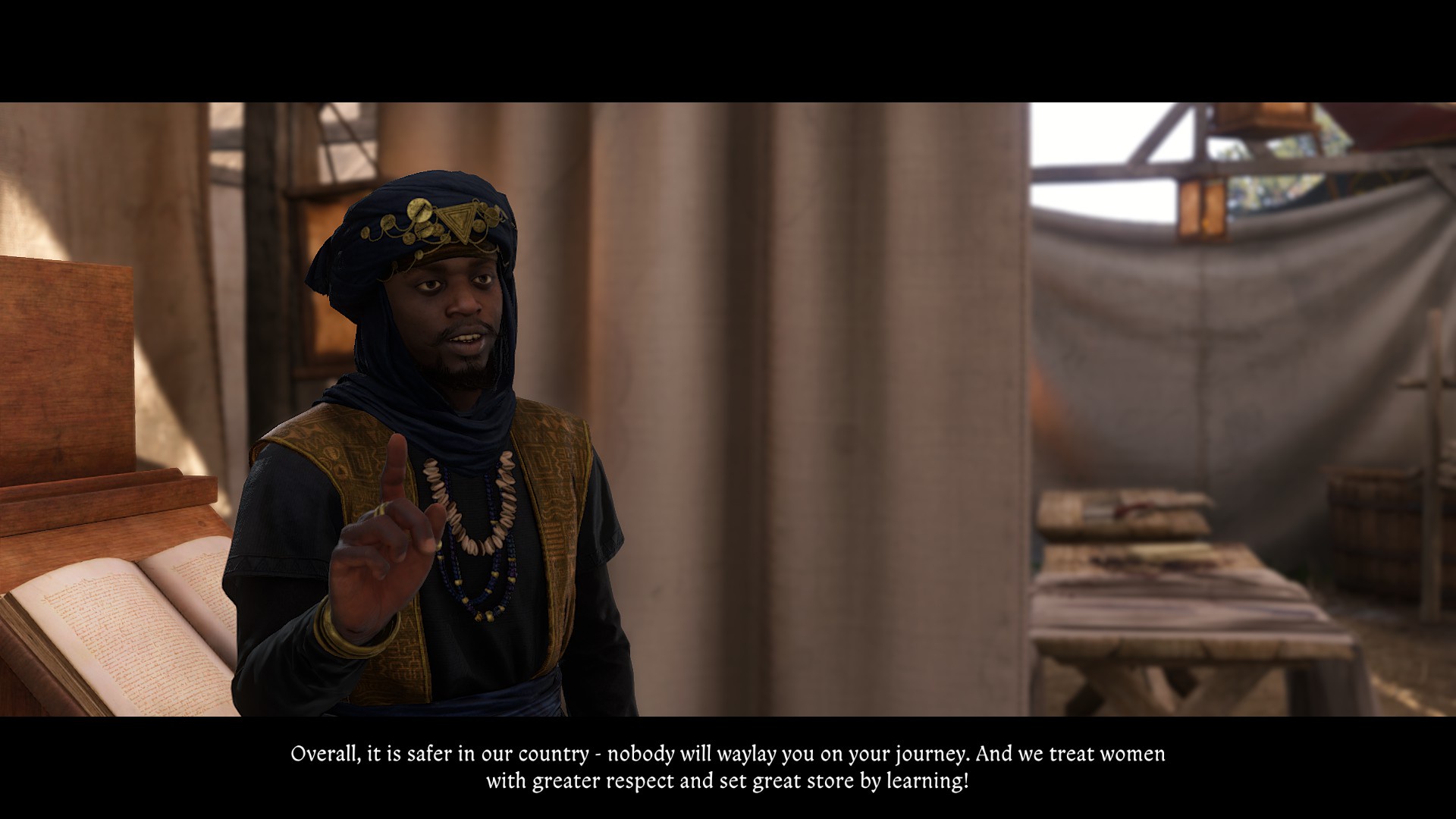
First off, looking at the image, it features a character named Musa of Mali, who is introduced as a scholar, explorer, and physician running the camp infirmary. He's dressed in traditional attire, including a turban and a decorative vest, and he's standing in what appears to be an indoor setting with wooden furniture and some fabric backdrop.
To start with, I should look for signs that might indicate whether this is a real in-game screenshot or if it's been tampered with or created artificially. One of the first things to check is for compression artifacts. These can often be seen as blocky areas or banding in the image, particularly in areas of gradient or fine detail.
Looking closely at the image, I don't see any obvious blockiness or pixelation that would suggest heavy compression. The character's face, clothing, and the background all appear smooth without discontinuities that might indicate compression artifacts.
Next, I should examine the image for consistency in lighting and shadows. In video game renders, especially if they're high-quality, lighting should be coherent and realistic. In this image, the lighting seems natural, with soft shadows cast by the character and furniture, suggesting a well-simulated environment.
Another aspect to consider is the rendering quality of the character models and environments. Video games have varying levels of detail, but modern games can produce highly realistic visuals. Musa's facial features and clothing details look intricate and well-textured, which aligns with what you might expect from a contemporary video game.
I should also check for any inconsistencies in the text or dialogue. The text at the bottom reads, "Musa of Mali is my name. Scholar, explorer and physician. I run the camp infirmary." This seems coherent and fits the character's appearance and setting.
Additionally, I can look for signs of digital manipulation such as cloning, stitching, or editing that might indicate the image has been altered after being captured from the game. However, without access to specialized software, this might be challenging. Still, a thorough visual inspection can reveal some anomalies.
Looking at the character's turban, I can see detailed patterns and folds, which suggest careful modeling and texturing. The beads around his neck also have a realistic sheen, indicating good material rendering.
The background elements, such as the wooden furniture and fabric backdrop, also appear well-rendered with appropriate textures and lighting. There doesn't seem to be any discrepancy in the quality between the foreground and background, which would be a red flag for possible manipulation.
Another thing to consider is the resolution of the image. Higher resolution images are less likely to show compression artifacts and look sharper. This image appears to be of high resolution, with clear details throughout.
Furthermore, checking for sharpness and focus is important. The character is in sharp focus, while the background is slightly blurred, which is a common depth of field effect in video games to emphasize the main subject.
Lastly, I should consider the overall composition and design of the image. It follows a standard setup for a character introduction in a game, with the character centered and facing the camera, allowing players to get a good look at their appearance and attire.
After examining these various aspects, I don't see any immediate signs of digital manipulation or compression artifacts that would cast doubt on the image's authenticity as a video game screenshot. Everything appears consistent with what one would expect from a high-quality in-game render.
However, it's important to note that sophisticated editing techniques can sometimes hide signs of manipulation, and without access to the original source or additional context, it's impossible to be absolutely certain. But based on the visual evidence available, it's reasonable to conclude that the image is likely a genuine screenshot from a video game.
Final Answer
The image appears to be a genuine screenshot from a video game without evident digital manipulation or compression artifacts.