
We have a Steam curator now. You should be following it. https://store.steampowered.com/curator/44994899-RPGHQ/

Various role-playing RPG game stuff not deserving its own thread
-
rusty_shackleford

- Site Admin
- Posts: 45468
- Joined: Feb 2, '23
- Gender: Watermelon
-
Geolocation
Adventurer's Guild


@WhiteShark I won't claim to have a tenth of the knowledge on the subject that Tolkien had, and the elves in his work were directly inspired by men before the fall. IIRC. I have no source for this claim, but I'd say with almost certainty that he wouldn't have made such a connection in his work without a good reason to do so. You might be able to find more about this by looking into his work/research.
Thank you for your attention to this matter!
Steam friend code: 40552640 https://steamcommunity.com/friends/add | email: [email protected]
Having trouble running an old Windows game?
Rusty's Stuff Collection
Steam friend code: 40552640 https://steamcommunity.com/friends/add | email: [email protected]
Having trouble running an old Windows game?
Rusty's Stuff Collection
-
Unhelpful Contrarian

- Posts: 3187
- Joined: Aug 24, '24
-
Geolocation
Nah. The game is straight up good.
-
WhiteShark

- Site Moderator
- Posts: 5056
- Joined: Feb 2, '23
-
Geolocation
Adventurer's Guild


But what is an elf?rusty_shackleford wrote: ↑ September 2nd, 2024, 04:13It means exactly what it says on the tin: elf.
Opinions seem divided. I think it's reasonable to assume that, given the positive associations you've shown, elves were regarded as wise, bright, and powerful, but whether they were benevolent or not is less clear. Regardless, whatever the perceptions thereof, they can only be angels or demons, and those are essentially the same thing: spirits. Perhaps our ancestors had encounters with both varieties.Wikipedia wrote:The Old English forms are cognates – linguistic siblings stemming from a common origin – with medieval Germanic terms such as Old Norse alfr ('elf'; plural alfar), Old High German alp ('evil spirit'; pl. alpî, elpî; feminine elbe), Burgundian *alfs ('elf'), and Middle Low German alf ('evil spirit').
[...]
Of the many words for supernatural beings in Germanic languages, the only ones regularly used in personal names are elf and words denoting pagan gods, suggesting that elves were considered similar to gods.
I'll have a look.rusty_shackleford wrote: ↑ September 2nd, 2024, 04:15I won't claim to have a tenth of the knowledge on the subject that Tolkien had, and the elves in his work were directly inspired by men before the fall. IIRC. I have no source for this claim, but I'd say with almost certainty that he wouldn't have made such a connection in his work without a good reason to do so. You might be able to find more about this by looking into his work/research.
-
rusty_shackleford
- Site Admin
- Posts: 45468
- Joined: Feb 2, '23
- Gender: Watermelon
-
Geolocation
Adventurer's Guild
It's worth remembering that Anglo-Saxons aren't "germanics", they're part of the North Sea Germanics group. Old High German is a cousin language to Old English, not a parent language. So, Old Norse is very close to Old English, but Old High German, Burgundian, etc., are quite far.WhiteShark wrote: ↑ September 2nd, 2024, 04:29But what is an elf?rusty_shackleford wrote: ↑ September 2nd, 2024, 04:13It means exactly what it says on the tin: elf.Opinions seem divided. I think it's reasonable to assume that, given the positive associations you've shown, elves were regarded as wise, bright, and powerful, but whether they were benevolent or not is less clear. Regardless, whatever the perceptions thereof, they can only be angels or demons, and those are essentially the same thing: spirits. Perhaps our ancestors had encounters with both varieties.Wikipedia wrote:The Old English forms are cognates – linguistic siblings stemming from a common origin – with medieval Germanic terms such as Old Norse alfr ('elf'; plural alfar), Old High German alp ('evil spirit'; pl. alpî, elpî; feminine elbe), Burgundian *alfs ('elf'), and Middle Low German alf ('evil spirit').
[...]
Of the many words for supernatural beings in Germanic languages, the only ones regularly used in personal names are elf and words denoting pagan gods, suggesting that elves were considered similar to gods.I'll have a look.rusty_shackleford wrote: ↑ September 2nd, 2024, 04:15I won't claim to have a tenth of the knowledge on the subject that Tolkien had, and the elves in his work were directly inspired by men before the fall. IIRC. I have no source for this claim, but I'd say with almost certainty that he wouldn't have made such a connection in his work without a good reason to do so. You might be able to find more about this by looking into his work/research.
Thank you for your attention to this matter!
Steam friend code: 40552640 https://steamcommunity.com/friends/add | email: [email protected]
Having trouble running an old Windows game?
Rusty's Stuff Collection
Steam friend code: 40552640 https://steamcommunity.com/friends/add | email: [email protected]
Having trouble running an old Windows game?
Rusty's Stuff Collection
-
WhiteShark
- Site Moderator
- Posts: 5056
- Joined: Feb 2, '23
-
Geolocation
Adventurer's Guild
I must also note that when I first read what is supposed to be the etymology of elf:
I was immediately reminded of this:Wiktionary wrote:From Middle English elf, from Old English ielf, ælf, from Proto-West Germanic *albi, from Proto-Germanic *albiz. Ultimately probably derived from Proto-Indo-European *h₂elbʰós (“white”).
Saint Paul's Second Epistle to the Corinthians, Chapter 11, Verse 14 wrote:And no marvel; for Satan himself is transformed into an angel of light.
-
rusty_shackleford
- Site Admin
- Posts: 45468
- Joined: Feb 2, '23
- Gender: Watermelon
-
Geolocation
Adventurer's Guild
Those 'proto' languages never existed, FWIW. They're hypothetical reconstructions.WhiteShark wrote: ↑ September 2nd, 2024, 04:41From Middle English elf, from Old English ielf, ælf, from Proto-West Germanic *albi, from Proto-Germanic *albiz. Ultimately probably derived from Proto-Indo-European *h₂elbʰós (“white”).
Thank you for your attention to this matter!
Steam friend code: 40552640 https://steamcommunity.com/friends/add | email: [email protected]
Having trouble running an old Windows game?
Rusty's Stuff Collection
Steam friend code: 40552640 https://steamcommunity.com/friends/add | email: [email protected]
Having trouble running an old Windows game?
Rusty's Stuff Collection
-
Acrux

- Turtle

- Posts: 6559
- Joined: Feb 8, '23
-
Geolocation
Adventurer's Guild


In medieval thought, there was another type of "being" that was outside of humans or spirits: the longaevi or "long lived". Elves, fairies, dwarves, etc would have fallen into this category - there were a lot of theories about where they might fit into the cosmological system. It was thought that they resided somewhere between earth and the air. In accordance with the confusion we see about elves the main theories were that they were:
a natural species somewhere in between humans and angelic beings
spirits of the dead that people occasionally encountered
angels who didn't rebel, but remained "neutral" during the angelic rebellion
fallen angels or demons
C.S. Lewis wrote a book about medieval thought (The Discarded Image) and includes an entire section on them (starts on p. 122):
https://archive.org/details/the-discard ... s/mode/2up
This is a really good book, by the way. It's one of a handful of books that has heavily influenced my thinking on how the world works.
a natural species somewhere in between humans and angelic beings
spirits of the dead that people occasionally encountered
angels who didn't rebel, but remained "neutral" during the angelic rebellion
fallen angels or demons
C.S. Lewis wrote a book about medieval thought (The Discarded Image) and includes an entire section on them (starts on p. 122):
https://archive.org/details/the-discard ... s/mode/2up
This is a really good book, by the way. It's one of a handful of books that has heavily influenced my thinking on how the world works.
Last edited by Acrux on September 2nd, 2024, 04:47, edited 1 time in total.
-
rusty_shackleford
- Site Admin
- Posts: 45468
- Joined: Feb 2, '23
- Gender: Watermelon
-
Geolocation
Adventurer's Guild
@WhiteShark Tolkien refers to this very thing(ælfsciene with respect to Sarah/Judith) in one of his letters. I'm not sure if he had any more knowledge on this topic than we do, and I suspect less as more documents have been found since this was written.
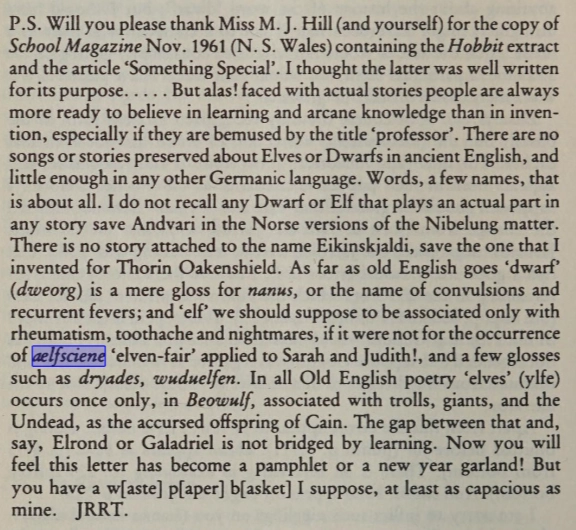
Also, he's (of course) correct about the Beowulf part, which I either subconsciously omitted or forgot. On the 'undead' part, the word is 'orcneas'(yes, orcneas) he's referring to. Which possibly gives more context to why orcs exist as they do in LotR. He also says "trolls, giants" but the text only states "eotenas": modern English ettins — jotun, not trolls, along with giants. That is, it did not equate ettins(jotun) with giants.
It seems there was no agreement as to what elves actually were. I suspect he was using other North Sea Germanic sources, rather than Old English ones. I know a lot of the dwarves come from Edda.
I have a feeling I actually remembered this from reading this letter prior.
[edit]
But I maintain that using 'ælf' so much, with such a positive connotation, would be quite strange if they were malevolent. Would you, as a pious Christian, be willing to name your child 'demon-gift'?
Also, he's (of course) correct about the Beowulf part, which I either subconsciously omitted or forgot. On the 'undead' part, the word is 'orcneas'(yes, orcneas) he's referring to. Which possibly gives more context to why orcs exist as they do in LotR. He also says "trolls, giants" but the text only states "eotenas": modern English ettins — jotun, not trolls, along with giants. That is, it did not equate ettins(jotun) with giants.
It seems there was no agreement as to what elves actually were. I suspect he was using other North Sea Germanic sources, rather than Old English ones. I know a lot of the dwarves come from Edda.
I have a feeling I actually remembered this from reading this letter prior.
[edit]
But I maintain that using 'ælf' so much, with such a positive connotation, would be quite strange if they were malevolent. Would you, as a pious Christian, be willing to name your child 'demon-gift'?
Last edited by rusty_shackleford on September 2nd, 2024, 05:31, edited 2 times in total.
Thank you for your attention to this matter!
Steam friend code: 40552640 https://steamcommunity.com/friends/add | email: [email protected]
Having trouble running an old Windows game?
Rusty's Stuff Collection
Steam friend code: 40552640 https://steamcommunity.com/friends/add | email: [email protected]
Having trouble running an old Windows game?
Rusty's Stuff Collection
-
WhiteShark
- Site Moderator
- Posts: 5056
- Joined: Feb 2, '23
-
Geolocation
Adventurer's Guild
No, but I did not mean to imply that they were regarded as purely malevolent, for that seems not to have been the case, at least among the Anglo-Saxons. The comparison with pagan gods makes sense to me: wise, powerful, and beings with whom you want a good relationship, but not unconditionally benevolent. If I were a medieval Christian with a belief in 'neutral' or otherwise ambiguous spirits of great power and wisdom and who had an immediate ancestry full of such names, I might name my progeny in such a fashion.rusty_shackleford wrote: ↑ September 2nd, 2024, 05:23But I maintain that using 'ælf' so much, with such a positive connotation, would be quite strange if they were malevolent. Would you, as a pious Christian, be willing to name your child 'demon-gift'?
-
Silvanus

- Posts: 76
- Joined: Aug 15, '24
-
Geolocation
In most instances they indubitably existed, but the hypothetical reconstruction may not perfectly reflect how they were spoken. For example, in the absence of recorded Latin literature, a Latin reconstruction would lack the common "-us" suffix.rusty_shackleford wrote: ↑ September 2nd, 2024, 04:43Those 'proto' languages never existed, FWIW. They're hypothetical reconstructions.WhiteShark wrote: ↑ September 2nd, 2024, 04:41From Middle English elf, from Old English ielf, ælf, from Proto-West Germanic *albi, from Proto-Germanic *albiz. Ultimately probably derived from Proto-Indo-European *h₂elbʰós (“white”).
The North Sea Germanics form a branch of the West Germanic family, of which Old High German is another member. Old Norse belongs to the North Germanic family, having separated from Proto-Germanic prior to the North Sea Germanics.rusty_shackleford wrote: ↑ September 2nd, 2024, 04:35It's worth remembering that Anglo-Saxons aren't "germanics", they're part of the North Sea Germanics group. Old High German is a cousin language to Old English, not a parent language. So, Old Norse is very close to Old English, but Old High German, Burgundian, etc., are quite far.
-
Mondain
- Posts: 382
- Joined: Dec 10, '23
-
Geolocation
He's rightSilvanus wrote: ↑ September 2nd, 2024, 07:16In most instances they indubitably existed, but the hypothetical reconstruction may not perfectly reflect how they were spoken. For example, in the absence of recorded Latin literature, a Latin reconstruction would lack the common "-us" suffix.rusty_shackleford wrote: ↑ September 2nd, 2024, 04:43Those 'proto' languages never existed, FWIW. They're hypothetical reconstructions.WhiteShark wrote: ↑ September 2nd, 2024, 04:41From Middle English elf, from Old English ielf, ælf, from Proto-West Germanic *albi, from Proto-Germanic *albiz. Ultimately probably derived from Proto-Indo-European *h₂elbʰós (“white”).
The North Sea Germanics form a branch of the West Germanic family, of which Old High German is another member. Old Norse belongs to the North Germanic family, having separated from Proto-Germanic prior to the North Sea Germanics.rusty_shackleford wrote: ↑ September 2nd, 2024, 04:35It's worth remembering that Anglo-Saxons aren't "germanics", they're part of the North Sea Germanics group. Old High German is a cousin language to Old English, not a parent language. So, Old Norse is very close to Old English, but Old High German, Burgundian, etc., are quite far.
https://en.wikipedia.org/wiki/Old_English
The influence of Old Norse certainly helped move English from a synthetic language along the continuum to a more analytic word order, and Old Norse most likely made a greater impact on the English language than any other language.[2][28]
Old Norse and old English are sister languages despite classificationsThe strength of the Viking influence on Old English appears from the fact that the indispensable elements of the language – pronouns, modals, comparatives, pronominal adverbs (like hence and together), conjunctions and prepositions – show the most marked Danish influence; the best evidence of Scandinavian influence appears in the extensive word borrowings because, as Jespersen indicates, no texts exist in either Scandinavia or Northern England from this time to give certain evidence of an influence on syntax. The effect of Old Norse on Old English was substantive, pervasive, and of a democratic character.[2][27] Old Norse and Old English resembled each other closely like cousins, and with some words in common, speakers roughly understood each other;[27] in time the inflections melted away and the analytic pattern emerged.[30][32] It is most important to recognize that in many words the English and Scandinavian language differed chiefly in their inflectional elements. The body of the word was so nearly the same in the two languages that only the endings would put obstacles in the way of mutual understanding. In the mixed population which existed in the Danelaw, these endings must have led to much confusion, tending gradually to become obscured and finally lost. This blending of peoples and languages resulted in "simplifying English grammar".[2]
Anyone who speaks Norwegian, Danish or Swedish knows this, English is much closer than german
Last edited by Mondain on September 2nd, 2024, 07:27, edited 1 time in total.
-
Silvanus
- Posts: 76
- Joined: Aug 15, '24
-
Geolocation
I don't disagree, but substrates do not change classification.Mondain wrote: ↑ September 2nd, 2024, 07:24Old Norse and old English are sister languages despite classifications
Anyone who speaks Norwegian, Danish or Swedish knows this, English is much closer than german
I'm not certain that the analytic nature of English can be attributed primarily to Old Norse influence given that Anglo-Saxon is far more synthetic than Modern English.Mondain wrote: ↑ September 2nd, 2024, 07:24The influence of Old Norse certainly helped move English from a synthetic language along the continuum to a more analytic word order, and Old Norse most likely made a greater impact on the English language than any other language.[2][28]
Last edited by Silvanus on September 2nd, 2024, 07:55, edited 1 time in total.
-
Irenaeus

- Posts: 10784
- Joined: Sep 29, '23
-
Geolocation
That's what I came to understand. Elf means White.WhiteShark wrote: ↑ September 2nd, 2024, 04:41I must also note that when I first read what is supposed to be the etymology of elf:Wiktionary wrote:From Middle English elf, from Old English ielf, ælf, from Proto-West Germanic *albi, from Proto-Germanic *albiz. Ultimately probably derived from Proto-Indo-European *h₂elbʰós (“white”).
Iren's Play-by-post: General Discussion
Upcoming: Karatasian Kings - A CK2 Random World LP
Winner of RPGHQ4 - The Search For Vengeance
Upcoming: Karatasian Kings - A CK2 Random World LP
Winner of RPGHQ4 - The Search For Vengeance
-
Rand

- Posts: 6640
- Joined: Sep 4, '23
- Location: On my last legs
-
Geolocation
Adventurer's Guild
Merlin, Moses, and Jesus are all famous and good-aligned spellcasters, though only one is described as a sorceror.Hauberk wrote: ↑ August 30th, 2024, 18:44PSA (food for thought for your next RPG session):
2.) There are no good spell casters, wizards, sorcerors, etc. in history. Not a single one.
Last edited by Rand on September 2nd, 2024, 15:30, edited 1 time in total.
You may as well not bother replying to my posts if it's to argue anything except concrete facts or your personal opinion. I still probably won't see it.
Reject your retarded-wing political programming and learn to think.
If you can.
Reject your retarded-wing political programming and learn to think.
If you can.
-
Hauberk
- Posts: 667
- Joined: Nov 16, '23
-
Geolocation
The first one was a satanic half-devil. The latter two are not spell casters.Rand wrote: ↑ September 2nd, 2024, 15:27Merlin, Moses, and Jesus are all famous and good-aligned spellcasters, though only one is described as a sorceror.Hauberk wrote: ↑ August 30th, 2024, 18:44PSA (food for thought for your next RPG session):
2.) There are no good spell casters, wizards, sorcerors, etc. in history. Not a single one.
-
Rand
- Posts: 6640
- Joined: Sep 4, '23
- Location: On my last legs
-
Geolocation
Adventurer's Guild
Quibbling about nomenclature?Hauberk wrote: ↑ September 2nd, 2024, 16:26The first one was a satanic half-devil. The latter two are not spell casters.Rand wrote: ↑ September 2nd, 2024, 15:27Merlin, Moses, and Jesus are all famous and good-aligned spellcasters, though only one is described as a sorceror.Hauberk wrote: ↑ August 30th, 2024, 18:44PSA (food for thought for your next RPG session):
2.) There are no good spell casters, wizards, sorcerors, etc. in history. Not a single one.
They're all magic users.
Last edited by Rand on September 2nd, 2024, 16:48, edited 1 time in total.
You may as well not bother replying to my posts if it's to argue anything except concrete facts or your personal opinion. I still probably won't see it.
Reject your retarded-wing political programming and learn to think.
If you can.
Reject your retarded-wing political programming and learn to think.
If you can.
-
maidenhaver

- Posts: 9452
- Joined: Apr 17, '23
- Location: ROLE PLAYING GAME
-
Geolocation
Adventurer's Guild

Qrd on Merlin?Hauberk wrote: ↑ September 2nd, 2024, 16:26The first one was a satanic half-devil. The latter two are not spell casters.Rand wrote: ↑ September 2nd, 2024, 15:27Merlin, Moses, and Jesus are all famous and good-aligned spellcasters, though only one is described as a sorceror.Hauberk wrote: ↑ August 30th, 2024, 18:44PSA (food for thought for your next RPG session):
2.) There are no good spell casters, wizards, sorcerors, etc. in history. Not a single one.
-
Hauberk
- Posts: 667
- Joined: Nov 16, '23
-
Geolocation
I expect one of our resident experts will chime in soon.Lazy wikipedia quote wrote:Merlin's traditional biography casts him as an often-mad cambion, born of a mortal woman and an incubus, from whom he inherits his supernatural powers and abilities.
-
Hauberk
- Posts: 667
- Joined: Nov 16, '23
-
Geolocation
No. God is responsible for any miracles.
-
Stack of Turtles

- Posts: 7041
- Joined: May 7, '24
- Location: Soon-to-be Iran
-
Geolocation


What else do you think good magic would be?
VAE VICTIS
-
rusty_shackleford
- Site Admin
- Posts: 45468
- Joined: Feb 2, '23
- Gender: Watermelon
-
Geolocation
Adventurer's Guild
Old High German is further from Old English than Old Norse is, regardless of language family lineage. Old Norse and Old English had regular contact with each other, Old High German and Old English branched off from each other and became separate languages.Silvanus wrote: ↑ September 2nd, 2024, 07:16In most instances they indubitably existed, but the hypothetical reconstruction may not perfectly reflect how they were spoken. For example, in the absence of recorded Latin literature, a Latin reconstruction would lack the common "-us" suffix.rusty_shackleford wrote: ↑ September 2nd, 2024, 04:43Those 'proto' languages never existed, FWIW. They're hypothetical reconstructions.WhiteShark wrote: ↑ September 2nd, 2024, 04:41From Middle English elf, from Old English ielf, ælf, from Proto-West Germanic *albi, from Proto-Germanic *albiz. Ultimately probably derived from Proto-Indo-European *h₂elbʰós (“white”).
The North Sea Germanics form a branch of the West Germanic family, of which Old High German is another member. Old Norse belongs to the North Germanic family, having separated from Proto-Germanic prior to the North Sea Germanics.rusty_shackleford wrote: ↑ September 2nd, 2024, 04:35It's worth remembering that Anglo-Saxons aren't "germanics", they're part of the North Sea Germanics group. Old High German is a cousin language to Old English, not a parent language. So, Old Norse is very close to Old English, but Old High German, Burgundian, etc., are quite far.
"Old English and its Closest Relatives: A Survey of the Earliest Germanic Languages"(can be found on e.g., z-library) is a decent read for this. In the concluding chapter they go so far as to suggest that the germanic languages can't be grouped as a tree because of repeated divergence and convergence. The current working theory is that Old Norse and Old English were most likely mutually intelligible, refer to works by Matthew Townend(e.g., "Language and History in Viking Age England: Linguistic Relations between Speakers of Old Norse and Old English" or more recent works.) Some go as far to suggest they were part of a language continuum rather than separate languages(e.g., Jackson Crawford, an expert in Old Norse), but I'm not sure if I'd say that.
From The Cambridge History of the English Language, Vol II(1992):
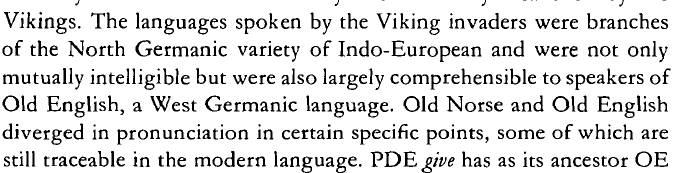
Old High German would have almost certainly not been mutually intelligible (i.e., Second Germanic Consonant Shift and such)
Thank you for your attention to this matter!
Steam friend code: 40552640 https://steamcommunity.com/friends/add | email: [email protected]
Having trouble running an old Windows game?
Rusty's Stuff Collection
Steam friend code: 40552640 https://steamcommunity.com/friends/add | email: [email protected]
Having trouble running an old Windows game?
Rusty's Stuff Collection
-
Acrux
- Turtle
- Posts: 6559
- Joined: Feb 8, '23
-
Geolocation
Adventurer's Guild
Yeah, there's really not too much more to tell other than that. I'm not aware of anything that gives more detail on Merlin's childhood.Hauberk wrote: ↑ September 2nd, 2024, 17:00I expect one of our resident experts will chime in soon.Lazy wikipedia quote wrote:Merlin's traditional biography casts him as an often-mad cambion, born of a mortal woman and an incubus, from whom he inherits his supernatural powers and abilities.
http://www.earlybritishkingdoms.com/bio ... t on earth.
Incidentally, Merlin's ancestry is a plot point in That Hideous Strength, as he's needed in the fight against NICE as someone who would "legally" be allowed to use magic.Merlin was the illegitimate son of a monastic Royal Princess of Dyfed. The lady's father, however, King Meurig ap Maredydd ap Rhain, is not found in the traditional pedigrees of this kingdom and was probably a sub-King of the region bordering on Ceredigion. Merlin's father, it is said, was an angel who had visited the Royal nun and left her with child. Merlin's enemies claimed his father was really an incubus, an evil spirit that has intercourse with sleeping women. The evil child was supposed to provide a counterweight to the good influence of Jesus Christ on earth. Merlin, fortunately, was baptized early on in his life, an event which is said to have negated the evil in his nature, but left his powers intact. The original story may have been invented to save his mother from the scandal which would have occurred had her liaison with one Morfyn Frych (the Freckled), a minor Prince of the House of Coel, been made public knowledge. Although, chronologically speaking, this man fits better as the father of the Northern Merlin (See below).
Last edited by Acrux on September 2nd, 2024, 17:55, edited 1 time in total.
-
WhiteShark
- Site Moderator
- Posts: 5056
- Joined: Feb 2, '23
-
Geolocation
Adventurer's Guild
There is no good magic. Magic is the practice of getting demons to do things for you, which is necessarily evil and the reason it's forbidden in the Bible. Some real-life sorcerers claim to practice 'white' (good) magic, as opposed to 'black' (evil) magic, but this is either spiritual delusion or intentional deception. If you want to put both magic and miracles in a single category, you have to call it something like 'supernatural acts'. When the **** call Jesus Christ a sorcerer in the Talmud, it's meant as a blasphemous defamation, not a neutral descriptor.
-
maidenhaver
- Posts: 9452
- Joined: Apr 17, '23
- Location: ROLE PLAYING GAME
-
Geolocation
Adventurer's Guild
How do we get good magicians in rpgs, if magic has to be evil?
-
Val the Moofia Boss

- Turtle
- Posts: 4198
- Joined: Jun 3, '23
-
Geolocation
Adventurer's Guild


They have to have been given authority/blessed by God. Or it's just manipulating the laws of physics of that world and isn't anything spiritual in nature.maidenhaver wrote: ↑ September 2nd, 2024, 18:28How do we get good magicians in rpgs, if magic has to be evil?
-
logincrash

- The Music Man
- Posts: 6040
- Joined: Sep 3, '23
- Location: Niger
-
Geolocation
Adventurer's Guild


'Cause nobody wants to have a child with a manlet.
"Oh, it all makes sense now, brother."
-
Stack of Turtles
- Posts: 7041
- Joined: May 7, '24
- Location: Soon-to-be Iran
-
Geolocation
This is just a difference in defining the term "magic". To most people, magic isn't specifically used in the sense in your second sentence, but means anything sufficiently inexplicable and supernatural.WhiteShark wrote: ↑ September 2nd, 2024, 18:24There is no good magic. Magic is the practice of getting demons to do things for you, which is necessarily evil and the reason it's forbidden in the Bible. Some real-life sorcerers claim to practice 'white' (good) magic, as opposed to 'black' (evil) magic, but this is either spiritual delusion or intentional deception. If you want to put both magic and miracles in a single category, you have to call it something like 'supernatural acts'. When the **** call Jesus Christ a sorcerer in the Talmud, it's meant as a blasphemous defamation, not a neutral descriptor.
VAE VICTIS
-
rusty_shackleford
- Site Admin
- Posts: 45468
- Joined: Feb 2, '23
- Gender: Watermelon
-
Geolocation
Adventurer's Guild
Umli from Middle Earth Roleplaying. They're based on this line from Tolkien:
swarthy Easterlings who have beards like dwarves and wield great axes
Thank you for your attention to this matter!
Steam friend code: 40552640 https://steamcommunity.com/friends/add | email: [email protected]
Having trouble running an old Windows game?
Rusty's Stuff Collection
Steam friend code: 40552640 https://steamcommunity.com/friends/add | email: [email protected]
Having trouble running an old Windows game?
Rusty's Stuff Collection
-
rusty_shackleford
- Site Admin
- Posts: 45468
- Joined: Feb 2, '23
- Gender: Watermelon
-
Geolocation
Adventurer's Guild
Have a higher over-deity that is implied to be God, barely mention said deity. All lower deities flow from God. Bam, all magic is biblically-approved magicmaidenhaver wrote: ↑ September 2nd, 2024, 18:28How do we get good magicians in rpgs, if magic has to be evil?
 .
.Thank you for your attention to this matter!
Steam friend code: 40552640 https://steamcommunity.com/friends/add | email: [email protected]
Having trouble running an old Windows game?
Rusty's Stuff Collection
Steam friend code: 40552640 https://steamcommunity.com/friends/add | email: [email protected]
Having trouble running an old Windows game?
Rusty's Stuff Collection
-
maidenhaver
- Posts: 9452
- Joined: Apr 17, '23
- Location: ROLE PLAYING GAME
-
Geolocation
Adventurer's Guild