

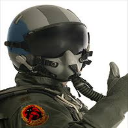

The old Knight is somewhat of an "Obi-Wan" mentor character to the protagonist and also a father figure. He was ordered to flee the kingdom with the then prince who was either a baby. as the castle was being besieged by a powerful force that had conquered the continent. He regretfully complies with the vow of raising the young Prince, keep him safe and preparing him to taking back Cornia, his birthright. And yet, in dialogue he always addresses Allain, the Prince and main character's name, as "my Lord". Other characters, including his childhood friends also do it like this. The only exception is the blonde, well endowed female cleric who the game really wants to pair with the main character but the Player gets to choose which character takes as Allain's bride. Nevertheless, it is shown that amongst the 3 kids that grew up with the Prince, Scarlett (said blonde cleric) is closer to him than the rest and he cares for her in a special fashion, whether love or not is up to the player to decide but she does have romantic feelings for him. I believe she calls him "Allain". It's been a couple of years now so I don't remember exactly, but I seem to recall his best friend and soldier calls him Allain as well, but said old Knight will correct him when he does so in public, stressing that he must address the Prince with the proper deference.Val the Moofia Boss wrote: ↑ June 21st, 2026, 21:01I have not played Unicorn Overlord, but how formal is the relationship between the lord character and the retainers in this case? In JRPGs/anime, class formalities with the heroes are usually very light/superficial or just nonexistent. You have the prince party member chilling and bantering with his low ranking knight or even commoner friends. I am hard pressed to think of many anime/JRPGs in which there were formal boundaries you do not ever cross, such as Ascendance of a Bookworm.Cipher wrote: ↑ June 21st, 2026, 20:04In anime, stuff like this happens all the time. "Tanomu!" which could roughly be translated in a context like this as "I am counting on you!" or "Makasero!" which can be roughly translated to "leave it to me!" or maybe "I got this!"
One word becomes a few, to a handful of words. Are you really going to tell me in American media you get stuff like this? One retainer just answers "Yup!" to his Lord when his Lord tasks him to hold this hill? Remember, its one single word. What would "Makasero" become in that context, if you could only use one word?
It also depends on the context in which the character lines are being said (to the in person lord, or to the player controlling the characters from above?). Trails, Valkyria Chronicles, etc also has characters say things such as "leave it to me" when it becomes their turn, saying it out loud to no actual character in the story but to the player.
They usually would say "Prince" (Ouji) or I believe it was "denka" (Your Highness). But, it could be that the old knight uses the more specific "waka" which could be roughly translated to "Young Lord". I don't remember exactly but I am pretty confident that there's always deference in the way he addresses the main character even if he is essentially his surrogate father and "family" at this point.
And of course, we can't really take the Japanese way of doing things and assume its the right way it would happen in medieval Europe.
You can also see this phenomenon in reverse, where Japanese would use more words than required, such as ending a phrase with "kashira" which roughly translates to something like "maybe?" or "I wonder?".
A popular character that does this comes to mind if Beatrice from Re:Zero who uses it as essentially her "verbal tic" something also extremely common in anime and games that use anime conventions. She finishes every single sentence with "kashira". The subs translate it literally, and a lot of times the sentences feel really awkward.
There's also the case of Lamia Loveless, a character debuting in Super Robot Wars Original Generation 2 in the GBA who has a very strange verbal tic in Japanese (from what I read, I played the game in English when it came out) that makes it so her speech pattern where she fragments grammar or use improper grammar. The localizers changed it into a stutter. Was this the best approach? I don't know, but Japanese are extremely fond of wordplay and puns and they love giving characters specific verbal tics, like a cat girl would insert "nya", which is the equivalent of "meow" for us, in every single sentence.
Sometimes, that can be easy, specially in a silly setting. So, said character would say something like "leave it to meow!" instead of "leave it to me!". But, Japanese find a way to insert it in every single sentence, whereas in English, if there's no word with "m" or "me" it becomes hard and awkward. How would you localize that?
It requires someone with intimate knowledge of both English and Japanese to come up with a line that has a word that can be used to be turned into "meow" while still keeping the sentence understandable and, if we want to stay true to the source material, it should flow in a way to make it almost invisible, contrary to just say "sure thing, meow!" which would be adding it to keep it there and maintain the idea of the character saying "meow" in every sentence but without the word play that is a key part of the way the character is writen.
Personally, I don't think it would be a great loss to just drop that. Americans don't have an equivalent for that, as far as I remember. But such verbal tics are extremely common in anime and games using anime conventions in their writing. I'll rather be closer to the source material than not, but some things don't really have an equivalent.
Additionally, just because "it's Japanese!" or "it's anime!" doesn't mean the writing is actually good. But, series that are otherwise very serious contain characters with such silly verbal tics that would stand out a lot in an equivalent American cartoon. Because sometimes the character is clearly a mascot, like Snarf for the Thundercats, meant for comic relief.
Sometimes they are not. They are a character that is otherwise supposed to be taken seriously, yet still will have a silly way of speaking just because Japanese really really like their word play and puns.



 ँ़── .✦.𖥔 ݁ ˖


