

Why are WRPG players always complaining about "the illusion of choice?"
-
Val the Moofia Boss

- Turtle

- Posts: 4199
- Joined: Jun 3, '23
-
Geolocation
Adventurer's Guild


 Why are WRPG players always complaining about "the illusion of choice?"
Tags:
-
UltraFan123

- Posts: 2647
- Joined: May 25, '24
- Gender: Potato
-
Geolocation
Several other CRPGs are pride themselves in "impactful decisions" at the end usually only offer different flavors of the same thing, like Wrath of the Righteous where it doesn't really matters what mythic path you took nor your alignment, at the end you always close the Worldwound and ascend into a higher being, the only real differences are how you close the Worldwound and what type of being you ascend into.
-
Vlajdimir Ermenović

- Posts: 648
- Joined: Apr 18, '23
- Location: a country
- Gender: Lemon
-
Geolocation

-
Vaako

- Posts: 1544
- Joined: Oct 17, '23
-
Geolocation
-
J1M

- Turtle
- Posts: 5068
- Joined: Feb 15, '23
-
Geolocation
Adventurer's Guild


Because the marketing doesn't claim "you can make a lot of choices that don't matter". And gamers are right to point out when promised features are not delivered.Val the Moofia Boss wrote: ↑ February 1st, 2025, 22:18It feels like this has been a complaint since time immemorial. WRPG players sure like to talk about "your choices matter" a lot, but with the WRPGs I am familiar with, they don't. In Mass Effect, none of your choices matter. Whether you choose to kill or spare the Rachini Queen doesn't matter. Whether you choose to kill Wrex doesn't matter. Whether you choose to save or spare the Citadel council doesn't matter. Whether you talk the bad guy into killing himself doesn't matter, it just skips the first phase of the final fight. Everything you do leads to the same conclusion. And then reading codex posts on BG3, you again see people complaining that the main story always plays out the same way. It feels like what these WRPG players really want is full blown diverging routes/campaigns like what you see in Japanese SRPGs and visual novels. Is there a reason why WRPGs don't do this?
-
Val the Moofia Boss
- Turtle
- Posts: 4199
- Joined: Jun 3, '23
-
Geolocation
Adventurer's Guild
It is scummy when marketing does that, but at this point WRPG fans should know that historically (from my perspective) WRPGs don't really deliver on that and should be able to anticipate what it will actually be like.J1M wrote: ↑ February 1st, 2025, 23:51Because the marketing doesn't claim "you can make a lot of choices that don't matter". And gamers are right to point out when promised features are not delivered.Val the Moofia Boss wrote: ↑ February 1st, 2025, 22:18It feels like this has been a complaint since time immemorial. WRPG players sure like to talk about "your choices matter" a lot, but with the WRPGs I am familiar with, they don't. In Mass Effect, none of your choices matter. Whether you choose to kill or spare the Rachini Queen doesn't matter. Whether you choose to kill Wrex doesn't matter. Whether you choose to save or spare the Citadel council doesn't matter. Whether you talk the bad guy into killing himself doesn't matter, it just skips the first phase of the final fight. Everything you do leads to the same conclusion. And then reading codex posts on BG3, you again see people complaining that the main story always plays out the same way. It feels like what these WRPG players really want is full blown diverging routes/campaigns like what you see in Japanese SRPGs and visual novels. Is there a reason why WRPGs don't do this?
-
J1M
- Turtle
- Posts: 5068
- Joined: Feb 15, '23
-
Geolocation
Adventurer's Guild
And companies should know that players will complain about marketing lies.Val the Moofia Boss wrote: ↑ February 1st, 2025, 23:57It is scummy when marketing does that, but at this point WRPG fans should know that historically (from my perspective) WRPGs don't really deliver on that and should be able to anticipate what it will actually be like.J1M wrote: ↑ February 1st, 2025, 23:51Because the marketing doesn't claim "you can make a lot of choices that don't matter". And gamers are right to point out when promised features are not delivered.Val the Moofia Boss wrote: ↑ February 1st, 2025, 22:18It feels like this has been a complaint since time immemorial. WRPG players sure like to talk about "your choices matter" a lot, but with the WRPGs I am familiar with, they don't. In Mass Effect, none of your choices matter. Whether you choose to kill or spare the Rachini Queen doesn't matter. Whether you choose to kill Wrex doesn't matter. Whether you choose to save or spare the Citadel council doesn't matter. Whether you talk the bad guy into killing himself doesn't matter, it just skips the first phase of the final fight. Everything you do leads to the same conclusion. And then reading codex posts on BG3, you again see people complaining that the main story always plays out the same way. It feels like what these WRPG players really want is full blown diverging routes/campaigns like what you see in Japanese SRPGs and visual novels. Is there a reason why WRPGs don't do this?
-
Irenaeus

- Posts: 10787
- Joined: Sep 29, '23
-
Geolocation
Yeah, Mass Effect sucks.Val the Moofia Boss wrote: ↑ February 1st, 2025, 22:18In Mass Effect, none of your choices matter. Whether you choose to kill or spare the Rachini Queen doesn't matter. Whether you choose to kill Wrex doesn't matter. Whether you choose to save or spare the Citadel council doesn't matter. Whether you talk the bad guy into killing himself doesn't matter, it just skips the first phase of the final fight. Everything you do leads to the same conclusion.
Upcoming: Karatasian Kings - A CK2 Random World LP
Winner of RPGHQ4 - The Search For Vengeance
-
Just Locus

- Posts: 62
- Joined: Dec 26, '24
-
Geolocation
I do like it when your choices have consequences on a more smaller scale, like side quests for example, I think the lack of meaningful consequences are far less excusable there.
-
WaterMage

- Posts: 2168
- Joined: Sep 30, '23
-
Geolocation
Adventurer's Guild
-
Vergil
- Posts: 15670
- Joined: Sep 6, '23
-
Geolocation

The issue is games are largely a business now and you can't show a bunch of small individual choices like that in a trailer or a pitch to investors. A big glowie prompt to fill your good boy or bad boy juice gauge is simple to do and you can advertise your game around "player choice" when that "choice" is often slightly different dialog. Devs are both incompetent and incentivized to focus on other flashier things. These games are all about marketing now. Western RPGs are the chip bag thats 60% air.Just Locus wrote: ↑ February 2nd, 2025, 00:15Player choice in RPGs is always ideal, whether it be mechanical or narrative. But I think the main reason why WRPG doesn't incorporate player choice and consequences too much and instead resorts to a "Karma System" of sorts that judges you based on the game's main theme (Renegade or Paragon/How 'hardline' of a Witcher you are) is that it lessens the workload on the designers since they're not too washed-down with possibilities and so the writing won't suffer for it.
I do like it when your choices have consequences on a more smaller scale, like side quests for example, I think the lack of meaningful consequences are far less excusable there.
Question is are you going to gargle the truth or swallow?
-
Just Locus
- Posts: 62
- Joined: Dec 26, '24
-
Geolocation
I think the simple issue is that developers don't trust the players as much as they used to, back then they had too much trust in them, to the point that signposting was non-existent and everything was hidden deep in the manual. Now, (and I'd argue this started in FPS games first) Developers don't trust the player to even do basic things and have to relegate it to QTEs, Cut-scenes, or other stuff that doesn't involve the player in any meaningful way.
-
rusty_shackleford

- Site Admin
- Posts: 45474
- Joined: Feb 2, '23
- Gender: Watermelon
-
Geolocation
Adventurer's Guild

The heart of RPGs† is freedom of choice, illusion of choice is a cheap marketing tactic popularized by e.g., Bioware to disguise a linear game as something it's not.
Watch this video from the ***** RPG thread:
There's no way you'd be able to get a tenth of that kind of freedom in a bioware-esque game. You'd get a couple choices that would mostly all converge together.
IMO if you're designing an RPG and you can't kill anyone, then you already messed up. This is often misconstrued by detractors as being able to kill everyone, which purposely misunderstands the point of any single piece being able to be removed and the story still stands. If you have that as your foundation, then it becomes much easier to build a freeform campaign upon it. Compare Starfield, where most named NPCs are now named, to Morrowind — Entirely different design philosophies underpin the games.
BG3 suffers from this after about the halfway mark, therefore it would be natural to see people complain about the design whiplash of suddenly pruning many paths that were before open. This is no surprise, they hired a bunch of bioware game fans to work on the game mid-development after years of purposely making games in the style of the later Ultimas.
† — This refers to games that aren't purposely imitating a specific kind of game that was a product of its time. There are people who enjoy Wizardry & its descendants for being a hack-and-slash dungeon crawling adventure, there is nothing wrong with this.
Steam friend code: 40552640 https://steamcommunity.com/friends/add | email: [email protected]
Having trouble running an old Windows game?
Rusty's Stuff Collection
-
rusty_shackleford
- Site Admin
- Posts: 45474
- Joined: Feb 2, '23
- Gender: Watermelon
-
Geolocation
Adventurer's Guild
Wanted to include this but I thought it was Dragon Magazine that the review was in, but it was Space Gamer. Remembered after posting.rusty_shackleford wrote: ↑ February 2nd, 2025, 03:12† — This refers to games that aren't purposely imitating a specific kind of game that was a product of its time. There are people who enjoy Wizardry & its descendants for being a hack-and-slash dungeon crawling adventure, there is nothing wrong with this.
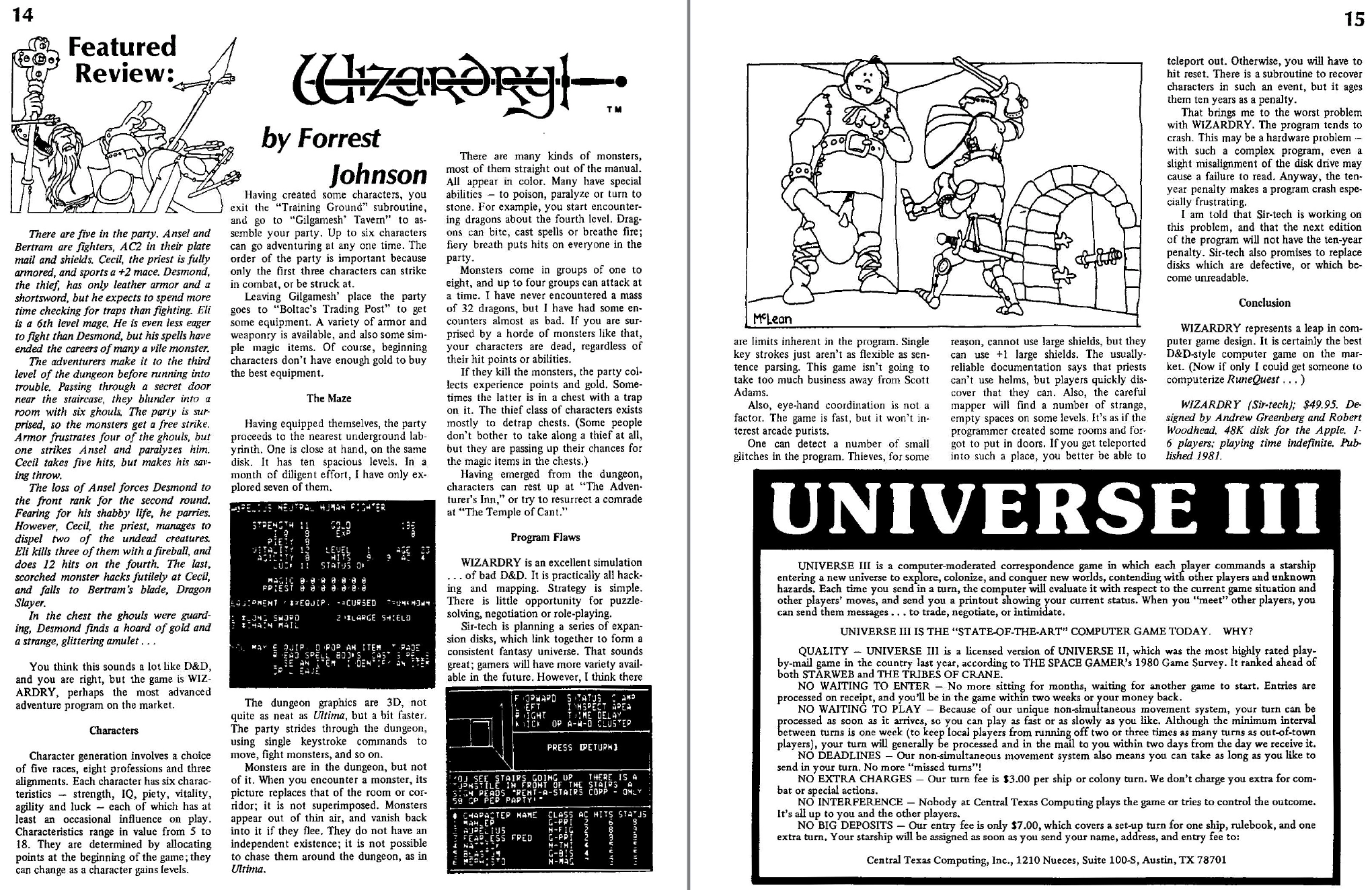
Highlighting: Even in 1981 it was understood that Wizardry was an adaptation of just one part of D&D, and overall was a poor adaptation of the entire genre and what it was capable of.
Steam friend code: 40552640 https://steamcommunity.com/friends/add | email: [email protected]
Having trouble running an old Windows game?
Rusty's Stuff Collection
-
Rand

- Posts: 6640
- Joined: Sep 4, '23
- Location: On my last legs
-
Geolocation
Adventurer's Guild

Although that's a bit misleading.
Compared to prices, most people were paid more and had more disposable income because the necessities were relatively cheaper as a % of income.
Reject your retarded-wing political programming and learn to think.
If you can.