The Necromancer's Tale Review
The Necromancer’s Tale
by Psychic Software gives players a chance to explore the depths of the black arts in a story-driven RPG. The game takes place in the fictionalized Sovereign Monarchy of Rulsthen, around part of the area that would later become Yugoslavia. The player steps into the scene in 1733 as a young noble newly returned home, some time after the military leaders of Rulsthen turned to dark powers to drive back the Republic of Venice. Necromancer’s Tale is a tale of revenge and the consequences of delving into black magic to achieve it. If you’re into playing games for the story, then this might be for you.
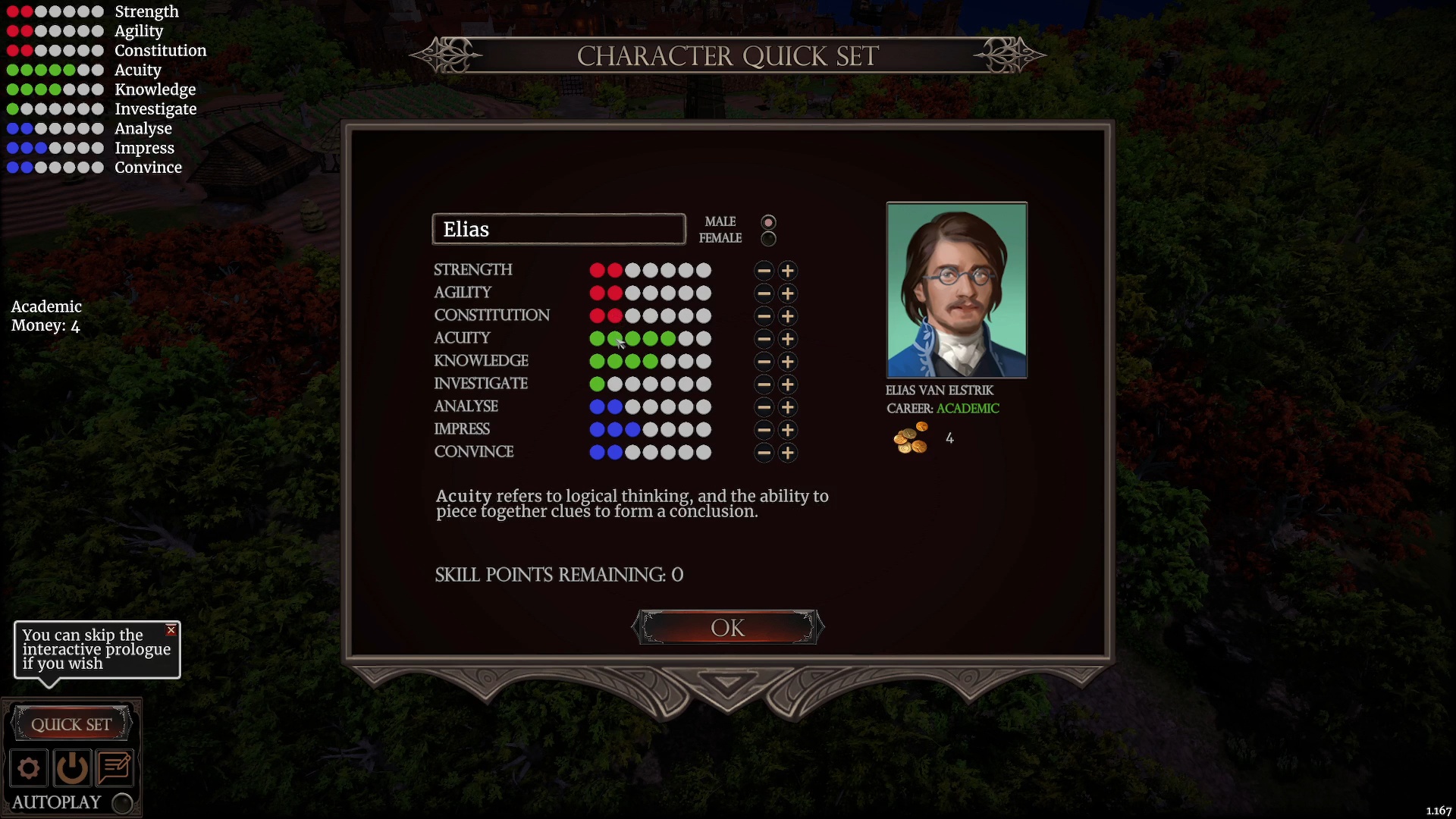
The game begins with a lengthy, but skippable, narrated character creation sequence, which also serves as the backstory dump. It plays out like a choose-your-own-adventure, with the final result being your character. The entire thing is almost thirty minutes long, but if you don’t sit through it at least once, you’ll be left in the dark on a lot of plot points, the biggest being that one of Rulsthen's leaders decided to become a lich and start a separate war, which he lost. Now undead dwell in crypts, and people are afraid to leave the town at night.
TNT offers three difficulty modes. The biggest differences between them are that story mode autoresolves all combat and strategy mode makes it more difficult.
Stats are filed into three categories with three career paths, which play a role in your job occupation and some plot elements. Stats can’t be adjusted after character creation, and there’s no way to gain more later, so you’ll always be at a disadvantage during certain skill checks. All is not lost, though: whenever the game tosses you a check and you come up short, you can spend skill points to make up the difference. Skill points are replenished at the start of every chapter, but they are not cumulative. Some of the challenge becomes knowing when and where to spend points. I kept a mental map of areas that contained static skill checks I hadn’t resolved yet and then spent my leftover points before the end of the chapter (when I could predict they were about to close). Some checks are made during plot-essential moments. I came up short on a few of these and took a beating to my trust.
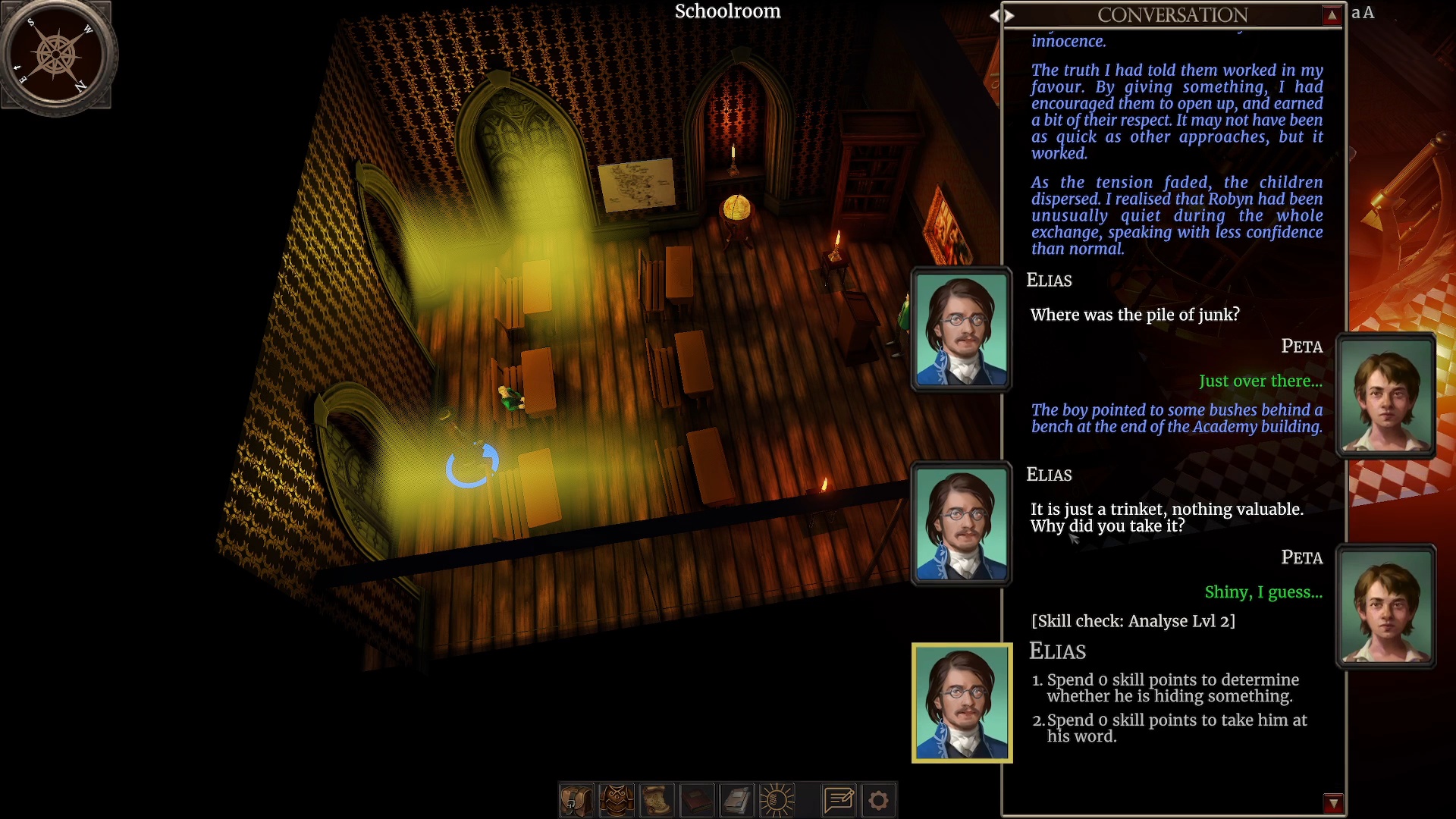
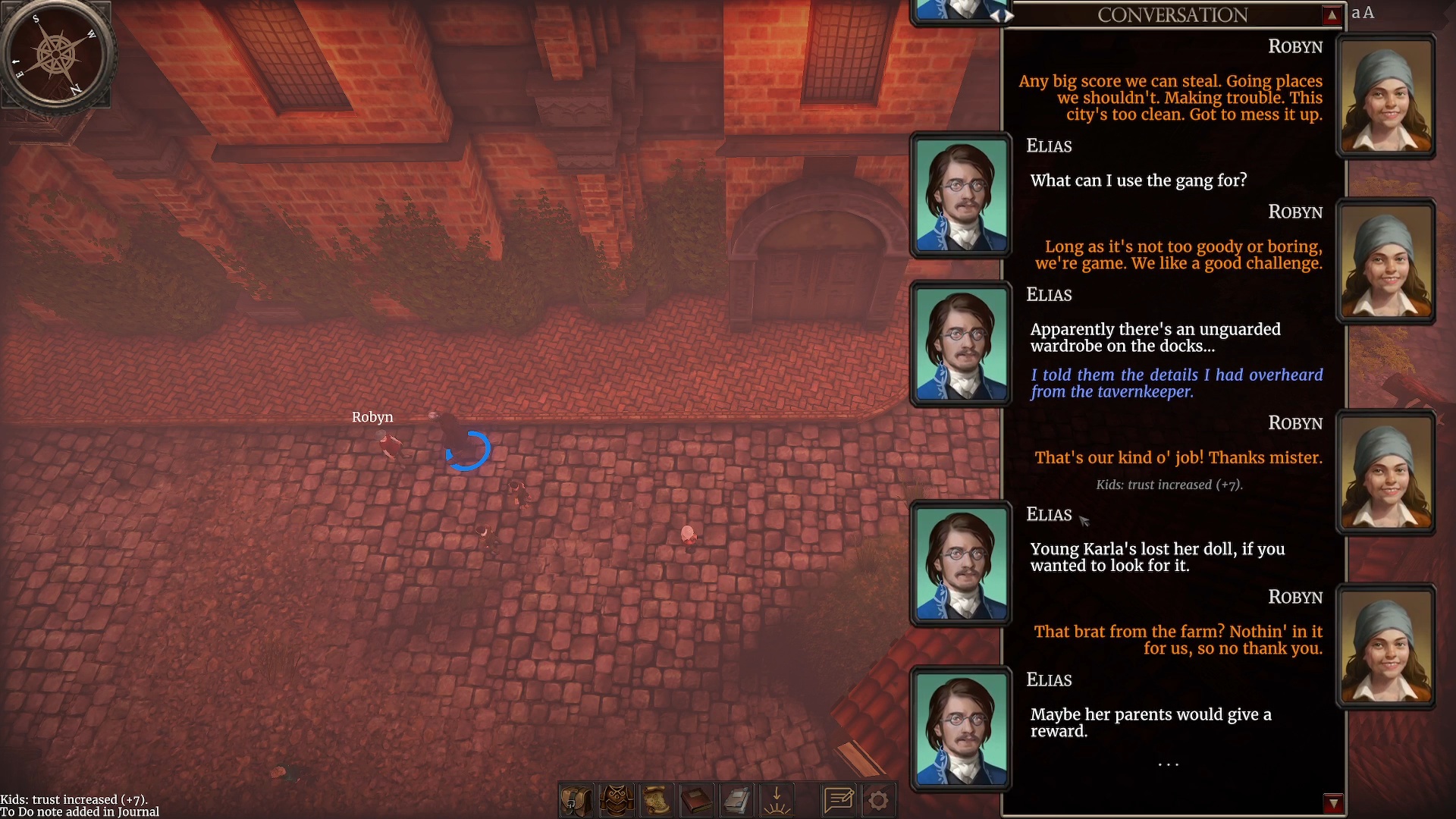
Social groups and individuals all have a level of trust, and it's essential to keep it as high as possible. A low trust level will lock you out of important information and easier routes through the game. It can also get you in trouble with the law and sent to the gallows. Trust is primarily gained from conversations, and picking the right and wrong choices will make small adjustments to the score. After awhile I started saving before each conversation because I was sick of bungling into trust loss and ticking people off to the point they wouldn’t speak to me.
Oftentimes, there are one or two optimal methods for achieving a plot goal that depends on your skills and trust, and then a brute-force method with consequences.
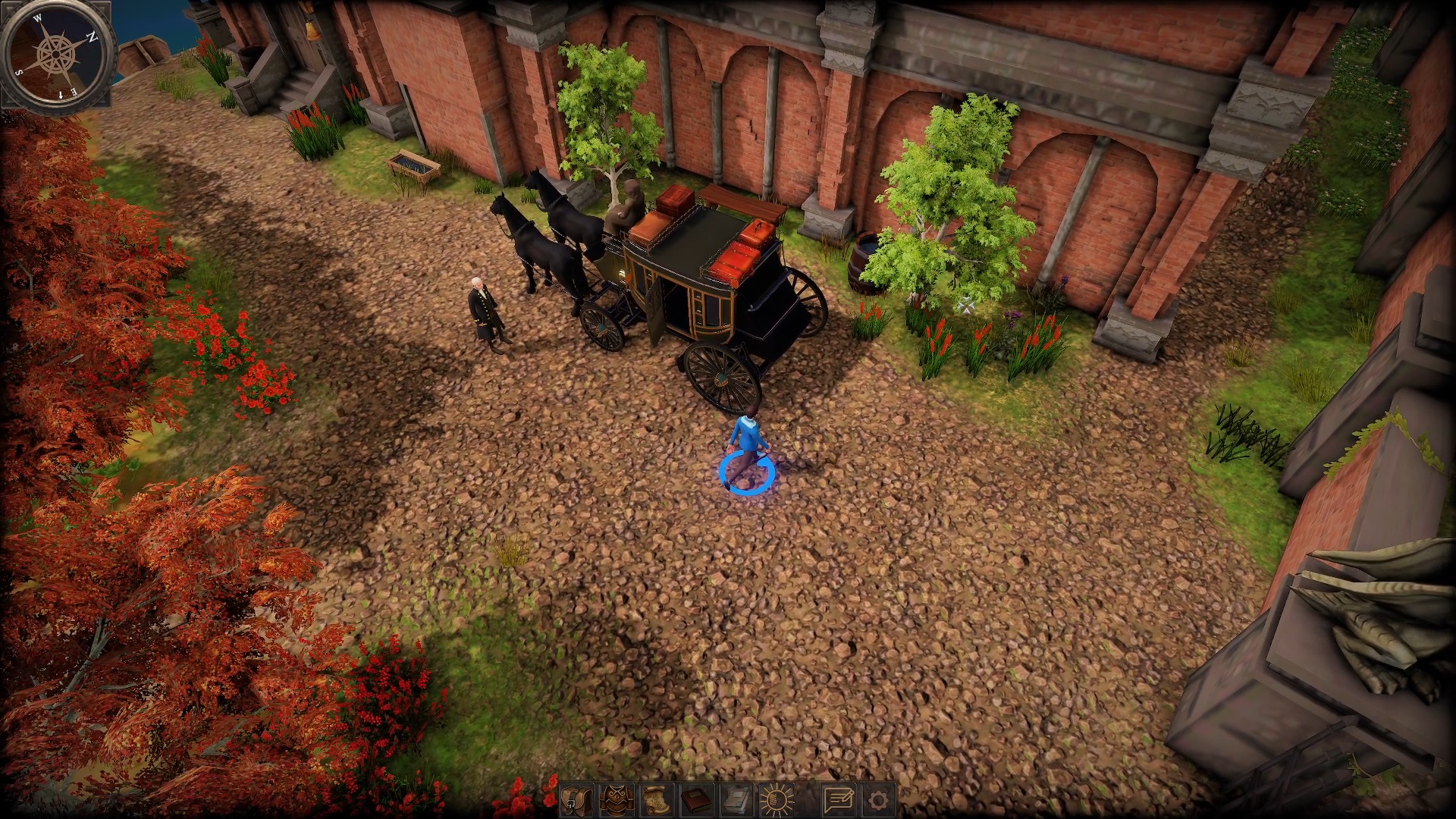
The majority of TNT is spent looking for clues on who murdered your father and learning more about the dark arts. Since the whole thing takes place in and around the city of Marns, that means a lot of backtracking. You go to work every day, talk to people for information, and run around filling in all the gaps for each chapter. Even with fast travel inside the city, there’s a ton of walking, and you can’t speed up the movement process outside of combat. I began to curse rather loudly when I realized that something I missed or someone I needed to talk to was, once again, outside of town.
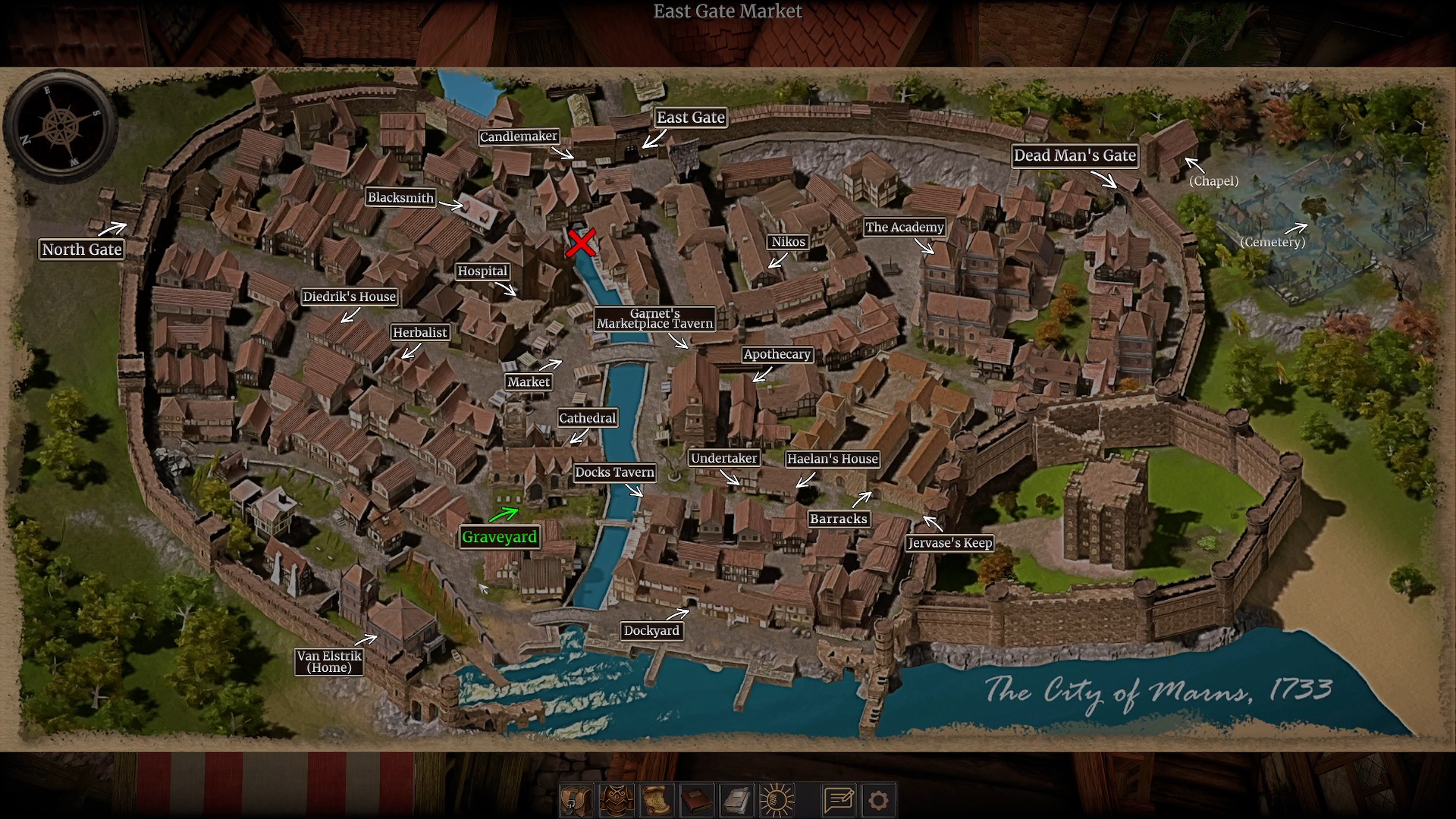
This problem becomes even worse when time comes into play. A lot of events in the game require you to be somewhere at the right time. It’s impossible to miss important events, but the game is touchy about where and when you can move the clock. The game gets a little more generous with where you can wait as the game progresses. However, only one gate out of Marns is active at night, so if you need to be on the other side of the landscape to talk to someone, it means even more walking and the occasional fight.
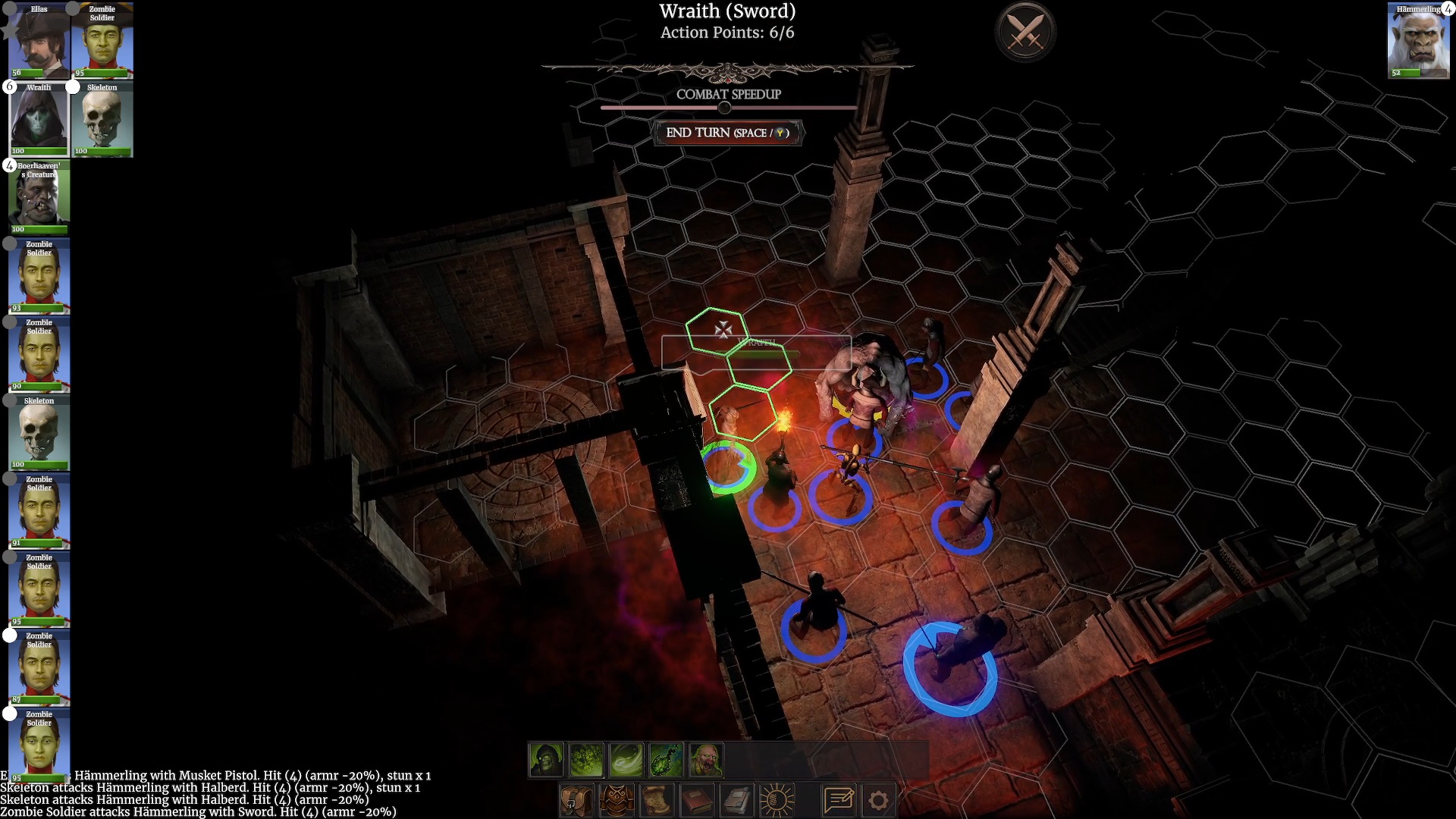
Combat is turn-based on a hex grid. Most encounters are clearly marked out before you walk into them, but there are a few potential ambushes. Agility determines combat order and how many action points you have to spend. Health is automatically restored at the end of battle so there’s no resting downtime. I noticed that most enemies tend to hit very hard, and it doesn’t take much to die; all the more incentive to summon a gang of deaders to take the beating instead. Undead minions can be armed and armored, but there isn’t much armor to go around, and it never seemed to make much difference in how fast they got wiped out. The only things that matter are giving them weapons and keeping them between you and the bad guys.
You start off with two spells: one of them commands your undead, and the other gives you more magic points. Magic costs health, action points, and magic points, so if you aren’t careful, you can cast yourself into a one-hit kill. The farther away the spell is from your current position, the more likely it will fail.
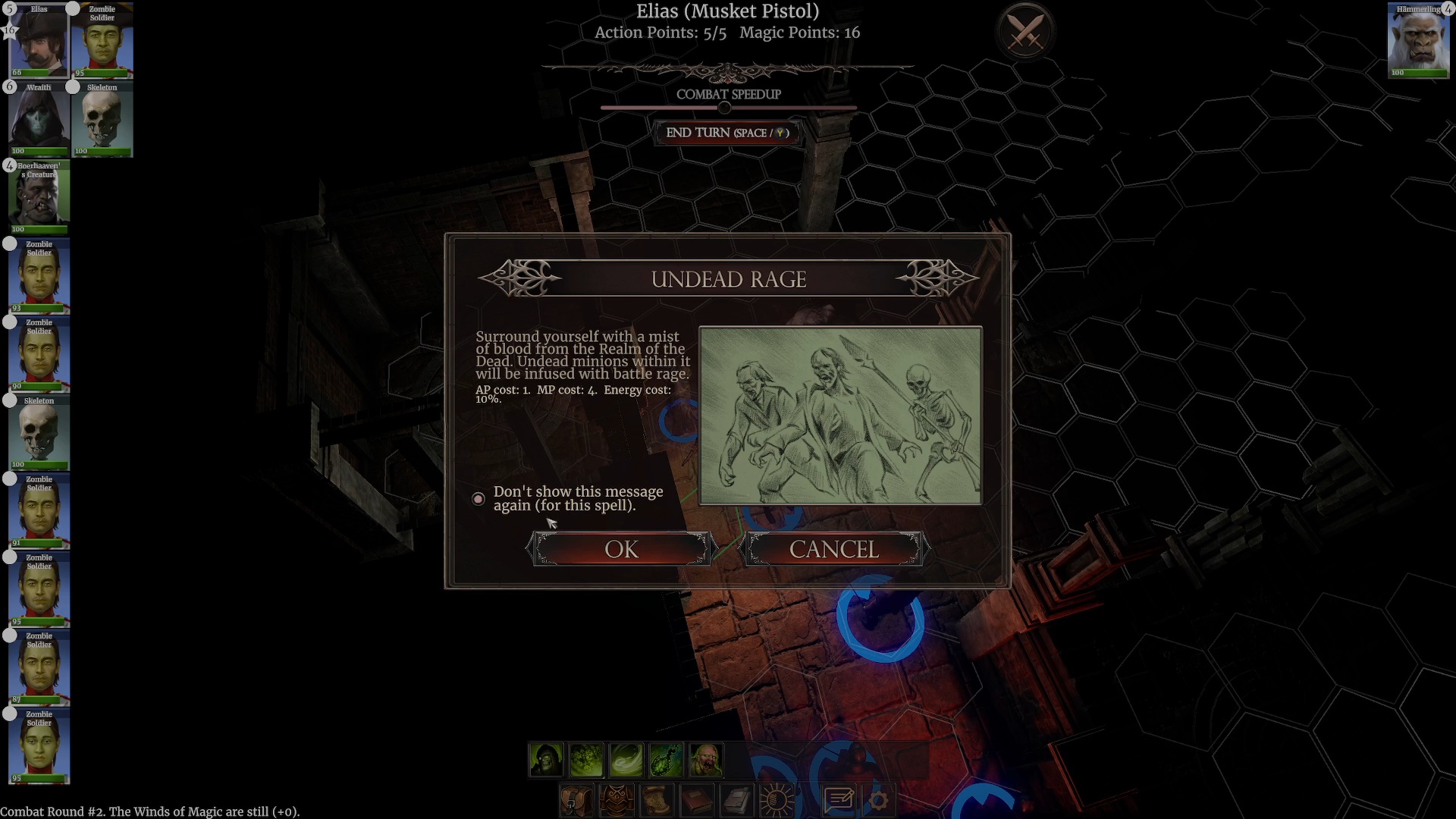
This distance-based casting is another tedious trouble with TNT. Every undead requires the command spell to make them do anything. This isn’t much of a problem near the beginning when there are only a few lackeys to boss around, but towards the end I needed a small army to handle dangerous monsters and opposing small armies. It’s possible to speed up combat animations, but there’s no way to speed up having to move every single minion, hope the command spell doesn’t fizzle, and then walk them across the field to hit someone. It becomes pure agony, and there’s no reward for fighting except looting the loose change and weapons off of bodies and the bodies themselves. When a minion goes down for the count, it can be reanimated, so long as you’re willing and able to drag it back to a ritual site.
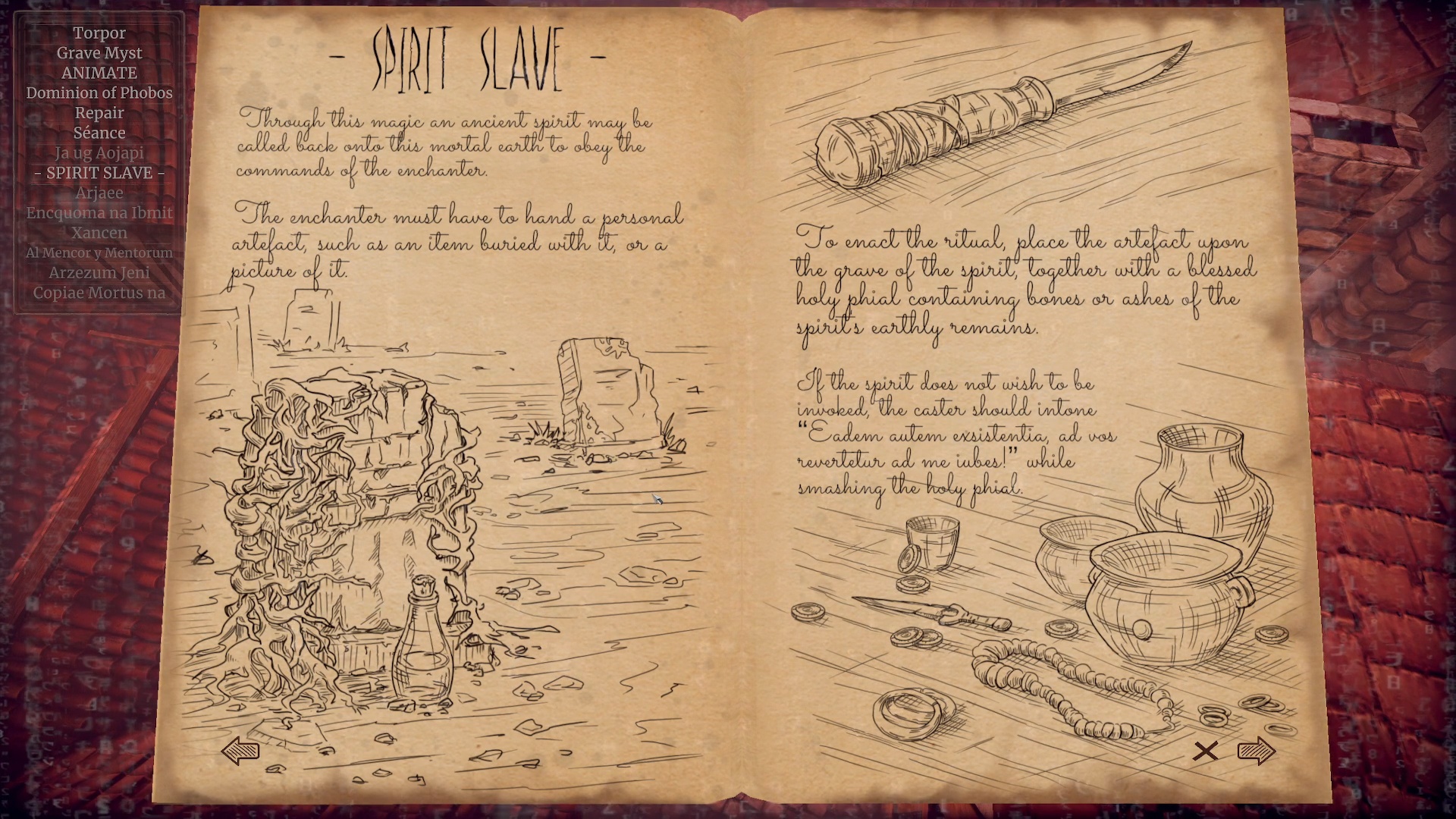
One of the first events in the game is discovering the same book of spells that let Rulsthen win the war. The heart of TNT’s story is the slow descent into madness for the want of doing something good. It begins with learning a recipe for a sleep potion, but as more troubles show up, it becomes necessary to uncover more of the spells in the book to deal with them. In fact, that’s the basic gameplay loop of TNT; some new problem arises that only a necromantic Deus Ex Machina can solve, so you give up a little more of yourself until merely being close to the local church makes you queasy.
For a game about necromancy, TNT didn’t let me animate my first skeleton until about a quarter into the game, and I didn’t get to keep it due to plot. Animating skeletons is yet another chore. Doing questionable acts like digging up graves or moving corpses will rouse the suspicion of the local townsfolk and requires the use of a spell to keep nosy villagers away. Setting up this spell takes a bit of time and animations and then it’s on to the digging.
Thanks to the Lich War, most graves are empty, since the church burned them to prevent the dead from getting back up. I had to dig up about half of the cemetery to find one, and the fun doesn’t end there. Despite being devoid of flesh and sinew, skeletons are apparently quite heavy because I moved at a crippled snail’s pace once I got one. Best of all, skeletons have something in their contract about not being animated in any old place. No, in order to make them bones walk around, you need a special ritual area to do the deed. There's a fine line between wanting the player to earn their skeleton raising merit badge, and wasting the player's time.
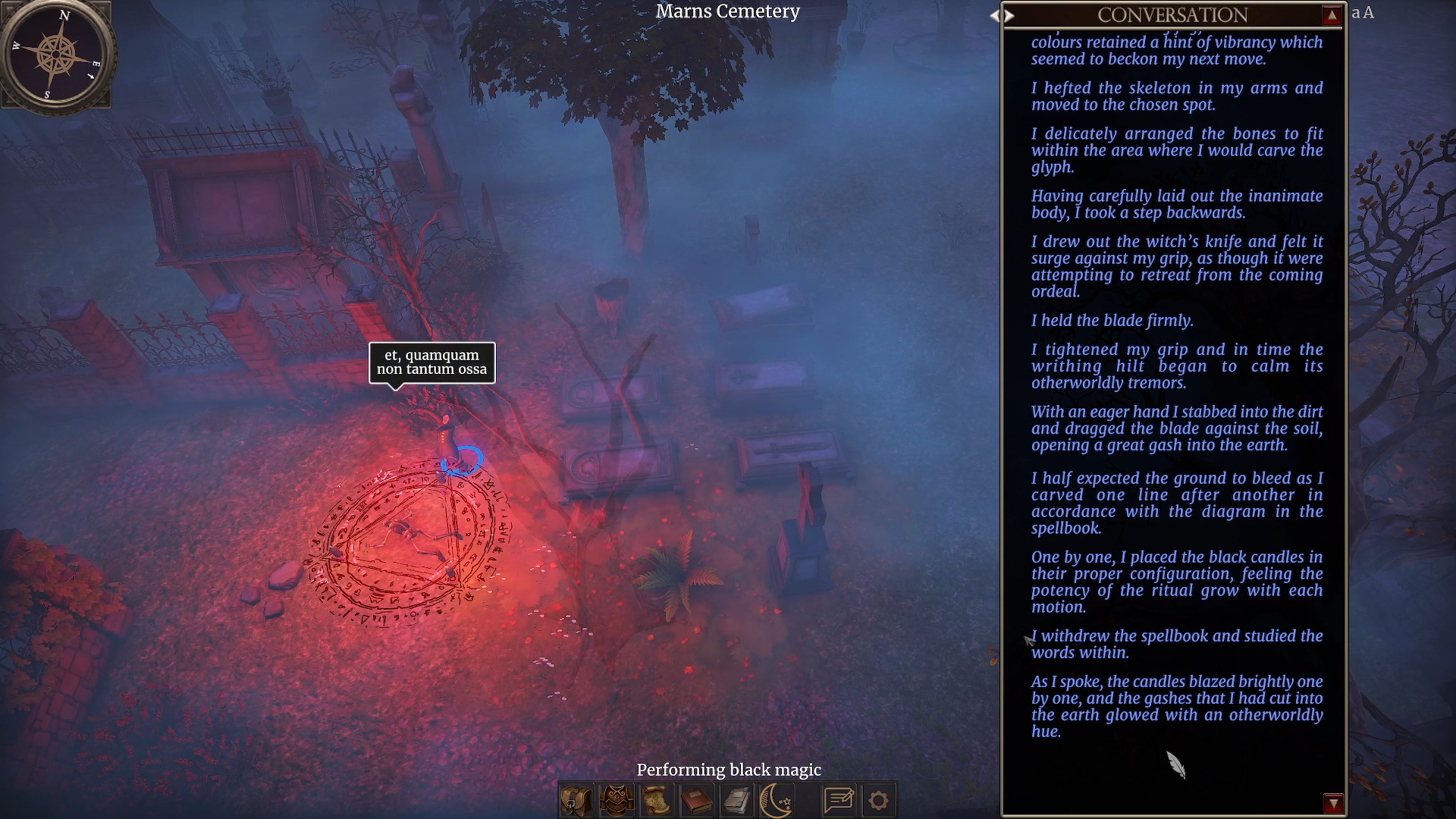
Some of the animations for doing all of this are sped up a bit after the first time, but the entire act of safeguarding my evil deeds, marking out the ritual site, digging up the graves, and lugging the body over to do the ritual is still a major task. I was so grateful when I finally learned how to animate zombies, which apparently don’t care where they’re animated and can be raised right on the spot. Also, to the best of my knowledge, there are no limits on how many undead you can raise and have following you about. When you don't want them following you, the best place to leave them is in the crypt, since nobody goes there out of fear—of the undead.
There are some pretty good tracks in here, particularly the combat themes and the witch's piece, but I need to make special mention of the music because the town theme started to annoy me. As I moved through the story, the theme for the city became the same but slightly spooky. The subtle change is nice at first, but it becomes tiresome towards the end because it plays for the majority of the game and could have done with a few more variations as the chapters moved along.
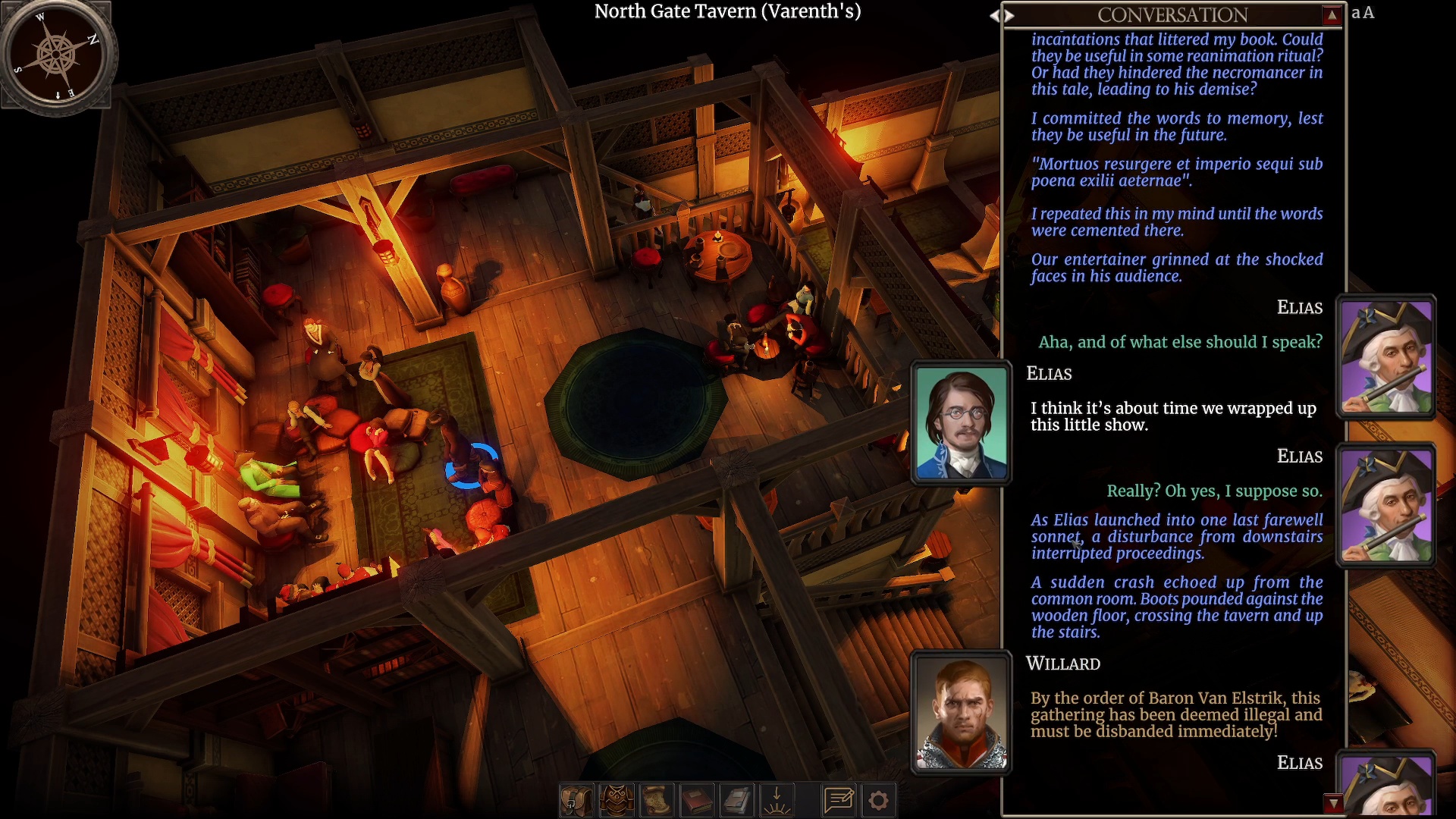
It’s fun becoming a necromancer and losing my marbles when the game isn't wasting my time with backtracking. I enjoyed learning more black magic while keeping up a façade. The subtle changes in flavor text were well done and it became a challenge to ensure I did the “right” thing to allay suspicions among the unsuspecting, foolish townspeople during my rise to power. There are a number of places where you can make the moral choice or one that helps you out; sometimes this can end up getting people close to you killed, but they’re just pawns, right?
One of the biggest highlights is attending the ball. Without revealing too much, it can be a real challenge to avoid saying the wrong thing to the wrong person if you aren’t paying careful attention to your dialog choices.
Exploration is a fun aspect of the game even though there aren’t too many places to uncover. There’s one or two optional locations in the game that are pure dungeon crawls with appropriate rewards for those who survive, but being a necromancer means having an army of cold bodies to do the dirty work for you.
Aside from the aforementioned tedium, player agency goes back and forth between being locked into what the developer wants and what you want. At one point early on in the game, I learned a spell that would spring a trap on trespassers. I needed to collect personal items from people I didn’t want getting caught in the spell. My first thought was, “Gee, I sure hope none of my closest friends walk into this thing and fill me with a terrible sense of hubris!” Needless to say, when I went to talk to said friends, there was no option to collect personal things from them. You can probably guess what happened later.
There are a couple of spells you learn that are “one and done” coupons for the story. You need to learn how to conduct a séance to talk to your dead father and then it never gets used again. Another spell lets you spread disease, but this is really just a moral choice in disguise.
There are also those that I would have liked to have punished out of my own principles but ultimately get away clean despite my supposed descent into darkness. There were also some I would have liked to have spared, but they ended up deceased in the name of the story because that’s what the developer had cooked up.
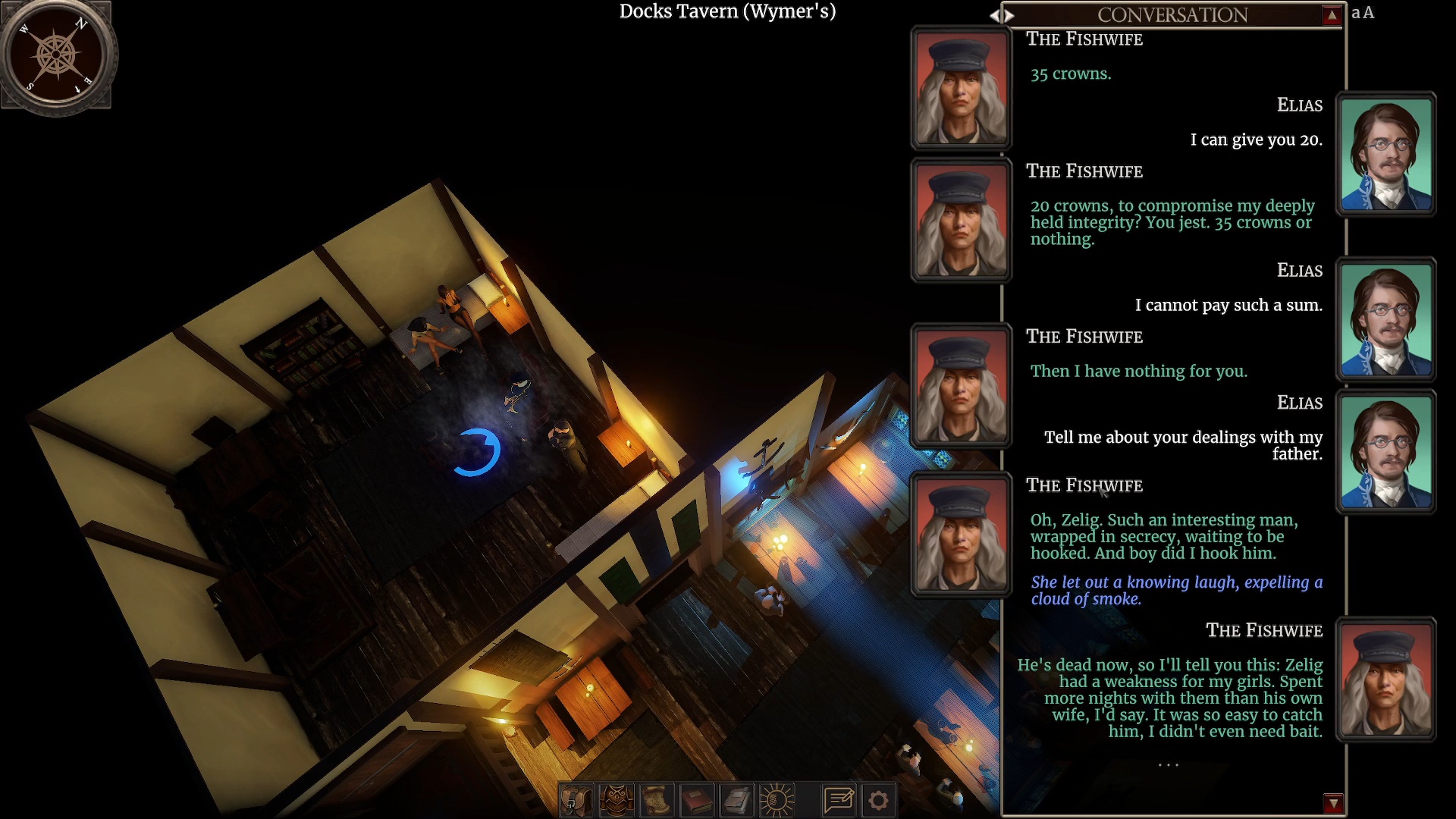
Player agency notwithstanding, there were major breaks from what was supposed to be 18th-century Europe. As a schoolteacher, when given the chance to physically discipline the orphans, it ends up being the bad choice despite being the norm of the day. Several characters are homosexual, and there’s an opportunity to pursue a same-sex romance. Homosexuality was still punishable by death around the time the game takes place. Furthermore, even if I wanted to play the role of the perverse, decadent noble, there’s no way some commoner is going to find it acceptable that I want to get into his pants.
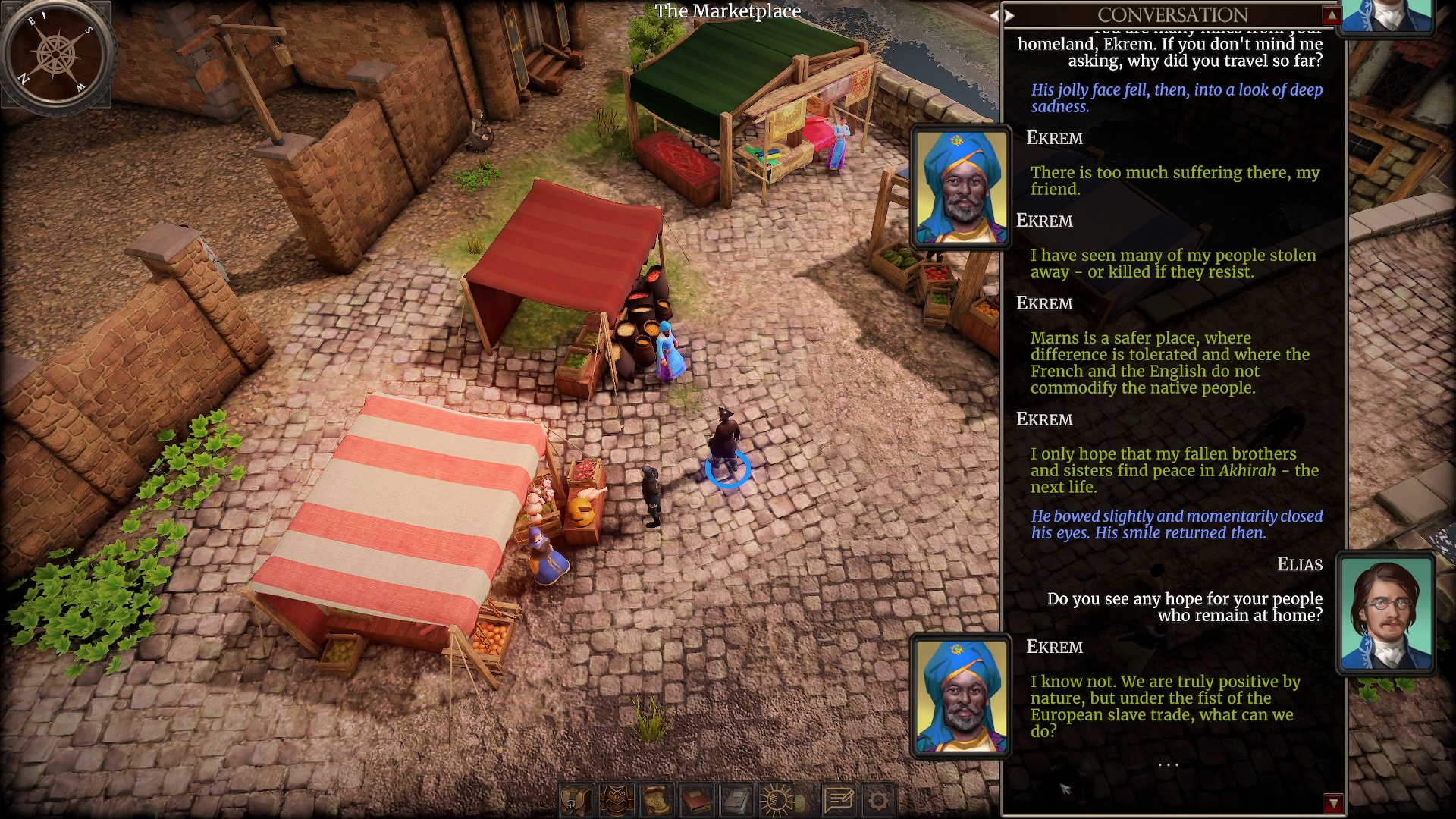
More of the usual modern fantasy tropes ooze into TNT as well. Female military officers, dock workers, and a girlboss crime lord are some of the empowered women I encountered. The player’s half-brother is black for some strange reason, and there are a number of out-of-place merchants, one of whom bemoans the terrible plight of Senegal. It’s funny how you can be hanged for moving corpses or doing black magic in front of people, but nobody seems to bat an eye at homosexuality.
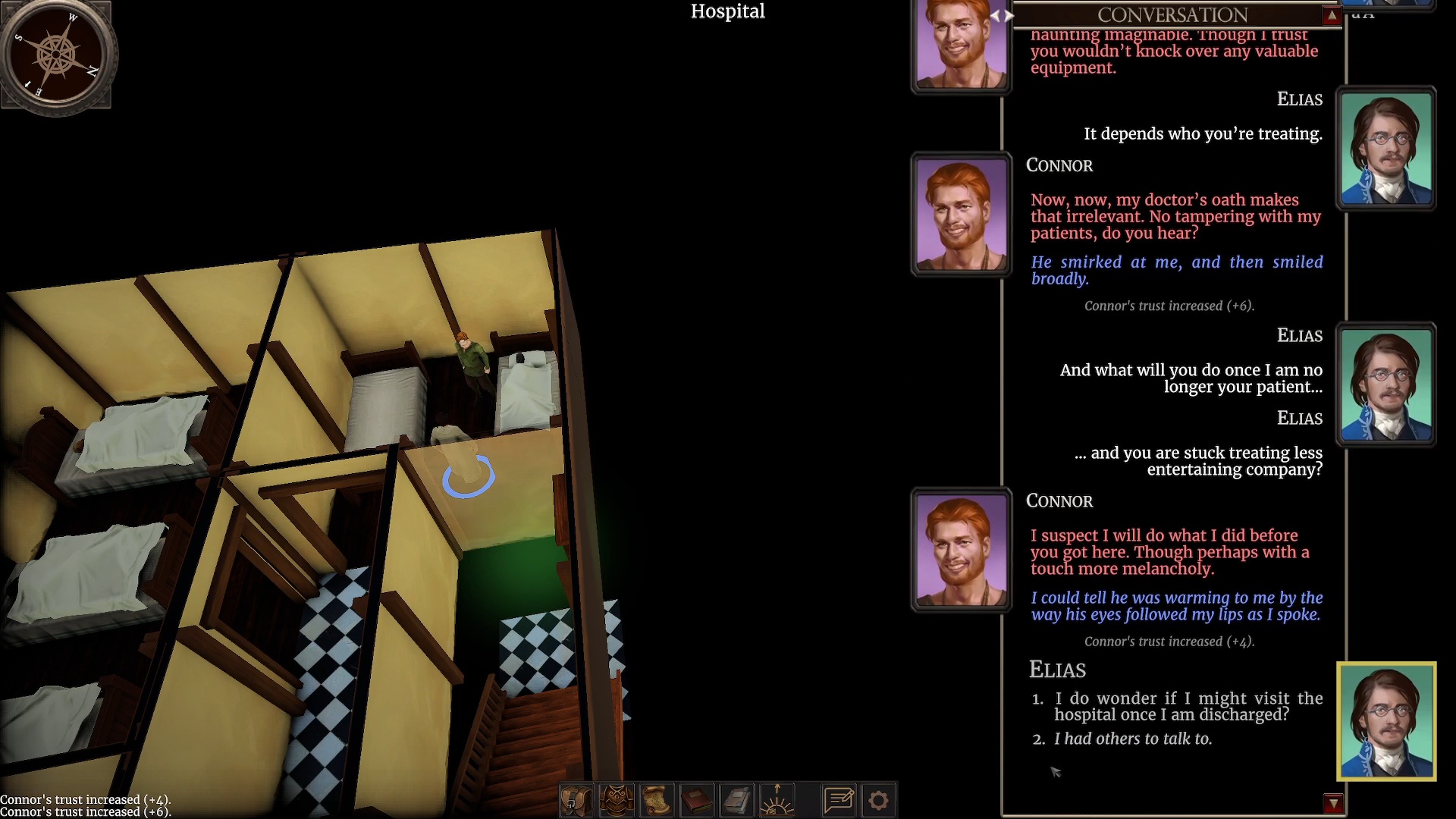
The entire point of placing a game into a historical setting, even one in altered history, is to create a scenario of how things might have gone differently with whatever magical boojums you’re using in your story, but when you violate the clear norms of society at the time, then you might as well put the game in a generic universe.
The game is not overwhelmingly woke, but there are enough elements that it’ll turn your stomach if you’ve lost all tolerance for it.
I still would have loved to have more agency over my actions, but there’s only so much you can do. As of the time of this review, there have been some quality-of-life updates, including making your minions lug the dead bodies around for you.
Overall, I enjoyed the game, but it would probably be a while before I tried out the changes. Sadly, I can’t try them because my key got revoked for some odd reason. Despite some wokeness and the fact that many spots in the game don’t respect the player’s time, it's quite a bit of fun. There’s some genuinely good writing in here, and games that explore the morality of evil deeds are few and far between. TNT is one of the very few games to explore necromancy and the consequences in-depth.
If you have a tolerance for woke tropes, weak combat, and playing games for the story, The Necromancer’s Tale will be an excellent game. Otherwise, you'll want to leave it buried.